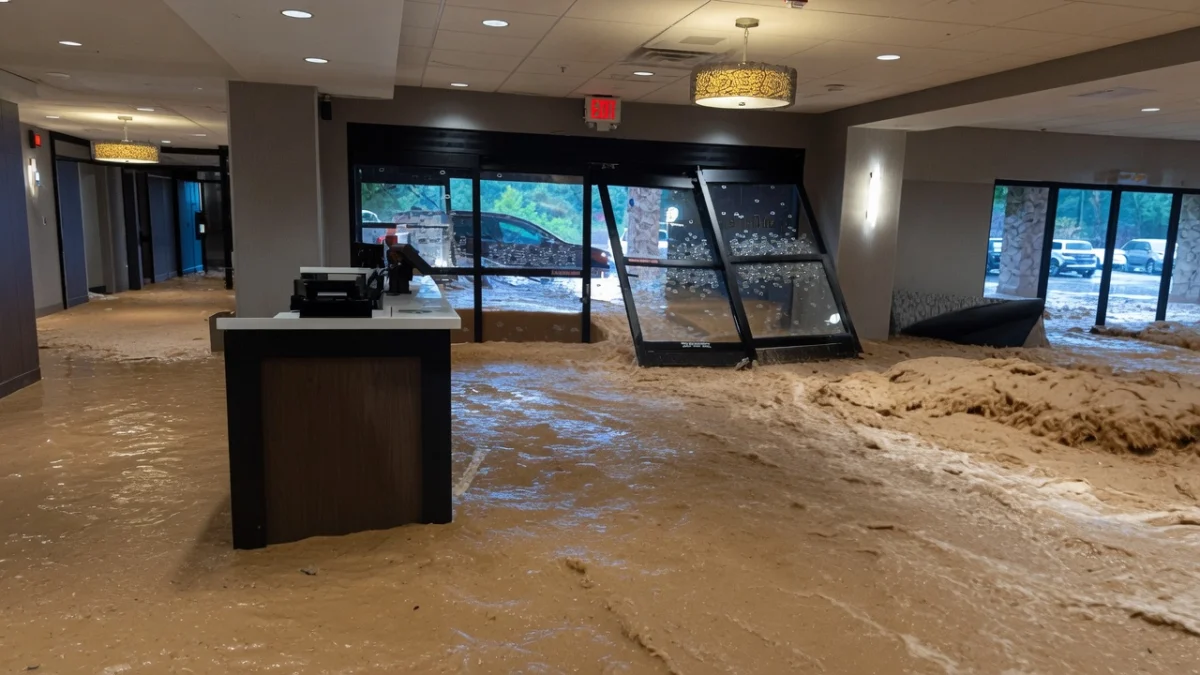
The quiet evening of a typical Tuesday in Weston, West Virginia, was abruptly transformed into a scene of chaotic survival when an unprecedented deluge triggered catastrophic flash flooding, centering its impact on the Hampton Inn by Hilton. For guests staying at the property, located conveniently off Interstate 79, the transition from a routine stay to an emergency situation occurred in a matter of minutes. Jeremy Thacker, a guest at the hotel, had intended to spend his evening at the indoor pool facility. However, upon descending to the first floor, he discovered that the environment had been violently altered. Instead of the controlled waters of the hotel amenity, he was met by a surging torrent of coffee-brown, muddy water that had breached the building’s perimeter, reaching thigh-high levels within the lobby.
The scene described by Thacker and other witnesses painted a picture of structural failure under the weight of natural forces. The hotel’s heavy front doors, designed to withstand standard Appalachian weather, were completely dislodged from their frames by the hydraulic pressure of the rising floodwaters. As alarms echoed through the hallways, guests watched as the lobby and breakfast areas—spaces typically reserved for hospitality and rest—were reclaimed by the surge. The exterior of the property offered no reprieve; Thacker recounted the shock of looking through the decimated entrance only to see his vehicle being swept across the parking lot, buoyant in the rising tide. This localized disaster was merely one flashpoint in a larger meteorological event that paralyzed Lewis County and left the city of Weston grappling with an infrastructure crisis.
The Chronology of an Extreme Weather Event
The flooding in Weston was not the result of a prolonged seasonal rise in river levels, but rather a "training" effect of thunderstorms that stalled over the region. The timeline of the event illustrates the terrifying speed of flash floods in the mountainous terrain of West Virginia. On Tuesday evening, the National Weather Service (NWS) issued urgent bulletins, upgrading initial flood watches to flash flood warnings as radar indicated rainfall rates that exceeded the soil’s capacity for absorption.
In a span of less than three hours, Lewis County recorded approximately six inches of rainfall. To put this in perspective, the intensity of the downpour was most acute during a 37-minute window where 4.5 inches of rain fell in a single location. This volume of water, funneling through the narrow valleys and steep hillsides characteristic of the Weston area, created a "wall of water" effect. By the time the NWS issued its highest-tier warnings, advising residents and travelers to seek higher ground immediately and avoid all non-essential travel, the Hampton Inn was already inundated.
Throughout the night, the hotel became a makeshift sanctuary. Despite the first floor being submerged, the building remarkably maintained electrical power for a significant duration. This provided a surreal contrast for guests who remained on the upper floors: they were surrounded by the comforts of a modern hotel while the ground floor beneath them functioned as a river channel. One guest noted that the upper floors of the Hampton Inn felt safer than a public shelter or a lifeboat, though they acknowledged that the stability of the situation was entirely dependent on the continued functioning of the power grid and the structural integrity of the building.
Meteorological Data and Historical Context
The rainfall totals recorded in Weston during this event represent a statistical anomaly, often categorized by meteorologists as a 1,000-year rain event. According to data from the National Oceanic and Atmospheric Administration (NOAA), the probability of receiving six inches of rain in such a short window in this specific geographic corridor is less than 0.1% in any given year.
West Virginia’s topography plays a critical role in the severity of these events. The state’s "hollows" and river valleys act as natural funnels. When extreme precipitation occurs, the runoff is directed into narrow channels with immense velocity. In Weston, which sits at the confluence of the West Fork River and Stonecoal Creek, the geography created a perfect storm for urban flooding. The speed at which the water rose—knocking out commercial-grade doors at the Hampton Inn—indicates that the drainage systems were overwhelmed almost instantly, turning streets and parking lots into high-velocity waterways.
Impact on Local Infrastructure and Economy
The devastation extended far beyond the walls of the Hampton Inn. Weston’s Mayor expressed grave concern over the city’s immediate future, noting that the flood had effectively crippled the local supply chain. In the immediate aftermath, the city was left without a single functioning grocery store. Major retailers, which serve as the primary source of food and supplies for the surrounding rural population, were forced to close due to water damage and power outages.
The loss of a grocery store in a community like Weston is more than a convenience issue; it is a food security crisis. For residents who may not have the means to travel to neighboring counties, the closure of local markets necessitates emergency food distribution by state agencies and non-profit organizations. Furthermore, the closure of the Hampton Inn—now listed as "temporarily closed" on Hilton’s official website—removes a significant portion of the area’s lodging capacity, impacting tourism and the revenue generated from travelers on the I-79 corridor.
Cleanup and restoration teams arrived at the Hampton Inn early Wednesday morning as the waters began to recede, leaving behind layers of silt and debris. The mandatory evacuation of the property was ordered to allow for a full structural assessment and to mitigate the risks of mold and electrical hazards. The recovery process for a commercial property of this size, particularly one that has suffered a breach of its primary entrance and extensive first-floor flooding, is expected to take months.
Social Media Misinformation and the Digital Narrative
As is common with dramatic weather events in the digital age, footage of the Hampton Inn flood quickly went viral. However, the speed of social media often outpaces the accuracy of reporting. Dramatic video of the water surging through the hotel lobby was repurposed by various accounts and falsely attributed to other locations.
One notable instance involved a post on the platform X (formerly Twitter) which claimed the footage was from a flooded hospital. This prompted a "Community Note"—a crowdsourced fact-checking feature—to clarify that the video actually depicted the Hampton Inn in Weston, West Virginia. This incident highlights the challenges facing emergency management and news organizations during a crisis: the need to combat misinformation that can lead to public panic or the misallocation of resources. The Hampton Inn footage was particularly susceptible to this because the modern, sterile interior of the lobby could easily be mistaken for a medical facility by those unfamiliar with the property.
Analysis of Implications for the Hospitality Industry
The incident at the Hampton Inn serves as a case study for the hospitality industry’s need for robust disaster preparedness. While the hotel’s upper floors provided a safe haven, the vulnerability of the ground-floor infrastructure raises questions about architectural resilience in flood-prone regions.
Comparisons have been drawn to a recent event at the J.W. Marriott Masai Mara, where guests were nearly swept away after a river burst its banks, overwhelming the resort. While the Masai Mara incident involved a more remote, wilderness setting, the common thread is the increasing frequency of "flash" events that provide little to no lead time for evacuation. For the Hampton Inn in Weston, the fact that power remained on was a fortunate anomaly that likely prevented a more chaotic evacuation in total darkness. Moving forward, hotel chains may need to invest in reinforced entryways and elevated critical systems (such as electrical transformers and server rooms) to ensure that properties can withstand the initial impact of such surges.
Official Responses and Path to Recovery
State and local officials have shifted their focus from rescue to recovery. West Virginia Governor Jim Justice and representatives from the Federal Emergency Management Agency (FEMA) are expected to conduct assessments to determine if the damage meets the threshold for a federal disaster declaration. Such a declaration would unlock funding for infrastructure repair and provide low-interest loans to businesses like the Hampton Inn to expedite their reopening.
The Mayor of Weston has emphasized that the priority remains restoring essential services to the residents. "By the grace of God, there was no loss of life in hard-hit Weston," officials noted, echoing the sentiment that while the economic and structural damage is severe, the human cost could have been far higher given the speed of the water’s rise.
As of the latest updates, the Hampton Inn remains closed to the public. Restoration specialists are working to dry out the structure and salvage what remains of the first-floor interior. For the town of Weston, the road to recovery will be long, marked by the need to rebuild not just a hotel, but the very infrastructure that sustains the community’s daily life. The event stands as a stark reminder of the power of nature and the fragility of the built environment in the face of a changing climate.