
The digital landscape has undergone a seismic shift, with the Cloud Security Alliance (CSA) reporting that identity and access management has officially supplanted misconfiguration as the foremost security concern for organizations globally. This pivot, detailed in the organization’s highly anticipated Top Threats to Cloud Computing Survey Report 2026, signals a maturation in how cyber adversaries approach cloud environments. While previous years focused heavily on the technical errors of infrastructure deployment, the current threat environment is increasingly defined by the exploitation of legitimate access and the nascent dangers posed by the integration of artificial intelligence.
The CSA’s Top Threats Working Group, which compiled the data by surveying 507 security professionals, has identified a list of 11 critical risks. Beyond identity, the report highlights that the proliferation of AI, third-party software supply chains, and interconnected cloud ecosystems now represent the primary vectors for modern cyberattacks. This transition marks a departure from the traditional emphasis on cloud service provider (CSP) infrastructure vulnerabilities, suggesting that the "perimeter" of cloud security has moved firmly into the realm of user behavior, API interactions, and machine-learning dependencies.
The Evolution of the Threat Landscape
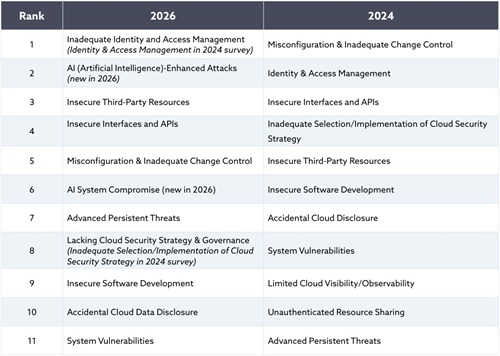
To understand the gravity of these findings, it is essential to look at the progression of cloud security over the past several years. In the 2024 report, the industry was primarily grappling with the "low-hanging fruit" of cloud security: misconfigurations, inadequate change control, and insecure interfaces. By 2026, these issues have not disappeared, but they have been deprioritized relative to more sophisticated, identity-centric attacks.
The migration of identity and access management (IAM) to the number one spot is a reflection of the "Zero Trust" era. As organizations decentralize their workforces and move applications to multi-cloud environments, the identity of the user—or the service principal—has become the primary key to the kingdom. If an attacker secures valid credentials, they can often bypass traditional network defenses entirely, moving laterally through cloud services with legitimate, albeit stolen, permissions.
The rise of insecure third-party resources, which climbed from the fifth position in 2024 to third in the 2026 rankings, further underscores the complexity of modern cloud architecture. Organizations are no longer building monolithic applications; they are orchestrating a complex web of SaaS integrations, API calls, and third-party plugins. Each of these external touchpoints represents a potential vulnerability that the primary organization does not directly control, creating a "supply chain" risk that is increasingly difficult to audit and secure.
The Emergence of Artificial Intelligence Risks
Perhaps the most significant addition to the 2026 rankings is the formal inclusion of two categories specifically related to artificial intelligence. While the CSA has not yet released the granular nomenclature for every entry in the top 11, the presence of AI-related threats confirms a long-held suspicion among industry analysts: that the adoption of Large Language Models (LLMs) and automated AI agents has outpaced the security controls designed to govern them.
The security implications of AI in the cloud are two-fold. First, there is the threat of "adversarial AI," where bad actors attempt to poison training data, perform prompt injection attacks, or extract proprietary information from model weights. Second, there is the "AI-enabled attack" vector, where attackers use generative AI to write polymorphic malware, craft highly convincing phishing campaigns at scale, or automate the discovery of vulnerabilities within a target’s cloud footprint.
The fact that these issues have landed directly in the top tier of the CSA’s rankings—despite being relatively new phenomena—indicates that security professionals are already seeing significant real-world exploitation. Organizations are currently racing to implement "Guardrails for AI," but the speed at which LLMs are being integrated into enterprise software has created a substantial window of exposure.
Comparative Analysis: 2024 vs. 2026
The CSA’s comparison of the 2024 and 2026 data provides a vital window into the changing priorities of Chief Information Security Officers (CISOs). In 2024, the top three concerns were (1) Misconfiguration and Inadequate Change Control, (2) Identity and Access Management, and (3) Insecure Interfaces and APIs.
By 2026, the shift is clear:
- Identity and Access Management: Moved from #2 to #1.
- Misconfiguration: Dropped to #5.
- Insecure Third-Party Resources: Rose to #3.
- Advanced Persistent Threats (APTs): Surged from #11 to #7.
The drop in the ranking of "Misconfiguration" should not be interpreted as a decrease in the number of misconfigurations occurring. Rather, it reflects a shift in focus. Security teams have invested heavily in Cloud Security Posture Management (CSPM) tools that automatically remediate many common misconfigurations. Consequently, while the risk remains, the perceived urgency is lower compared to the high-stakes, harder-to-detect risks associated with identity theft and AI manipulation.

Strategic Implications for Organizations
For executives and security practitioners, the 2026 report serves as a roadmap for budget allocation and governance. The data suggests that investment should move away from purely infrastructure-focused tools and toward identity-centric security, such as Privileged Access Management (PAM) and Identity Threat Detection and Response (ITDR).
Furthermore, the prominence of API security and third-party risk suggests that organizations must adopt a more rigorous "Vendor Risk Management" (VRM) program. Simply trusting a third-party service provider is no longer sufficient; companies must demand transparency regarding the security of the APIs they integrate and the AI models they employ.
The impact of these threats is not merely technical; it is operational and financial. A successful identity-based breach can lead to massive data exfiltration, regulatory fines under frameworks like GDPR or CCPA, and significant brand damage. By focusing on the CSA’s top-ranked concerns, organizations can align their security strategy with the most pressing dangers facing the cloud ecosystem today.

A New Era of Governance
The 2026 report is designed for a broad audience, ranging from technical engineers to C-suite executives. Each identified threat in the full report includes a breakdown of business impacts, real-world examples, and actionable security controls. This is critical because the threats identified—particularly identity and AI—cannot be solved by technology alone; they require a combination of policy, process, and technical enforcement.
For example, mitigating identity risks requires a robust "Least Privilege" policy, regular access reviews, and the implementation of phishing-resistant Multi-Factor Authentication (MFA). Addressing AI risks requires the creation of an AI-specific security framework that mandates data sanitization, output filtering, and strict model access controls.
Conclusion
The 2026 CSA Top Threats report is a stark reminder that the cloud is a dynamic, evolving ecosystem. As organizations continue to move their critical infrastructure to the cloud, the threat surface will continue to shift. The move toward identity as the "new perimeter" and the emergence of AI as a primary threat vector are not just trends—they are the new reality of the digital economy.
Organizations that ignore these findings do so at their own peril. As the survey results suggest, the gap between the top-ranked threat and the eleventh-ranked threat is narrow, implying that the entire list of 11 represents a cohesive set of risks that require a holistic, enterprise-wide security strategy. As we move further into 2026, the focus will undoubtedly shift toward how effectively organizations can integrate these findings into their ongoing risk management cycles to build more resilient, secure cloud environments.









Leave a Reply