
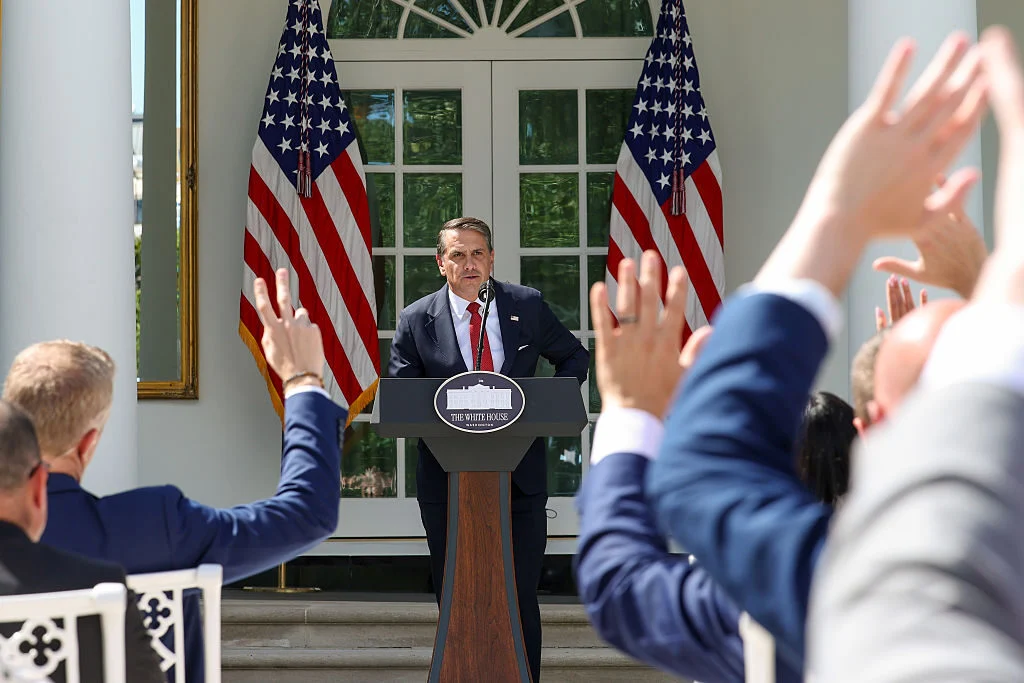
Attorney General Todd Blanche declared on Tuesday that the Trump administration remains steadfast in its commitment to monitoring the upcoming midterm elections, signaling that a recent Supreme Court ruling against the administration’s U.S. Postal Service (USPS) policy will not deter federal efforts to oversee the electoral process. Speaking during a press briefing held in the White House Rose Garden, the nation’s top law enforcement official defended the administration’s aggressive posture on voting integrity while dismissing concerns regarding federal overreach.
The briefing followed a high-stakes legal confrontation in which the Supreme Court effectively blocked an administration-backed directive that sought to grant the USPS broad authority to implement new, restrictive nationwide rules regarding the handling and processing of mail-in ballots. The ruling has sparked a fresh round of friction between the White House and the judiciary, particularly among justices previously appointed by President Trump.
Chronology of the Legal and Political Dispute
The tension surrounding the administration’s election oversight efforts has been building for several months. In early September, reports emerged indicating that various civil rights organizations and political opposition groups were mobilizing to counter potential changes to federal election procedures. These groups argued that the administration’s proposed rules, which focused on stricter verification for mail-in ballots, were designed to create hurdles for voters in key swing states.
On September 14, the Supreme Court issued an unsigned order that effectively halted the administration’s attempt to impose its USPS mail-in ballot standards. The court’s decision was characterized as a significant procedural victory for those advocating for expanded access to mail-in voting.
Following the ruling, the political atmosphere in Washington intensified. President Trump, expressing public frustration with the court’s decision, took to social media to criticize three conservative justices—Neil M. Gorsuch, Brett M. Kavanaugh, and Amy Coney Barrett—all of whom were his own judicial appointees. Trump characterized the decision as a "horrible, highly political" ruling, lamenting that the justices appeared to be "a shell of their original selves." Only Justices Samuel A. Alito Jr. and Clarence Thomas publicly dissented from the majority, drawing praise from the President for their alignment with his administration’s position.
The Administration’s Stance on Election Integrity
During Tuesday’s briefing, Attorney General Blanche sought to pivot the narrative away from the Supreme Court’s rebuke and toward the administration’s overarching goals. Blanche, who previously served as Trump’s personal attorney, emphasized that the Department of Justice’s primary objective remains the prevention of illegal voting and the verification of voter eligibility.
"The Supreme Court’s decision does not affect ongoing criminal investigations into illegal voting," Blanche stated. "There should be nothing surprising about what we’re trying to do when it comes to mail-in voting. We want to make sure that there is safe voting, that there is integrity, and that we are achieving free and fair elections where one eligible person casts one vote."
Blanche categorically rejected the notion that the current administration’s involvement in election oversight is unprecedented or uniquely partisan. He noted that the federal government has historically played a significant role in election administration and oversight under various statutes, including the Help America Vote Act (HAVA) and the National Voter Registration Act. "The federal government is always involved in elections. That’s not new to this administration, and it’s not new to the Biden administration. Our role is consistent with what federal governments have played under the law for decades," he added.
Artificial Intelligence and Political Strategy
Beyond the immediate conflict over mail-in ballots, Blanche addressed the escalating national discourse surrounding the role of artificial intelligence (AI) in the electoral process. As AI technology advances, concerns have mounted regarding its potential for generating deepfakes, automating misinformation, and influencing voter behavior.
Recently, executives from leading AI firms called upon Congress to establish legislative guardrails. Blanche, however, framed the sudden interest in AI regulation among Democratic lawmakers as a strategic maneuver intended to galvanize voters ahead of the midterms.
"Every Democrat senator suddenly races to a microphone to talk about AI after being eerily silent for months," Blanche remarked. "To talk about the timing of this as being anything other than an effort to influence the midterms is disingenuous. That is what it is, and that shouldn’t be what drives the policy decisions we are making."
Blanche clarified that the Department of Justice intends to maintain a narrow focus on criminal activity related to technology—such as fraud or interference—rather than pursuing broad regulatory authority over the AI industry. "We are prosecutors, not regulators," he stated, emphasizing that the department would avoid interfering with the technological development sector, which he noted remains highly beneficial to the national economy.
Broader Implications and Institutional Tensions
The public spat between President Trump and the Supreme Court underscores a growing institutional divide. While the executive branch is tasked with enforcing federal election laws, the judiciary serves as the ultimate arbiter of those laws’ constitutionality and procedural compliance. The administration’s continued insistence on moving forward with oversight initiatives despite judicial pushback suggests that the White House may explore alternative legal avenues or administrative workarounds to achieve its goals.
Political analysts suggest that the administration’s strategy is designed to keep the topic of "election integrity" at the forefront of the public debate, a move that resonates with the President’s base. However, the reliance on the Department of Justice to lead these efforts—rather than traditional state-level election officials—has drawn criticism from legal scholars who worry about the politicization of federal law enforcement.
The historical context of such disputes is significant. In previous election cycles, the Department of Justice has typically maintained a policy of avoiding actions that could be perceived as interfering with the democratic process, particularly within the 60-day window before an election. By remaining vocal and active in its oversight mission, the current administration is effectively challenging these long-standing norms.
Looking Ahead to the Midterms
As the midterms approach, the interaction between the White House, the Supreme Court, and the Department of Justice will likely remain a focal point of national media coverage. The administration has signaled that it will not retreat from its position, even as it faces legal and political opposition.
The briefing also marked a shift in the White House communication strategy. Following the departure of former press secretary Karoline Leavitt, the administration has utilized Cabinet members to front briefings. Attorney General Blanche’s appearance, characterized by his combative stance toward both the media and political opponents, signals a more aggressive communications strategy.
For voters, the implications of these developments are twofold. First, they highlight the intense, ongoing debate over how federal, state, and local entities balance security and access in electoral systems. Second, they demonstrate the volatility of the relationship between the executive and judicial branches, which may lead to further litigation in the weeks preceding the election.
Ultimately, the Attorney General’s comments confirm that the administration views the oversight of the electoral process as a core component of its executive duty. Whether this approach results in further legal challenges or succeeds in shaping the administrative landscape of the midterms remains to be seen, but it is clear that the Department of Justice intends to remain a primary player in the upcoming electoral cycle. As the legal battles continue to play out in lower courts, the nation will be watching closely to see how the federal government balances its prosecutorial role with the delicate task of protecting the integrity of the ballot box.







Leave a Reply