
The political landscape of 2026 was on full display this week in Dallas, as President Donald Trump navigated a complex itinerary that saw him oscillating between the high-octane rhetoric of a campaign trail veteran and the restrained dignity expected of the commander-in-chief. The week served as a definitive marker for the Republican midterm strategy, with the president acting as the central engine for a party seeking to solidify its legislative majorities. However, the juxtaposition of political warfare against the backdrop of historical remembrance and military honors created a surreal atmosphere that left political observers debating the future of American norms.
A Two-Day Spectacle in Dallas
The American Airlines Center in Dallas became the epicenter of the Republican midterm effort during a two-day convention designed to energize the party’s base ahead of the November elections. Trump, the headline speaker, utilized the platform to cast the midterm contests as an existential struggle. He painted the Democratic opposition in broad, combative strokes, labeling them as communists and radical leftists while throwing his full weight behind specific state-level and federal candidates.
The president’s rhetoric during these sessions was characterized by its intensity. He explicitly campaigned for Texas Attorney General Ken Paxton, urging the crowd to elevate the state official to the U.S. Senate. This endorsement was framed within a broader narrative of party loyalty. In a move that garnered both fervent support from attendees and sharp criticism from observers, Trump led his audience in a collective oath, demanding they pledge their commitment to voting in the November cycle.
Chronology of a High-Stakes Week
The week’s events followed a rigorous schedule that highlighted the friction between executive governance and campaign-style mobilization:
- Wednesday, September 9: President Trump delivered a nearly two-hour keynote address at the American Airlines Center, focusing on partisan grievances and the necessity of maintaining Republican control in Congress.
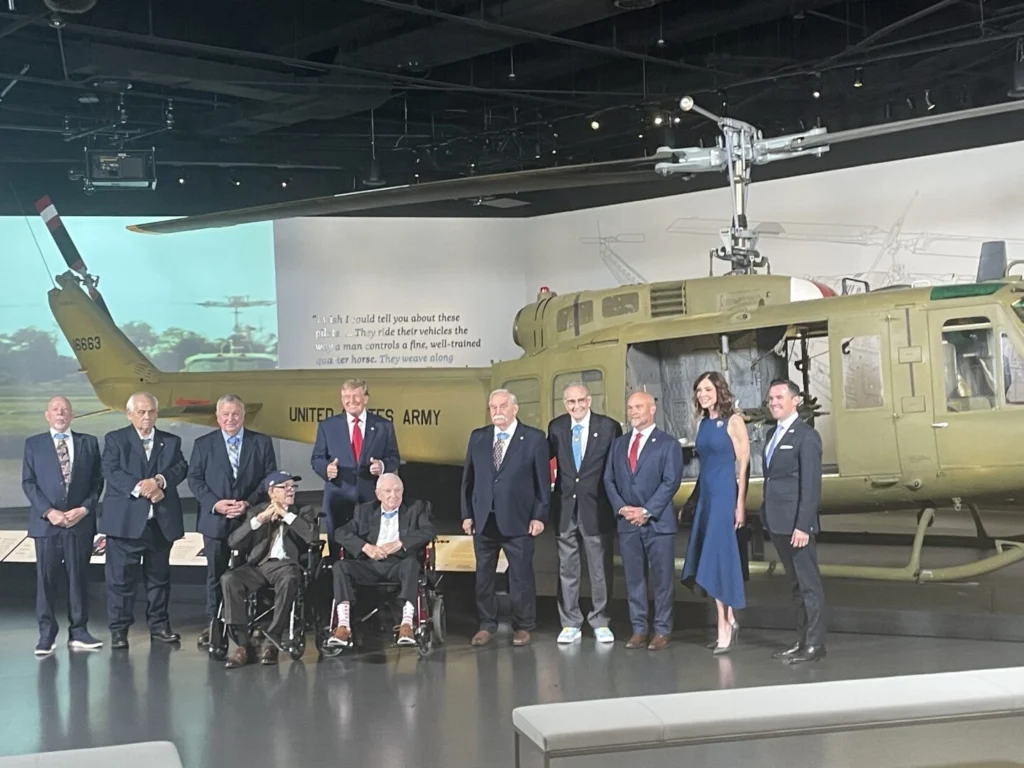
- Thursday, September 10: The president traveled to Arlington to visit the National Medal of Honor Museum. The morning began with a stark contrast in tone, featuring the somber imagery of military history. Following the museum tour, Trump returned to the convention stage in Dallas, where the evening concluded with operatic performances and a video presentation titled "God made Trump."
- Friday, September 11: The President attended a Pentagon ceremony marking the 25th anniversary of the 9/11 attacks, where he delivered formal, prepared remarks honoring the victims and the resilience of the nation.
The Medal of Honor Controversy
Perhaps the most scrutinized moment of the week occurred during Trump’s visit to the National Medal of Honor Museum in Arlington. Standing before a blue curtain adorned with a replica of the military’s highest decoration, the president engaged in a discourse that blurred the lines between humor and policy.

"I want for myself a Congressional Medal of Honor. And I’ve studied it. And I will give it to myself, I have no problem, but I’m not allowed to. Can you believe it?" Trump remarked to the gathered guests. While he initially framed the comment as a joke, he doubled down on the sentiment shortly after, stating, "Actually, I’m not kidding. I would like to have it."
The comment drew immediate attention given the president’s own military history. During the Vietnam War, Trump received four student deferments, followed by a medical exemption that prevented him from serving in the armed forces. Critics pointed to this history as the reason why the remark felt particularly jarring to veterans and military families, despite the president’s insistence that his intent was lighthearted.
Data and Political Context
The urgency displayed by the president in Dallas is underpinned by polling data and historical trends regarding midterm elections. Historically, the party of the incumbent president faces significant headwinds in the midterms, often losing seats in both the House and the Senate. With the 2026 election approaching, the Republican strategy has shifted toward identifying "ultraprogressive" candidates—such as Texas state Representative James Talarico—and framing them as incompatible with the traditional values of the American electorate.
Trump’s focus on Texas is strategic. As a state with significant electoral weight, a shift in the political composition of the Texas congressional delegation could determine the balance of power in Washington. By labeling his opponents with nicknames like "Talafreako" and criticizing their policy platforms, the president is attempting to localize the national narrative, turning the midterms into a referendum on individual candidates rather than party policy alone.
Reactions and Official Responses
The president’s "pledge" at the convention, in which he asked supporters to raise their hands and commit to voting—even suggesting that those who do not vote are destined for "hell"—drew a sharp divide in reaction. Supporters within the American Airlines Center responded with thunderous applause and screams of affirmation. Conversely, political analysts and opposition groups on social media characterized the scene as a "cult ritual," arguing that the rhetoric transcended traditional political mobilization and entered into the realm of personality-driven devotion.
The White House, while maintaining that the President’s appearances were in his capacity as the head of the party, emphasized his respect for the solemnity of the 9/11 anniversary. "The president recognizes the gravity of the September 11th commemoration," a spokesperson noted, highlighting his focus on personal stories and the national response to the tragedy during the Friday ceremony.

Implications for the GOP
The suggestion by House Speaker Mike Johnson that Trump might run for a seat in the House of Representatives after his presidency ends in 2029 added a layer of complexity to the convention’s closing hours. While the speaker acknowledged the possibility as a hypothetical, it highlighted the extent to which the party’s identity remains tethered to the former president.
If Trump were to pursue a House seat—a feat historically achieved only by John Quincy Adams—it would fundamentally alter the dynamics of the legislative branch. It would likely create a "thorn in the side" for existing GOP leadership, as Trump’s influence would move from the executive branch directly onto the floor of the House, potentially complicating the party’s legislative agenda and leadership structure.
Conclusion: The Future of the Party
The Dallas convention and the subsequent commemorative events underscore a pivotal moment for the Republican Party. The ability to pivot between the "campaigner-in-chief" persona and the somber, traditional executive role is a skill Trump has mastered, yet it remains a point of contention for his detractors.
As the calendar moves toward November 3, the strategy appears clear: the president intends to use every tool at his disposal, from rally-style theatrics to the moral weight of the presidency, to drive voter turnout. Whether this approach succeeds in retaining the House and Senate remains to be seen, but the events in Dallas confirm that the party is operating under a singular, forceful vision—one that is as unapologetic as it is controversial. The "tightrope" walk that Trump performed this week is not merely a reflection of his political style; it is the blueprint for a Republican Party that has fully embraced the influence of its most unconventional leader.







Leave a Reply