
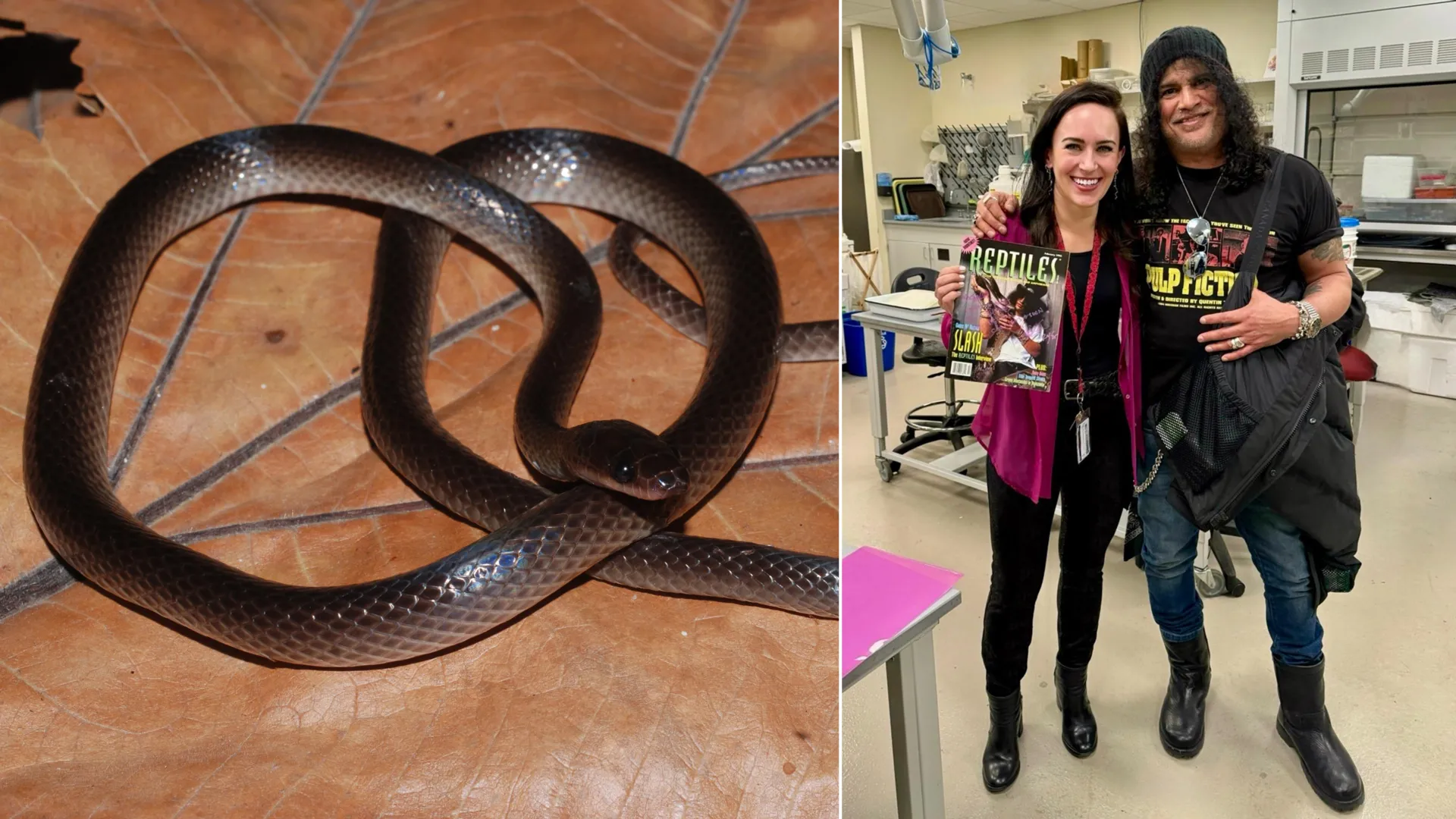
The legendary guitarist Saul Hudson, known to the world simply as Slash, has spent decades defining the sound of hard rock as the lead guitarist for Guns N’ Roses. However, beyond the pyrotechnics of sold-out stadium tours and iconic guitar solos, the musician has harbored a lifelong, private devotion to the world of herpetology. This intersection of rock stardom and scientific inquiry has now culminated in a unique taxonomic tribute: researchers have formally identified a new snake species from the dense forests of New Guinea and named it Lielaphis slashi, or Slash’s groundsnake.
The naming of the 28-inch-long, reddish-brown snake represents a rare instance where pop culture iconography and rigorous biological classification collide. The discovery, published in the journal Zootaxa, serves not only as a nod to the musician’s public persona but also as a testament to the ongoing, essential work of documenting the biodiversity of one of the planet’s least-explored tropical regions.
A Scientific Tribute Born from Childhood Fandom
The initiative to honor the guitarist originated with Dr. Sara Ruane, an Associate Curator of Herpetology at the Field Museum and the senior author of the study. For Dr. Ruane, the naming process was deeply personal, bridging her childhood influences with her professional trajectory.
"Guns N’ Roses has been one of my favorite bands since I was in first grade," Dr. Ruane explains. Her interest in herpetology was equally precocious; by the fifth grade, she had already declared her career ambition to her teachers. Her professional path was solidified when, as a twelve-year-old, she opened an issue of Reptiles Magazine to find a cover image of Slash holding his pet reticulated python. For a young scientist-in-training, the image of a rock star who was also an advocate for exotic, often misunderstood animals, was formative.
Years later, while reviewing historical interviews with the guitarist, Dr. Ruane noted his consistent support for museums, zoos, and the broader field of natural history. His childhood anecdotes—spending hours outdoors hunting for snakes—mirrored the experiences of many biologists. When the opportunity arose to formally name a new species discovered in New Guinea, Dr. Ruane determined that naming it after Slash would celebrate both his music and his long-standing commitment to herpetological awareness. Upon learning of the honor, Slash expressed both surprise and gratitude, noting that as a lifelong "herpephile," he never imagined his name would be etched into the annals of scientific nomenclature.
The Discovery: A Night in the New Guinea Rainforest
The specimen that would become Lielaphis slashi was first encountered during a 2006 field expedition led by Dr. Chris Austin, a professor and curator of herpetology at the Louisiana State University Museum of Natural Science. New Guinea, the second-largest island in the world, remains a frontier for biodiversity research. Divided between Indonesia and Papua New Guinea, its rugged, tropical terrain hosts an array of species that have evolved in relative isolation for millennia.
Dr. Austin’s discovery occurred under the cover of night, the peak activity period for many of the region’s groundsnakes. "These New Guinea groundsnakes are nocturnal, so the best way to find them is at night," Austin notes. "They are typically found just after sunset at the base of large trees where they are looking for something to eat." The fieldwork is inherently hazardous; researchers must exercise extreme caution, as many of the local species that occupy similar ecological niches are highly venomous, making the identification of non-venomous snakes a high-stakes endeavor during night surveys.
The Rigor of Modern Taxonomy
While the physical appearance of the specimen hinted at a potential new species, visual identification in the field is rarely sufficient for formal classification. The process of verifying Lielaphis slashi required a decade of collaborative research between the Field Museum and LSU.
The analytical team, led by post-doctoral researcher Tianqi Huang, utilized a multi-faceted approach to distinguish the new species from its closest relatives within the same genus. "Using multiple cutting-edge genetic analyses, we found that L. slashi is genetically distinct from other similar snakes in the same genus," Huang explains.
The researchers employed a combination of traditional and modern methodologies:
- Genetic Sequencing: Comparing DNA sequences to establish evolutionary divergence.
- Morphological Analysis: Assessing physical differences, specifically variations in scale counts and patterns, which serve as diagnostic markers in herpetology.
- Ecological Modeling: Determining the specific environmental variables and habitat preferences that separate L. slashi from its congeners.
This rigorous validation process is essential in an era where many species are lost to habitat destruction before they are ever documented by the scientific community.
Ecological Context and Behavioral Traits
While the classification of Lielaphis slashi is now official, the behavioral biology of the snake remains a subject of ongoing study. Because these snakes are elusive and typically flee when disturbed, direct observation in their natural environment is exceedingly rare.
Based on anatomical analysis, particularly the presence of large teeth in the rear of the mouth, scientists believe the snake occupies a specialized feeding niche. Unlike larger constrictors that rely on crushing, or vipers that utilize potent venom to subdue larger prey, L. slashi likely utilizes its teeth to secure slippery, small prey—such as skinks and other small lizards—as well as the eggs of other reptiles. Notably, despite the "dangerous" reputation of the band associated with its name, the snake itself is non-venomous and poses no threat to humans.
Conservation Implications in a Changing Landscape
The formal naming of Lielaphis slashi is more than a novelty; it is a critical step in the conservation of New Guinea’s biodiversity. The forests that house this species are under increasing pressure from anthropogenic activities, including large-scale coffee farming, logging, and mining operations.
"Every species should be recognized in order for us to better understand how ecosystems work, how everything fits into the environment," Dr. Ruane emphasizes. "We can’t conserve animals or other living things that we don’t know about."
By identifying and cataloging species like L. slashi, researchers provide local governments and international environmental organizations with the data necessary to argue for habitat protection. Biodiversity hotspots in New Guinea are currently among the most vulnerable areas on Earth, with undocumented species potentially facing extinction due to the rapid conversion of primary forests into agricultural land.
A Legacy of Scientific Collaboration
The study of Lielaphis slashi stands as a model for modern international cooperation in biology. The research team involved a diverse group of institutions, including the Field Museum, Rutgers University, Louisiana State University, Slippery Rock University, the American Museum of Natural History, the Papua New Guinea National Museum and Art Gallery, the Virginia Museum of Natural History, and the University of Kentucky.
This collaborative framework highlights the global nature of biodiversity research, where experts from different corners of the world pool resources and genetic data to piece together the history of life on Earth. As Slash continues his musical journey, his namesake now rests within the collections of natural history museums, serving as a reminder that science, much like music, is a process of discovery that requires passion, curiosity, and a commitment to preserving the wonders of the natural world.
The identification of this snake is not the end of the research, but rather the beginning. With the formal species description now in the public record, future expeditions can focus on population surveys, life-history studies, and determining the specific conservation status of the snake. In a world where environmental change is constant, the addition of Lielaphis slashi to the scientific catalog is a small but vital victory for conservation, ensuring that one more piece of the puzzle of New Guinea’s complex ecosystem is firmly in place.










Leave a Reply