
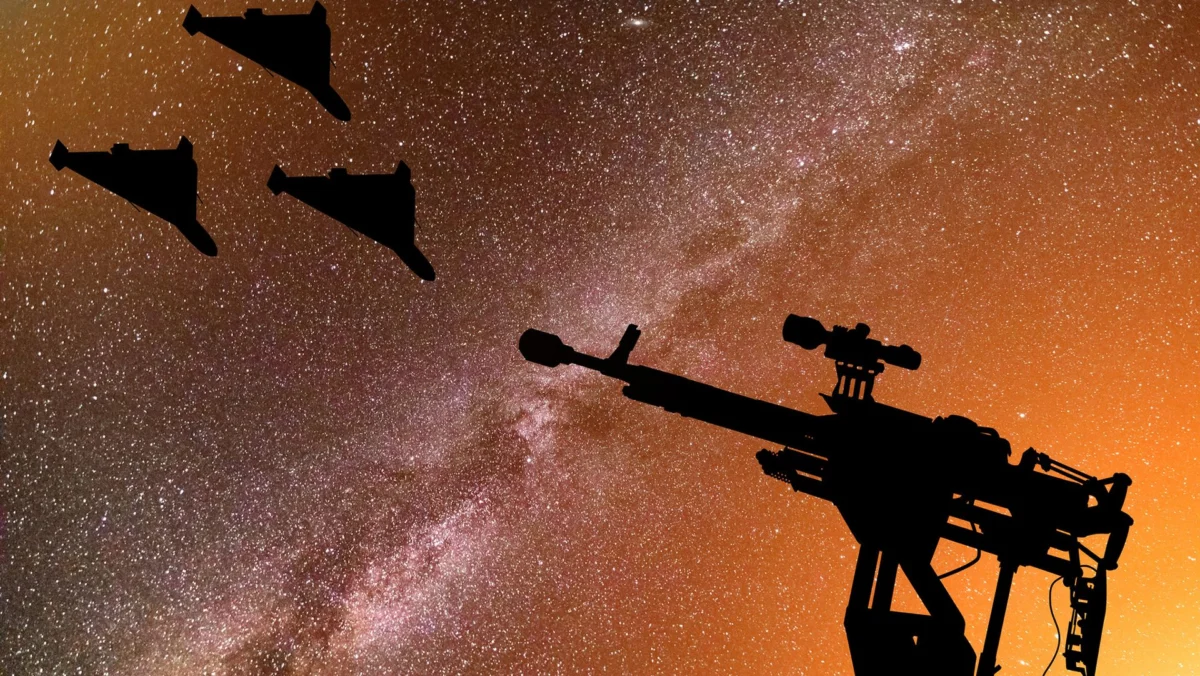
The militarization of Earth’s orbit, once confined to the pages of science fiction novels and cinematic thrillers, crossed a monumental threshold when senior United States defense officials formally acknowledged that the nation has deployed operational weapons in space. Speaking at the annual Air, Space and Cyber Conference in Maryland, U.S. Air Force Secretary Troy Meink confirmed that the military has actively integrated on-orbit space control systems designed to protect joint military forces from emerging adversary threats.
This historic disclosure marks the first time Washington has publicly admitted to placing offensive or defensive weaponized assets directly into Earth’s orbit. While military planners argue that the deployment is a necessary deterrent to protect critical communication, navigation, and reconnaissance infrastructure, arms control experts and international observers warn that the admission could dismantle decades of geopolitical norms and accelerate an uncontrolled escalation into the final frontier.
The 1967 Outer Space Treaty and the Limits of International Law
The foundation of modern space governance rests heavily on the Outer Space Treaty of 1967, a landmark agreement negotiated during the height of the Cold War by the United States, the Soviet Union, and other global stakeholders. Designed to ensure that outer space remained an international domain reserved for peaceful exploration and scientific discovery, the treaty explicitly prohibits signatory nations from placing nuclear weapons or any other weapons of mass destruction into Earth’s orbit, installing them on celestial bodies, or stationing them in space in any other manner.
However, legal scholars and defense analysts have long pointed out a critical vulnerability within the treaty: its ambiguity regarding conventional, kinetic, or electronic warfare systems. Because the framers of the 1967 treaty could not foresee the advanced technological capabilities of the 21st century—such as directed-energy weapons, satellite-jamming technologies, and robotic grapple systems—the agreement lacks comprehensive prohibitions against conventional defensive or offensive space control hardware.
Furthermore, the Outer Space Treaty suffers from a glaring absence of a formal enforcement mechanism or a dedicated verification regime. Without an international policing body equipped to inspect payloads or penalize violations, major spacefaring nations have operated in a geopolitical gray area. Meink’s recent disclosure demonstrates how modern military strategy has fully exploited these legal loopholes, transforming low-Earth orbit from a zone of scientific cooperation into a contested operational domain.
A Brief Chronology of Orbital Militarization
To understand how the United States arrived at this unprecedented deployment, it is necessary to examine the steady evolution of space as a military theater over the past several decades:
- October 4, 1957: The Soviet Union launches Sputnik 1, the world’s first artificial satellite, instantly initiating both the Space Race and early military reconnaissance concerns within the United States.
- January 27, 1967: The United States, the United Kingdom, and the Soviet Union sign the Treaty on Principles Governing the Activities of States in the Exploration and Use of Outer Space, Including the Moon and Other Celestial Bodies (Outer Space Treaty).
- 1980s (The SDI Era): The Reagan administration introduces the Strategic Defense Initiative (SDI), popularly known as "Star Wars," proposing a space-based missile defense shield. While never fully deployed due to technological and financial hurdles, it signals the first serious governmental push toward orbital combat systems.
- January 11, 2007: China conducts a successful anti-satellite (ASAT) missile test, destroying one of its own defunct weather satellites in polar orbit and creating thousands of pieces of hazardous long-lasting space debris. This event severely raises threat perceptions within the Pentagon.
- December 20, 2019: The United States officially establishes the U.S. Space Force as the sixth branch of the Armed Forces, centralizing military space operations and cementing the perspective of space as a distinct warfighting domain.
- September 14 (Recent Announcement): Air Force Secretary Troy Meink officially acknowledges at the Air, Space and Cyber Conference that the U.S. has deployed on-orbit space control weapons capable of defending joint military forces against hostile actions.
Strategic Rationale: Protecting the Ultimate High Ground
From the perspective of the Pentagon and Department of Defense strategists, the deployment of space-based capabilities is no longer a luxury, but an absolute operational necessity. Modern military operations rely almost entirely on space assets. Global Positioning System (GPS) constellations coordinate troop movements, guide precision munitions, and synchronize secure communications. Missile warning systems rely on infrared sensors mounted on satellites to detect hostile launches within seconds, while intelligence, surveillance, and reconnaissance (ISR) payloads provide real-time situational awareness across every theater of conflict.
As potential adversaries such as China and Russia rapidly advance their own counter-space programs—including ground-based laser dazzlers, cyber-attack capabilities, and co-orbital inspector satellites capable of disabling or capturing American hardware—the vulnerability of U.S. space assets has reached critical levels.
By deploying "space control" weapons directly into orbit, the U.S. military aims to establish a robust defensive posture. These systems are ostensibly designed to deter hostile interference, protect friendly constellations from kinetic or electronic disruption, and ensure continuous operational resilience even in the event of an escalating terrestrial conflict.
Global Reactions and the Specter of an Arms Race
The public confirmation from Washington has predictably triggered sharp reactions from international competitors and deep anxiety within global disarmament organizations. Beijing and Moscow, both of which have actively developed and tested counter-space technologies for years, seized upon the announcement to criticize U.S. hypocrisy and warn of the destabilizing consequences of militarizing orbit.
Representatives from the Chinese Foreign Ministry warned that the introduction of weapons into space fundamentally violates the spirit of peaceful coexistence in the cosmos and actively fuels a dangerous, irreversible arms race. Similar sentiments have been echoed by diplomats in Geneva, where discussions at the United Nations Conference on Disarmament have routinely stalled over the creation of verifiable rules for the prevention of an arms race in outer space (PAROS).
Independent security analysts share these concerns, noting that the open acknowledgement of deployed space weapons lowers the political and diplomatic threshold for other nations to follow suit. When one superpower openly embraces orbital weaponry, rival states feel compelled to accelerate their own programs to maintain strategic parity, creating a classic security dilemma.
Implications for the Future of Global Security and Space Sustainability
The long-term implications of this policy shift extend far beyond geopolitical posturing, directly threatening the physical safety of orbital infrastructure. Low-Earth orbit is already heavily congested with tens of thousands of active satellites and millions of pieces of defunct space debris. Traveling at speeds exceeding 17,000 miles per hour, even a tiny fragment of debris can catastrophic damage to a functional spacecraft.
The introduction of dedicated weapons systems into this fragile ecosystem drastically increases the risk of kinetic conflict in space. An accidental collision, a misread signal, or an intentional engagement between rival orbital assets could generate catastrophic amounts of hypervelocity shrapnel. Under the disastrous dynamics of the Kessler Syndrome—a theoretical scenario where the density of objects in low-Earth orbit is high enough that collisions between objects could spawn a cascade, each creating new debris that increases the likelihood of further collisions—an orbital conflict could render entire bands of Earth’s orbit entirely unusable for generations. This would effectively cripple global weather forecasting, telecommunications, financial networks, and scientific observation.
As the international community digests the reality of the United States’ newly acknowledged space-based arsenal, the pressure mounts on diplomatic bodies to establish new frameworks, transparent communication channels, and updated legal definitions. Without immediate and serious multilateral engagement to draft enforceable rules of behavior in space, humanity risks transforming the pristine expanse of the cosmos into the next active theater of war.










Leave a Reply