
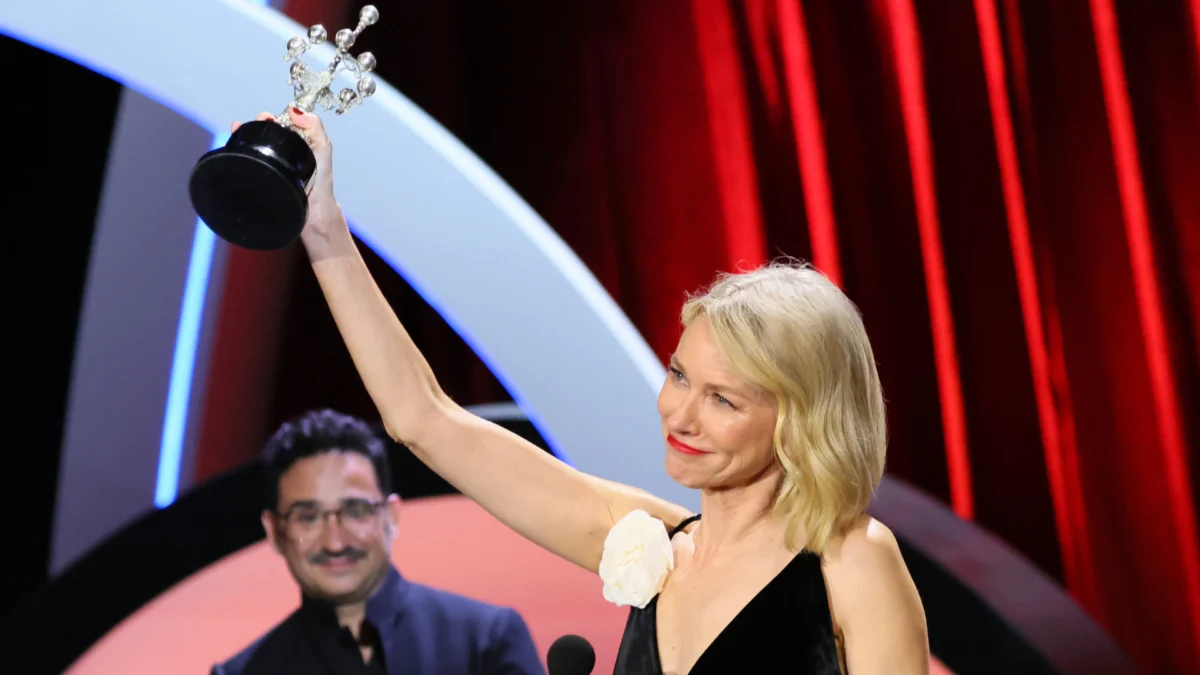
The historic coastal city of San Sebastián played host to a poignant evening of cinematic celebration as British actress Naomi Watts accepted the prestigious Donostia Award at the San Sebastián International Film Festival. The honor, which recognizes lifetime achievement and contributions to the world of cinema, was presented to Watts on Saturday night before a packed, enthusiastic audience. Rather than merely focusing on her own extensive and varied filmography, Watts used her platform to pay heartfelt tribute to the late director David Lynch, whose groundbreaking 2001 psychological thriller Mulholland Drive propelled her to international stardom after years of persistent rejection in the industry.
The evening’s celebrations preceded the festival screening of Watts’s latest feature film, The Housewife. Directed by Ben Shirinian and featuring an ensemble cast that includes Tye Sheridan, Michael Imperioli, and Luke Evans, the psychological thriller is set in 1964 New York and centers on a young journalist who uncovers a potential Nazi officer living quietly in Queens. As the journalist befriends the suspect’s charming wife, the investigation spirals into dark and unexpected territory. The screening added a contemporary showcase of Watts’s ongoing versatility to an event dedicated to honoring her decades-long cinematic journey.
A Touching Introduction by J.A. Bayona
The emotional resonance of the evening was established early when Watts was introduced by Spanish filmmaker J.A. Bayona. The director shared a deep professional and personal bond with Watts, having directed her in the critically acclaimed 2012 survival drama The Impossible. Based on the harrowing true story of a family caught in the catastrophic 2004 Boxing Day tsunami in Southeast Asia, the film proved to be a critical and commercial powerhouse, grossing over $198 million globally and earning Watts her second Academy Award nomination for Best Actress.
Taking to the stage, Bayona offered a deeply personal reflection on their time working together on the physically and emotionally demanding project. Addressing the audience, Bayona thanked Watts for placing her trust in him during a period when he was a relatively young and inexperienced feature director. He praised her as the ultimate professional and the best travel companion he had ever encountered on a film set, noting that she taught him standards of excellence and collaboration that he continues to look for when working with actors today. Bayona concluded his introduction by declaring his deep admiration and love for the actress, noting that honoring her at the festival felt like the fulfillment of a long-held personal dream.
Reflections on Resilience and The Impossible
Visibly moved by Bayona’s remarks, Watts stepped up to collect her award and reciprocated the warmth, reflecting fondly on the grueling yet rewarding experience of making The Impossible. She recalled the intense physical demands of the shoot, which included spending long hours submerged in water tanks while filming in Spain and collaborating with local communities in Thailand.
With characteristic humor, Watts recalled shooting over thirty takes in the water tank and gave a cheerful shout-out to her co-star Tom Holland. Holland, who was making his live-action feature film debut at the age of 15 in the movie, famously described the experience as the best water park he had ever visited—a sentiment that Watts playfully contrasted with her own memory of the shoot as an exercise in pure pain. Despite the difficulties, Watts emphasized that the memories and the artistic collaboration forged during the production remain among the most cherished of her career.
The Long Road to Hollywood Recognition
Watts’s path to becoming an internationally recognized Academy Award-nominated actress was far from straightforward. During her acceptance speech, she candidly addressed the trials of her early career, admitting that breaking into the upper echelons of Hollywood required navigating a decade marked by relentless rejection. For years, she faced casting directors and industry insiders who told her she lacked what it took to succeed and that she would not make it in the fiercely competitive entertainment business.
Everything shifted when she crossed paths with visionary auteur David Lynch. Auditioning for Mulholland Drive, Watts found a filmmaker who looked past her history of professional setbacks and recognized her raw talent. Lynch offered her a complex, career-defining role that transformed her trajectory overnight. Watts noted that Lynch taught her to trust her instincts, embrace the abstract and unexplained, and find strength in artistic vulnerability. By believing in her capabilities long before she had fully learned to believe in herself, Lynch left an indelible mark on her life and career, prompting Watts to dedicate her Donostia Award explicitly to his memory, telling the audience that the accolade felt fundamentally tied to his enduring legacy.
Challenging Industry Ageism and Pushing for Authentic Representation
Now 57 years old, Watts used her moment in the spotlight to address broader systemic issues within the entertainment industry, specifically confronting the pervasive issue of ageism. She recalled the discouraging warnings she received at the age of 31 when Mulholland Drive was first launching—warnings from industry figures who claimed her career would inevitably dry up and finish by the time she turned 40.
Expressing profound gratitude for the opportunity to help dismantle those outdated paradigms, Watts emphasized that the narrative surrounding women over forty in cinema is actively shifting. She issued a passionate call to action for continued progress, stressing that women are substantial consumers of film and storytelling who deserve to see their complex lived experiences authentically reflected on the screen. Her remarks resonated strongly with the audience, highlighting the ongoing cultural shift toward inclusivity and longevity for women in Hollywood.
Looking Ahead and Continuing the Craft
Concluding her acceptance speech with a forward-looking perspective, Watts assured the festival audience that her creative journey is far from over. Acknowledging the privilege of being able to pursue her passion every day, she expressed excitement for future projects and her continued desire to push artistic boundaries. Holding the Donostia Award aloft, she closed with a final, poignant tribute to her late mentor, declaring simply and affectionately that she misses David Lynch dearly.
The San Sebastián International Film Festival continues to build on its rich tradition of celebrating cinematic icons. The 2026 edition, running from September 18 to 26, opened with a celebration of veteran filmmaker Werner Herzog, who received a Donostia Award on Friday ahead of a screening of Fatih Akin’s Ghost Song. Festival organizers noted that Watts was selected for this year’s honor due to her unique ability to seamlessly bridge independent arthouse cinema with major commercial productions across both film and television.
Watts’s impressive filmography underscores this versatility. Beyond her breakthrough in Mulholland Drive and her Oscar-nominated performances in The Impossible and Alejandro González Iñárritu’s 21 Grams (2003), she has worked with some of the most celebrated directors in modern cinema. Her credits include Peter Jackson’s King Kong, David Cronenberg’s Eastern Promises, Clint Eastwood’s J. Edgar, Michael Haneke’s psychological thriller Funny Games, Audrey Diwan’s Emmanuelle, and Noah Baumbach’s While We’re Young. She also previously attended the San Sebastián festival in 2009 alongside director Rodrigo García to close the official selection out of competition with Mother & Child.
As the festival progresses, the spotlight remains firmly on cinematic excellence, the courage of artists who challenge industry norms, and the enduring power of mentorship and collaboration in storytelling. Through her resilience, exceptional body of work, and ongoing advocacy for authentic representation, Naomi Watts has cemented her place not only as a defining talent of her generation but as a vital voice for the future of global cinema.








Leave a Reply