
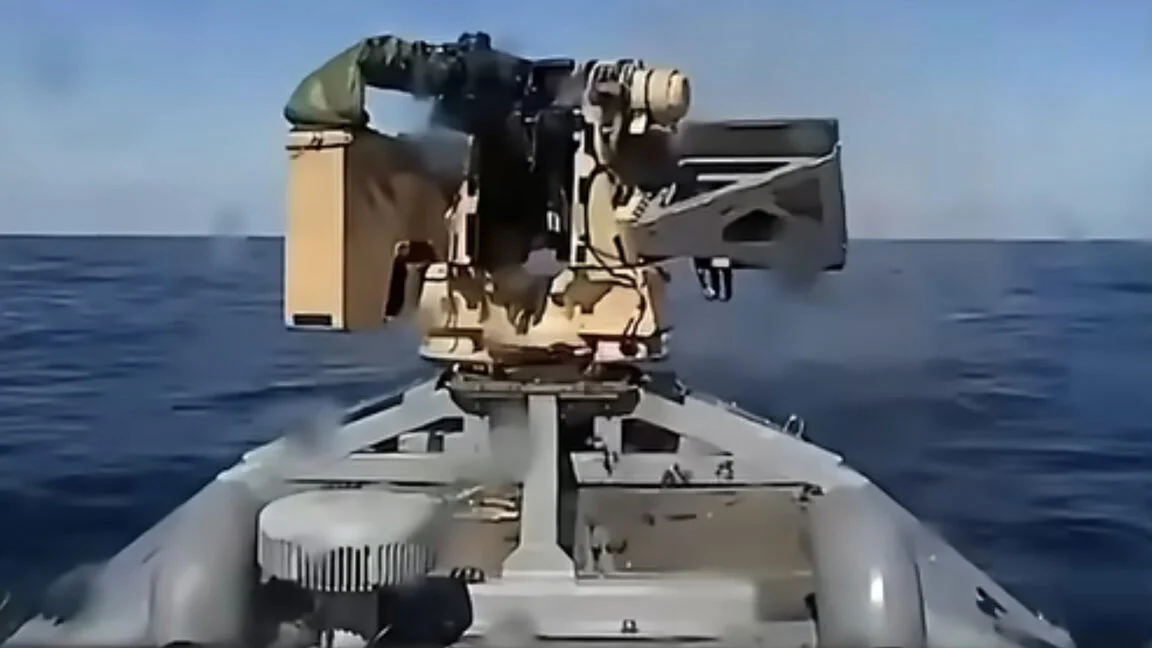
The warfare in Ukraine, which has persistently served as a live-fire laboratory for modern military technology, has officially crossed a historic threshold: the world’s first recorded combat engagement between two uncrewed surface vessels (USVs). In a milestone deployment of autonomous and remote-controlled maritime hardware, a Ukrainian naval drone successfully tracked, engaged, and obliterated a Russian explosive drone boat in the contested waters of the Black Sea. This engagement signals a profound paradigm shift in naval warfare, demonstrating that the future of combat at sea is not only uncrewed, but increasingly characterized by autonomous systems hunting one another.
The lopsided yet technologically momentous engagement unfolded on September 12, marking a new chapter in a conflict that has already redefined the tactical employment of aerial drones, loitering munitions, and ground-based robotic platforms. According to military analysts and official reports, the clash underscores how rapidly the Black Sea has transformed into a high-stakes proving ground for naval robotics, where the line between science fiction and frontline reality continues to blur.
Anatomy of an Uncrewed Engagement
The sequence of events leading to the historic maritime duel began when operatives within Ukraine’s Defense Intelligence directorate detected a hostile vessel operating in the strategic waters of the Black Sea. The target was identified as a Russian uncrewed surface vessel belonging to the "Orcan" class—a specialized kamikaze-style drone boat engineered for offensive operations.
Naval defense analyst H.I. Sutton, writing for Naval News, provided detailed technical insights regarding the Russian asset. The Orcan drone features a jet-ski-type steerable water jet propulsion system, allowing for high-speed maneuverability, and is designed specifically to ram high-value targets, detonating a heavy explosive payload upon impact. These vessels have previously been deployed by Russian forces to harass Ukrainian maritime infrastructure, target ports, and threaten commercial shipping lanes. Furthermore, these explosive boats frequently operate in tandem with aerial reconnaissance platforms, such as Russian Geran-series loitering munitions, which act as airborne spotters to relay targeting telemetry and enhance communication links between human operators and their remote marine craft.
Recognizing the imminent threat posed by the incoming Orcan drone, Ukrainian military command directed a specialized Ukrainian Navy uncrewed surface vessel to intercept and neutralize the target before it could reach friendly positions or critical maritime assets.
The hunter in this scenario was a Ukrainian Sargan-3000 drone boat. Unlike its purely kamikaze Russian counterpart, the Sargan-3000 is a versatile, heavily armed naval platform. It was equipped with a stabilized 12.7-millimeter heavy machine gun mounted on a remote weapon station manufactured by the prominent Norwegian defense firm Kongsberg. This sophisticated remote turret allows operators stationed at safe, distant command centers to accurately acquire, track, and fire upon targets even while navigating choppy open-water conditions at high speeds.
Chronology of the Black Sea Duel
The operational timeline of the engagement highlights the speed and precision with which modern robotic naval warfare is conducted:
- Detection: Ukrainian Defense Intelligence sensors spot an incoming Russian Orcan explosive USV operating autonomously or via remote link in the Black Sea.
- Interception Vector: Ukrainian naval command dispatches a Sargan-3000 armed drone boat to intercept the trajectory of the hostile vessel. Positive visual and electronic identification of the Orcan drone is confirmed.
- Engagement Phase: Closing to a distance of approximately one kilometer, the Ukrainian operator initiates engagement using the Kongsberg remote weapon station.
- Destruction: The Sargan-3000 fires a precision burst of 12.7mm rounds, successfully severing and disabling the Russian drone’s critical communications antenna. With its remote link severed, the target is systematically riddled with high-caliber gunfire until catastrophic structural failure leads to its sinking.
- Documentation: The Ukrainian Navy subsequently releases verified combat footage of the incident, showcasing the remote gun turret locking onto the target and executing the decisive strike.
The official video released by the Ukrainian Navy, alongside corroborating reports from the government media platform United24, vividly illustrates the clinical efficiency of the engagement. Operating from a standoff distance of roughly one kilometer, the Sargan-3000’s remote-controlled heavy machine gun methodically dismantled the threat. By first destroying the Orcan’s communications antenna, the Ukrainian operator neutralized any potential automated or emergency steering protocols the Russian vessel might have retained, before delivering the coup de grâce that sent the explosive boat to the seabed.
The Inevitability of USV-on-USV Combat
Military technologists and defense analysts have long predicted that as both sides in modern conflicts saturate operational zones with uncrewed systems, those systems would inevitably clash with one another. Speaking to New Scientist following the incident, H.I. Sutton remarked that this maritime duel was merely a matter of time. "It was inevitable that there would be USV-on-USV combat," Sutton stated. "We have seen the same in the air and on the ground."
Indeed, the war in Ukraine has consistently foreshadowed this development. In the skies above the front lines, Ukrainian and Russian first-person view (FPV) interceptor drones routinely engage in high-speed aerial dogfights, hunting enemy reconnaissance and strike quadcopters. On the terrestrial battlefield, tracked and wheeled ground robots utilized for supply transport, casualty evacuation, and direct fire support have increasingly become targets for opposing uncrewed ground vehicles (UGVs) and munitions.
However, translating this dynamic to the maritime domain introduces unique engineering and tactical hurdles. Unlike the air, where aerodynamic surfaces allow for agile three-dimensional movement, or land, where terrain dictates pathways, the open ocean presents constant variables of wave action, current drift, and limited sensory feedback. The success of the Sargan-3000 in this engagement demonstrates that remotely operated marine platforms have achieved a level of stability, targeting accuracy, and operational maturity previously thought years away.
Strategic Implications and Future Outlook
The implications of the world’s first naval drone duel extend far beyond a single tactical victory in the Black Sea. Navies around the globe—from the United States and NATO allies to Indo-Pacific defense forces—are closely studying the conflict in Ukraine as a primary case study in modern naval warfare evolution.
For decades, the foundation of blue-water and green-water naval power rested on traditional capital ships: destroyers, frigates, corvettes, and aircraft carriers. These multi-billion-dollar platforms require extensive crew complements, robust damage control infrastructure, and complex logistics chains. The proliferation of asymmetric, low-cost uncrewed surface vessels has fundamentally challenged this traditional calculus.
When a relatively inexpensive, remote-controlled marine drone armed with a heavy machine gun can successfully track, outmaneuver, and destroy a specialized explosive boat, the cost-benefit analysis of naval defense shifts dramatically. Traditional warships are increasingly vulnerable to swarming tactics by cheap explosive USVs, necessitating the rapid development of counter-USV (C-USV) technologies. The engagement on September 12 provides a working blueprint for such defense: utilizing armed, maneuverable interceptor USVs equipped with remote weapon stations to patrol sea lanes, protect ports, and hunt down hostile explosive boats before they can threaten high-value assets.
Furthermore, this incident highlights the growing importance of electronic warfare and communications security in the maritime theater. The targeted destruction of the Russian drone’s communication antenna underscores the reality that uncrewed vessels are only as effective as the data links connecting them to their operators or parent networks. As artificial intelligence and autonomous navigation capabilities continue to mature, future iterations of these systems will likely operate with even greater independence, reducing reliance on vulnerable radio-frequency links and setting the stage for fully autonomous naval combat engagements.
As the conflict in Ukraine persists, the Black Sea remains an unrelenting crucible for military innovation. The historic clash between the Ukrainian Sargan-3000 and the Russian Orcan drone is not merely an isolated curiosity of modern warfare; it is the opening salvo in an entirely new era of naval combat—one where human sailors may increasingly command the battlefield from afar while machines fight for supremacy on the waves.










Leave a Reply