
The quest for sustainable agriculture has long focused on the holy grail of on-farm nitrogen fixation. Nitrogen is the fundamental building block of life, essential for the synthesis of proteins, chlorophyll, and DNA in crops. For over a century, the Haber-Bosch process has provided the backbone of global food security, creating synthetic ammonia that sustains billions. In recent years, innovators have sought to decentralize this process through plasma-based nitrogen fixation. Among these, Green Lightning—a technology utilizing electricity to oxidize atmospheric nitrogen into aqueous nitrate—has garnered significant attention. However, a rigorous analysis of the physics and chemistry behind the technology suggests a profound chasm between the volume of nitrogen the machine physically produces and the lofty claims regarding its ability to replace conventional fertilizer inputs.
The Chemical Reality of Plasma Fixation
At its core, the Green Lightning technology is scientifically sound. It employs plasma chemistry to break the strong triple bonds of atmospheric nitrogen, allowing it to react with oxygen and ultimately dissolve in water as nitrate. This process is essentially a modern, electrified iteration of the Birkeland-Eyde process, first developed in the early 1900s. When operating, the equipment produces a measurable, nitrogen-enriched liquid.
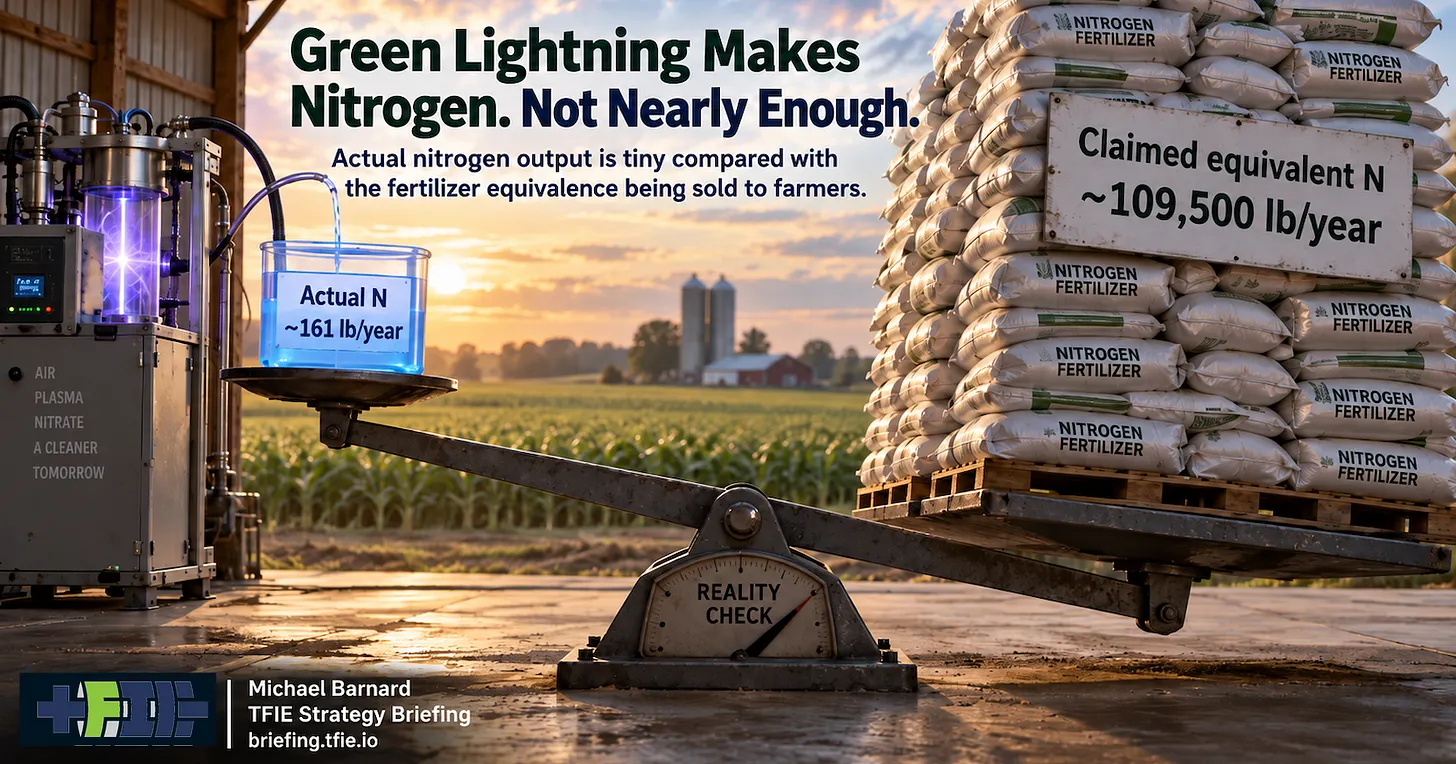
However, the discrepancy arises when one shifts from the laboratory observation of nitrate creation to the agronomic promise of "fertilizer replacement." According to data provided by Washington State University Extension, the current output of a standard Green Lightning unit producing 100 gallons of solution per day equates to approximately 161 pounds of actual nitrogen fixed per year. Conversely, marketing materials for such technologies often claim that these units can displace thousands of pounds of conventional synthetic fertilizers, such as urea or urea-ammonium nitrate (UAN).
The arithmetic of this claim reveals a staggering 680-fold gap. If a system claims to replace 109,500 pounds of conventional nitrogen per year while only physically producing 161 pounds, the fundamental law of conservation of mass dictates that the "replaced" nitrogen must be sourced from elsewhere—typically the soil’s organic matter or existing residual nitrogen—rather than being provided by the machine.
A Chronology of Field Testing and Performance
The transition from theoretical output to field-scale performance is where the technology faces its most significant hurdles. Throughout 2024, agricultural observers and technology testers initiated formal evaluations to determine if these machines could indeed maintain crop yields while reducing reliance on traditional inputs.
In a prominent 2024 trial conducted by Precision Planting, researchers attempted a full replacement of their conventional nitrogen program with Green Lightning. The protocol involved applying 120 gallons of the machine’s output per acre across six separate applications. The result was a yield of 235.9 bushels of corn per acre. In direct contrast, the control group utilizing a standard UAN nitrogen program produced 280.7 bushels per acre.
This difference of nearly 45 bushels per acre is statistically significant. While the testers noted operational challenges—specifically the management of hard water and the consistency of the product—the data provides a clear indication that the current iteration of the technology does not achieve parity with conventional nitrogen applications. These results emphasize that, while the machine generates a useful supplemental stream of nitrate, it does not currently function as a direct, scalable substitute for the heavy nitrogen requirements of modern high-yield corn production.
The Physics of Fertilizer Efficiency
Proponents of decentralized nitrogen fixation often argue that better timing and placement of nitrogen—so-called "precision application"—can allow farmers to achieve similar yields with lower total nitrogen inputs. While it is true that fertilizer efficiency can be optimized through split applications and variable rate technology, these management practices do not create new nitrogen atoms. They simply reduce the amount of nitrogen lost to leaching, denitrification, or volatilization.

If a farmer reduces their total synthetic nitrogen input by 50% and maintains yield, they are not necessarily proving that their alternative technology is "producing" the missing nitrogen; they are likely mining the soil’s natural reserves. Over several seasons, this practice can lead to the degradation of soil health as organic matter is depleted to compensate for the nitrogen deficit. This distinction is critical for the long-term viability of agricultural land. Scientists and agronomists maintain that a mass-balance accounting—tracking every pound of nitrogen entering and leaving the field—is the only way to verify the efficacy of on-farm fixation.
Corporate Claims and the Need for Peer Review
The company behind the technology, Nytro, has countered these findings by pointing to newer iterations of their hardware. The firm claims that updated equipment is capable of achieving significantly higher nitrate concentrations, which would theoretically alter the arithmetic of the input requirements.
These claims, while promising, underscore the necessity for independent, third-party validation. In the agricultural technology sector, early-stage equipment often suffers from "pilot-scale bias," where small-scale successes are extrapolated into massive commercial projections without accounting for the complexities of field-scale variability. For farmers, who operate on thin margins and rely on predictable inputs, the difference between a "supplemental" nitrogen source and a "replacement" technology is the difference between a profitable harvest and a failed crop.
Experts from the TFIE Strategy Briefing have noted that the fundamental question remains unanswered: How can a few hundred pounds of newly fixed nitrogen sustain a high-yield crop that typically requires hundreds of pounds of nitrogen per acre? Until a controlled experiment demonstrates a closed-loop mass balance—where the output of the machine is chemically reconciled with the total nitrogen content of the harvested biomass—claims of large-scale fertilizer replacement remain speculative.
Implications for the Future of Farm Technology
The implications of this technology are vast. If decentralized nitrogen production can be optimized, it would represent a revolution in the agricultural supply chain, potentially shielding farmers from the price volatility of global natural gas markets, which dictate the price of ammonia. However, the current reality suggests that the technology is in its infancy.
As the industry moves from experimental prototypes to commercial sales, the standard for evidence must rise. Farmers are not buying abstract chemical theories; they are purchasing equipment designed to displace expensive, essential inputs. A machine that produces a modest, supplemental stream of nitrogen may still provide value by improving crop health or providing a minor boost to nitrogen-use efficiency. Yet, there is a clear distinction between a "value-add" tool and a "replacement" solution.
Moving forward, the industry requires three specific pillars of evidence:
- Third-Party Mass Balance: Independent audits of total nitrogen input versus total nitrogen removal in harvested biomass.
- Long-Term Soil Health Studies: Monitoring the impact of reduced synthetic nitrogen application on soil organic matter over a minimum of five years.
- Consistency Verification: Technical assessments of equipment reliability under varied farm conditions, including water quality fluctuations and continuous operational stress.
Conclusion
Green Lightning and similar plasma-based technologies represent a fascinating intersection of energy and agronomy. The physics of oxidizing atmospheric nitrogen to create nitrates is well-understood, and the capability of these machines to produce a measurable nitrogen solution is a verified fact. However, the claim that these systems can serve as a massive replacement for conventional synthetic fertilizers is currently unsupported by the available field evidence and the basic principles of plant nutrition.
For the agricultural community, the takeaway is one of cautious optimism tempered by analytical rigor. While the technology holds potential as an auxiliary tool for nitrogen management, it is not currently a substitute for the intensive nitrogen requirements of industrial-scale crop production. As researchers continue to refine the hardware and increase the concentration of the nitrate output, the burden of proof rests on demonstrating that the nitrogen math adds up. Until that happens, farmers should view these systems as a supplemental technology rather than a fundamental replacement for the nitrogen programs that underpin modern food production. The journey toward a more sustainable, decentralized nitrogen future is underway, but it must be built on a foundation of verifiable data and accurate chemical accounting, ensuring that the promise of the technology matches the physical reality of the field.









Leave a Reply