
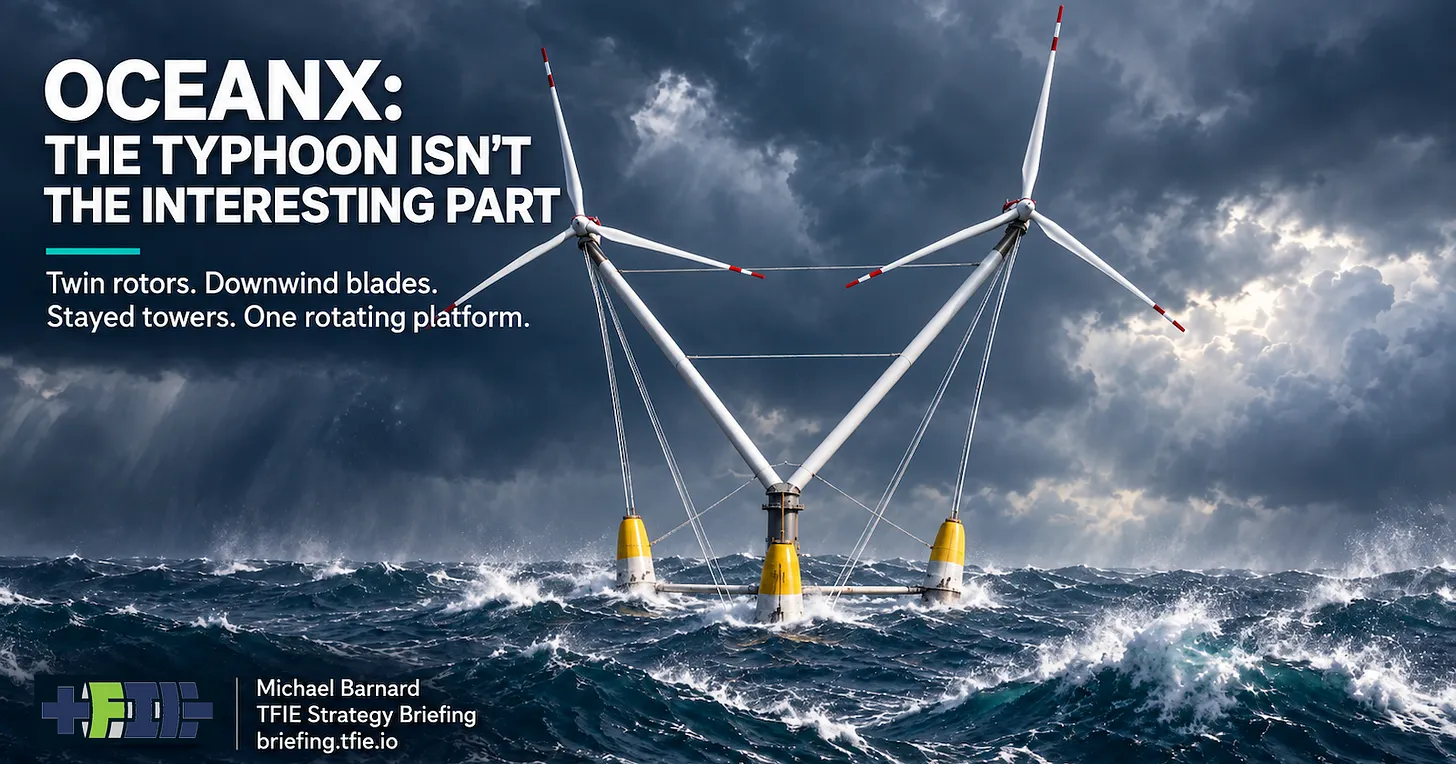
The resilience demonstrated by the OceanX floating offshore wind platform during the passage of Super Typhoon Yagi has provided the offshore wind industry with a compelling case study in structural innovation. While the platform’s distinct visual profile—characterized by its twin-rotor configuration and downwind orientation—initially drew skepticism from traditional engineering circles, the empirical data gathered during one of the most powerful storms of the year has forced a reevaluation of unconventional floating wind architectures.
The Trial by Typhoon: Data from the Field
Super Typhoon Yagi, a Category 5 equivalent storm, struck the South China Sea in September 2026, creating extreme hydrodynamic and aerodynamic conditions. For the OceanX platform, a full-scale floating unit operated by Mingyang Smart Energy, the storm served as a real-world stress test.
According to post-storm telemetry released by Mingyang, the platform faced wind speeds exceeding 41.5 meters per second at the nacelle level. The wave environment was equally hostile, with significant wave heights reaching 6.5 meters and a recorded maximum wave height of 9.8 meters. Despite these severe environmental loads, the platform’s performance metrics remained within a remarkably narrow margin. The nacelle inclination—the tilt of the turbine housing—varied by only zero to three degrees throughout the storm’s peak.
This stability suggests that the platform’s center of gravity and mooring dynamics were effectively balanced against the intense forces of the typhoon. Engineers noted that the platform’s physical response aligned closely with pre-storm computational fluid dynamics (CFD) simulations, indicating an absence of unexpected resonant frequencies or structural deformations that would typically threaten a floating unit of this scale.
The Evolution of Floating Wind Architecture
To understand the significance of OceanX, one must distinguish between its four core design innovations: twin-rotor configuration, downwind operation, stayed supports, and whole-platform weather-vaning. These choices represent a departure from the "Danish concept," the industry-standard design featuring a single, three-bladed, upwind rotor mounted on a freestanding tubular tower.

The standard upwind design became the global norm for a variety of reasons, primarily centered on aerodynamic efficiency and fatigue life. In a traditional downwind configuration, blades must pass through the "wake shadow" created by the tower, which causes periodic pressure fluctuations that lead to increased stress, material fatigue, and acoustic noise.
OceanX addresses this by abandoning the bulky, freestanding tubular tower in favor of slender, inclined structural members supported by a complex network of high-tension stays. This approach minimizes the surface area of the support structure directly in front of the rotor, theoretically reducing the severity of the wake disturbance. By effectively thinning the "shadow" that the blades pass through, the designers have attempted to mitigate the inherent disadvantages that have historically relegated downwind turbines to niche applications.
Passive Alignment and Weather-Vaning
Perhaps the most structurally significant feature of the OceanX platform is its ability to weather-vane as a single, integrated unit. In traditional floating wind farms, each turbine nacelle is equipped with an active yaw system—a motor-driven mechanism that rotates the rotor to face the incoming wind.
OceanX, however, utilizes the entire floating platform’s mooring system to align the structure with the prevailing wind direction. This passive alignment ensures that the rotors, the stayed supports, and the nacelles maintain a consistent aerodynamic relationship with the wind flow. For a design that relies on the precise, slender geometry of its stayed supports to minimize wake interference, this passive orientation is critical. By allowing the platform to move with the environment rather than fighting against it with individual yaw motors, the design potentially reduces the mechanical wear and tear on the nacelles, though it shifts the burden of structural integrity to the mooring lines and the platform’s underwater hull.
The Twin-Rotor Question
While the stayed, downwind architecture has gained credibility through the performance data from Typhoon Yagi, the twin-rotor design remains the most contentious element of the OceanX concept. A dual-rotor system necessitates the duplication of critical components: two drivetrains, two hubs, and six total blades.
Proponents argue that splitting the generating capacity between two smaller rotors allows for a lower center of gravity and keeps individual components within a size range that is easier to manufacture, transport, and maintain. Conversely, critics point to the increased complexity of the system. Two turbines interacting on a single platform introduce complex load-path challenges and increase the total number of failure points. Whether the structural benefits of a multi-rotor setup outweigh the added maintenance costs and component complexity over a 25-year operational lifespan is a question that current data cannot yet fully answer.

Broader Industry Implications
The success of the OceanX platform during Typhoon Yagi serves as a validation of integrated design. In the past, industry analysts were quick to dismiss downwind designs due to the historical fatigue problems associated with rigid tower structures. However, the floating offshore sector is fundamentally different from fixed-bottom wind. Floating platforms provide designers with greater freedom to alter the structure ahead of the blades, allowing for the use of tensioned stays and slender members that were not feasible in fixed-bottom, cantilevered towers.
The fact that the OceanX unit survived the typhoon with minimal structural deviation suggests that the coupled system—comprising rotors, supports, stays, and mooring—interacts in a predictable and manageable way. This shifts the conversation from whether such a design is "possible" to whether it is "economically competitive."
Future Outlook and Economic Viability
The path to commercializing the OceanX architecture requires further scrutiny of long-term fatigue data. While the platform proved its durability in a single, high-intensity weather event, the true test lies in the cumulative damage caused by millions of cycles of wind and wave loading over several decades.
Maintenance remains a significant hurdle. In a conventional wind turbine, access to the nacelle is standardized. In an OceanX configuration, the offshore inspection and repair procedures for the rotating interfaces and the stayed support network will require specialized logistics and potentially new maintenance protocols. Furthermore, the economic trade-offs between the reduced material mass of the stayed structure and the increased component count of the dual-rotor drivetrain will be the primary metric by which developers judge the platform’s potential for wide-scale deployment.
As the offshore wind industry continues to move into deeper waters, the constraints of fixed-bottom engineering are fading. Innovations like those showcased by the OceanX platform represent a broader trend toward systems-level engineering, where the platform and the turbine are designed as a single, cohesive unit rather than as separate, modular components. If the data gathered from the Yagi storm holds up under continued scrutiny, it may signal the start of a period where unconventional floating architectures become a standard, rather than a speculative, component of the global renewable energy landscape.
In conclusion, while the twin-rotor design continues to face skepticism, the OceanX platform has successfully challenged the industry’s prevailing biases against downwind, stayed-support architectures. By proving its structural integrity under extreme conditions, the design has secured a place in the ongoing debate over the most efficient way to capture wind energy in deep-sea environments. The coming years of operational data will determine if this radical departure from the standard turbine configuration can offer a lower cost of energy, but for now, the engineering community has been provided with a compelling reason to keep watching.







Leave a Reply