
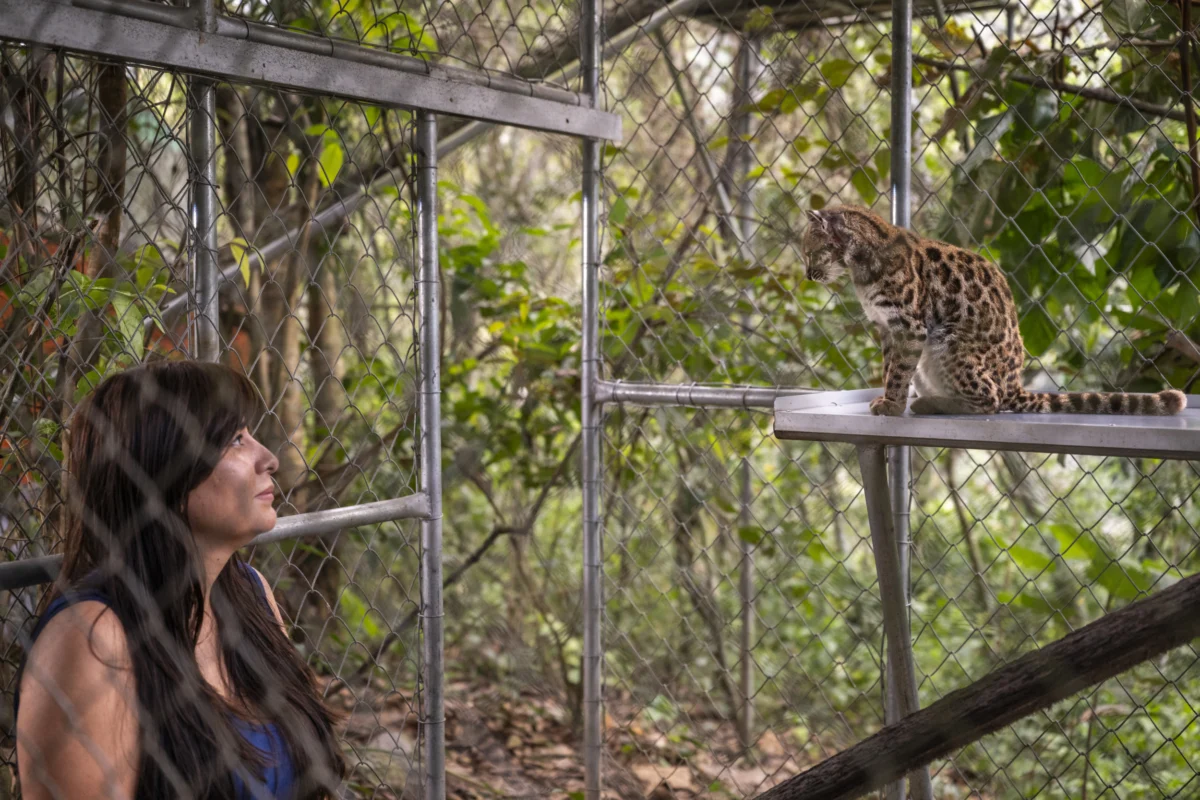
In a landmark revelation for global mammalogy, an international team of researchers has formally described a new species of small wildcat native to the misty elevations of Bolivia’s Yungas cloud forests. Scientific publication of the findings, featured in the journal Current Biology, marks the first formal description of a living, novel feline species in more than a century. Named the tilcayo (Leopardus tilcayo), the diminutive predator challenges long-held taxonomic assumptions regarding South America’s diverse array of small spotted cats.
Measuring roughly 1.4 kilograms (3 pounds), the tilcayo is even smaller than the average domestic cat. It is characterized by a slender body, rounded ears, and a distinct coat adorned with large, striking spots. Despite its feline grace and predatory instincts, its diminutive stature allowed it to slip past formal scientific detection for generations, hiding in plain sight within one of the most biodiverse, albeit inaccessible, ecosystems on the South American continent.
Unraveling the Genetic Web of South America’s Tiger Cats
For decades, mammalogists and wildlife biologists categorized the continent’s small, spotted felines under a broad umbrella species known commonly as the tiger cat, or Leopardus tigrinus. However, mounting morphological anomalies, behavioral discrepancies, and ecological variances suggested to researchers that the traditional classification was an oversimplification—a taxonomic catch-all hiding immense biodiversity.
In recent years, the scientific community has increasingly turned to advanced molecular genetics to untangle these complex relationships. Often, these investigations result in the elevation of recognized subspecies to full species status, or the re-evaluation of isolated populations. Yet, the discovery of the tilcayo defied the standard playbook of taxonomic reshuffling. While researchers knew that an unidentified small cat inhabited the high-altitude Yungas cloud forests, it had never been subjected to formal scientific description or comprehensive genetic profiling.

The breakthrough arrived entirely by serendipity. Around 2017, a local Bolivian family brought an unusual small cat to the Senda Verde Wildlife Sanctuary, located near the capital city of La Paz. The family had rescued the animal as a helpless kitten, operating under the assumption that it was merely an unusual domestic cat. That illusion faded quickly as the tiny feline began displaying authentic, highly focused wild predator behaviors—specifically, systematically stalking and hunting their neighbor’s backyard chickens.
Recognizing that the animal required specialized wildlife care, the family surrendered it to the Senda Verde sanctuary, where it was affectionately named Tigrino. Years later, as researchers intensified their efforts to sample small wildcats across the region, Tigrino and a secondary hair sample—recovered from a rehabilitated tilcayo that had been successfully treated and returned to the wild—became the focal points of a rigorous genetic investigation.
A Deep Evolutionary Divergence
When Paola Nogales-Ascarrunz, a National Geographic explorer and researcher at the Universidad Mayor de San Andrés in La Paz, and her co-authors began sequencing the genetic material, they anticipated discovering that the tilcayo might represent a distinct regional subspecies of a known tiger cat lineage. Instead, the laboratory data revealed a stunning evolutionary chasm.
The genetic analysis proved that Leopardus tilcayo matched no known database records and possessed a genetic profile entirely unique from any other recognized feline lineage. Most astonishingly, molecular clock estimates revealed that the tilcayo lineage diverged from other South American small cats approximately 1.4 million years ago.
To put this evolutionary timeline into perspective, 1.4 million years of separation predates the divergence of modern humans from Neanderthals, which occurred roughly 800,000 years ago. Such deep genetic divergence underscores the evolutionary uniqueness of the animal, transforming what might have been viewed as a minor regional variation into a profoundly significant branch on the feline family tree.

"We expected the tilcayo to maybe be a subspecies, or something like that, because it was different," Nogales-Ascarrunz said in an interview. "Then we saw it was 1.4 million years ago that this cat separated from the others, and that was amazing because we didn’t expect that much separation."
With the publication of the study on September 17, the tilcayo officially takes its place in history as the first new living cat species to be formally described since the Uruguayan pampas cat (Leopardus fasciatus) was documented in 1923. For Nogales-Ascarrunz, who spearheaded the research initiative, the milestone carries profound personal and professional weight. "I have the honor of naming a cat, and that’s a really big thing," she noted.
Honoring Indigenous and Local Heritage
In a conscious nod to the communities that share territory with the newly described predator, the research team selected the species epithet tilcayo based on the name local residents had already applied to the animal for generations.
By integrating traditional ecological knowledge into formal taxonomic nomenclature, the researchers sought to bridge the often-isolated worlds of indigenous observation and Western science. Local populations in the Yungas region had long recognized the existence of the elusive, small-spotted forest cat, distinguishing it from other regional fauna long before geneticists confirmed its ancient lineage. Conservationists and scientists alike have praised this approach, emphasizing that local and indigenous communities frequently hold invaluable insights regarding undocumented biodiversity in fragile tropical and cloud forest ecosystems.
Conservation Status and Vulnerabilities in the Cloud Forests
Despite the excitement surrounding its formal introduction to science, the discovery of Leopardus tilcayo immediately raises critical conservation alarms. The Yungas cloud forests of Bolivia—characterized by steep, mist-shrouded mountain slopes, dense vegetation, and extraordinary endemism—face mounting anthropogenic pressures.

Deforestation driven by agricultural expansion, infrastructure development, and the illegal wildlife trade pose severe threats to the fragile habitats upon which the tilcayo depends. Because the cat exists at low densities within specialized high-altitude microclimates, habitat fragmentation could spell disaster for populations that have remained isolated for over a million years.
Furthermore, the path that led Tigrino to the Senda Verde Wildlife Sanctuary highlights the ongoing peril of human-wildlife overlap. As human settlements encroach further into cloud forest margins, young wild animals are increasingly vulnerable to capture by well-meaning citizens who mistake them for abandoned domestic pets. Currently, Tigrino remains the only known individual of the species living in protective captivity, serving simultaneously as an ambassador for its kind and a testament to the gaps that still exist in our understanding of neotropical wildlife.
Broader Implications for Neotropical Biodiversity
The formal recognition of Leopardus tilcayo fundamentally reshapes conservation priorities in South America. For decades, broad conservation strategies for small wildcats have been shaped by the assumption that the continent’s spotted cat populations were relatively well-mapped. By demonstrating that an entire species, separated by over a million years of evolution, could remain undescribed until the 21st century, the discovery signals that our inventory of tropical biodiversity is far from complete.
Wildlife biologists emphasize that this taxonomic revision will necessitate a comprehensive re-evaluation of conservation policies across the Andean slopes. Conservation frameworks, protected area boundaries, and funding allocations for endangered species management may need to be adjusted to account for the distinct ecological needs of Leopardus tilcayo.
As researchers prepare for subsequent field expeditions to determine the wild population density, geographic range, and exact ecological niche of the tilcayo, the scientific community is reminded of the vast, hidden complexities of the natural world. In the misty depths of the Yungas, a tiny, ancient predator has finally stepped out of the shadows of history and into the light of formal science, reminding humanity of how much of the planet’s evolutionary heritage remains waiting to be discovered.










Leave a Reply