
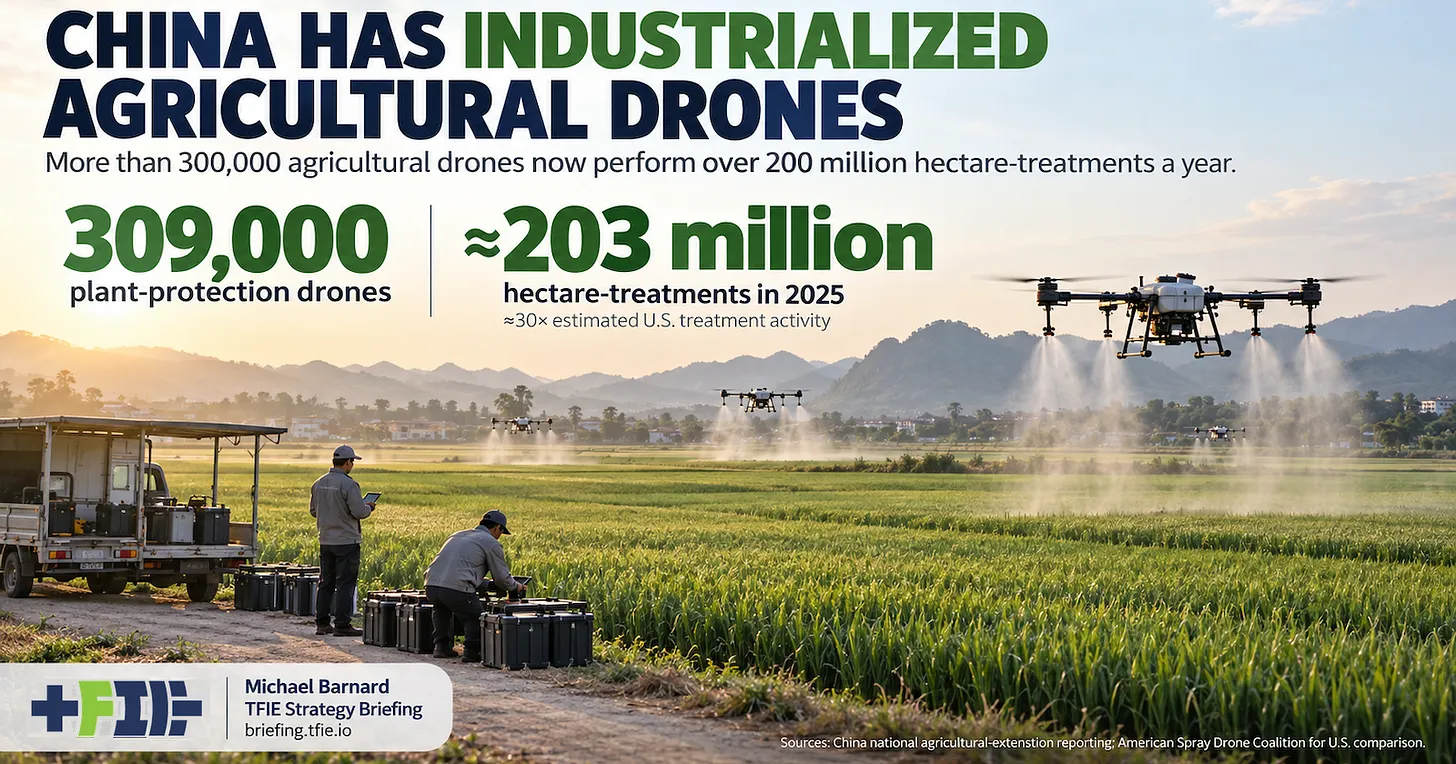
The agricultural sector in China has undergone a profound technological transformation, moving from the experimental phase of robotic aviation to a fully industrialized model of crop management. As of the start of 2026, China’s fleet of plant-protection drones has surged to approximately 309,000 units, facilitating roughly 203 million hectare-treatments over the course of 2025. This scale of deployment marks a shift from early-stage adoption to a complex ecosystem defined by service-level agreements, rigorous maintenance protocols, and standardized operating procedures.
A Rapid Expansion in Scale and Utility
The growth trajectory of China’s agricultural drone industry has been nothing short of exponential. In 2024, the nation reported a fleet of approximately 251,000 drones, which performed 178 million hectare-treatments. Within a single year, the industry added 58,000 new aircraft and increased its operational output by 25 million hectare-treatments. This figure—the "hectare-treatment"—is the industry-standard metric for assessing work volume, accounting for the fact that a single field may receive multiple applications of fertilizer or pesticide throughout a growing season.
The sheer volume of these operations underscores that drones are no longer novelties or supplemental tools; they are now considered essential farm machinery, operating with the same frequency and reliability as tractors or traditional ground-based sprayers. While the initial adoption was driven by the specific needs of China’s diverse topography, including terraced fields and rice paddies where heavy machinery often fails, the current scale suggests a broader systemic integration that transcends regional limitations.
Comparative Analysis: The China-U.S. Divide
In contrast to the Chinese model, the United States presents a different, albeit rapidly evolving, picture. Data from the 2025 American Spray Drone Coalition (ASDC) industry survey indicates that Part 137 operators—the FAA-certified commercial agricultural aircraft operators—performed roughly 16.4 million acres of treatments in 2025. When converted, this equals approximately 6.64 million hectare-treatments.
While the United States and China possess broadly comparable amounts of cultivated land—roughly 133 million hectares in the U.S. versus 128 million in China—the volume of drone-led activity in China is approximately thirty times greater than in the U.S. This massive disparity is not a result of land availability, but rather a reflection of how the technology has been woven into the agricultural value chain.
In the U.S., the agricultural landscape is defined by high-horsepower tractors, self-propelled sprayers, and a mature, traditional aerial application industry using crewed aircraft. Despite this existing infrastructure, the rapid growth in U.S. drone utilization suggests that farmers are identifying specific, high-value niches where drones outperform traditional methods. These niches include treating tall, dense crops that would be damaged by tractor tires, navigating water-logged soil that is inaccessible to ground equipment, and servicing irregular field patches that render large-scale machinery inefficient.
The Technological and Operational Ecosystem
The reason China has achieved such a significant lead is not merely the availability of low-cost hardware. Europe, which also has access to the same advanced drone platforms, has yet to see a similar level of deployment. This suggests that the "hardware-first" perspective is insufficient to explain the divergence in market adoption.
The success of the Chinese model is rooted in the infrastructure built around the aircraft. This includes:
- Specialized Contracting Services: The rise of third-party operators who manage, maintain, and pilot drones for multiple farmers, reducing the barrier to entry for individual landowners.
- Standardized Training: The professionalization of pilot training and the establishment of regulatory frameworks that allow for large-scale operations in rural environments.
- Maintenance and Lifecycle Management: As the fleet ages, China has developed a robust secondary market and service network, ensuring that drones are repaired and upgraded rather than discarded.
These factors allow the Chinese agricultural sector to move beyond the question of "if" drones can be used to "how" they can be optimized. Discussions in the Chinese agricultural tech community now focus on fleet efficiency, data-driven application rates, and the integration of AI for precision crop scouting—topics that signal a mature, industrial-grade market.
Economic and Agronomic Implications
The shift toward drone-based crop management offers several distinct advantages that are driving adoption worldwide. One of the primary drivers is the reduction in soil compaction. Traditional heavy machinery can compress soil, potentially damaging root systems and reducing long-term yield. Drones eliminate the need for equipment to enter the field, preserving the soil structure.
Furthermore, the "on-demand" nature of drone operations allows for highly localized treatments. Instead of blanketing an entire field with pesticides or fertilizers—a common practice when using large ground sprayers—drones can be programmed to target specific, infested areas. This precision reduces the overall volume of chemicals released into the environment, potentially lowering costs for the farmer and mitigating ecological runoff.

However, the rapid growth of this sector also brings new challenges. As fleets expand, regulatory bodies face the difficult task of managing airspace for hundreds of thousands of autonomous systems. In China, this has necessitated the creation of sophisticated traffic management systems that ensure safety without stifling the industry’s pace of innovation.
Future Outlook and Global Competitiveness
As the United States and other Western nations look to scale their own agricultural drone industries, the primary takeaway from the Chinese experience is that hardware is only a component of the equation. Success depends on the creation of a supportive ecosystem—one that encompasses agronomic training, regulatory agility, and, crucially, a business model that makes drone-as-a-service (DaaS) a profitable endeavor for contractors.
The U.S. market is currently in a phase of rapid growth, which, while smaller in absolute terms than China’s, serves as a proof-of-concept that drone technology is not limited by geography or farm size. If the growth of the American market continues at its current rate, it will likely necessitate a shift in how agricultural policy and crop insurance providers view robotic application.
The most significant barrier for countries attempting to replicate the Chinese model may be the speed at which the industry moves. In China, the transition from an emerging technology to a baseline standard took roughly a decade of aggressive investment and operational learning. The "system" that has emerged—a blend of manufacturing, technical support, and widespread contractor adoption—represents a formidable competitive advantage.
Conclusion: A New Era of Farming
The proliferation of over 300,000 plant-protection drones in China is more than a statistic; it is a signal of a global shift in agricultural production. The era of the "all-purpose" large machine is being augmented, and in some cases replaced, by fleets of specialized, autonomous, and data-connected aerial vehicles.
As the technology continues to mature, the focus of the industry will likely shift toward inter-operability, long-term sustainability, and the integration of these drones into broader "smart farm" architectures. For producers in both the East and the West, the question is no longer whether to adopt drone technology, but how to effectively scale it to remain competitive in a landscape where precision and efficiency are increasingly synonymous with profitability. The Chinese experience provides a roadmap for this transition, highlighting that while the technology is global, the industrial infrastructure required to support it must be built locally, intentionally, and at scale.









Leave a Reply