
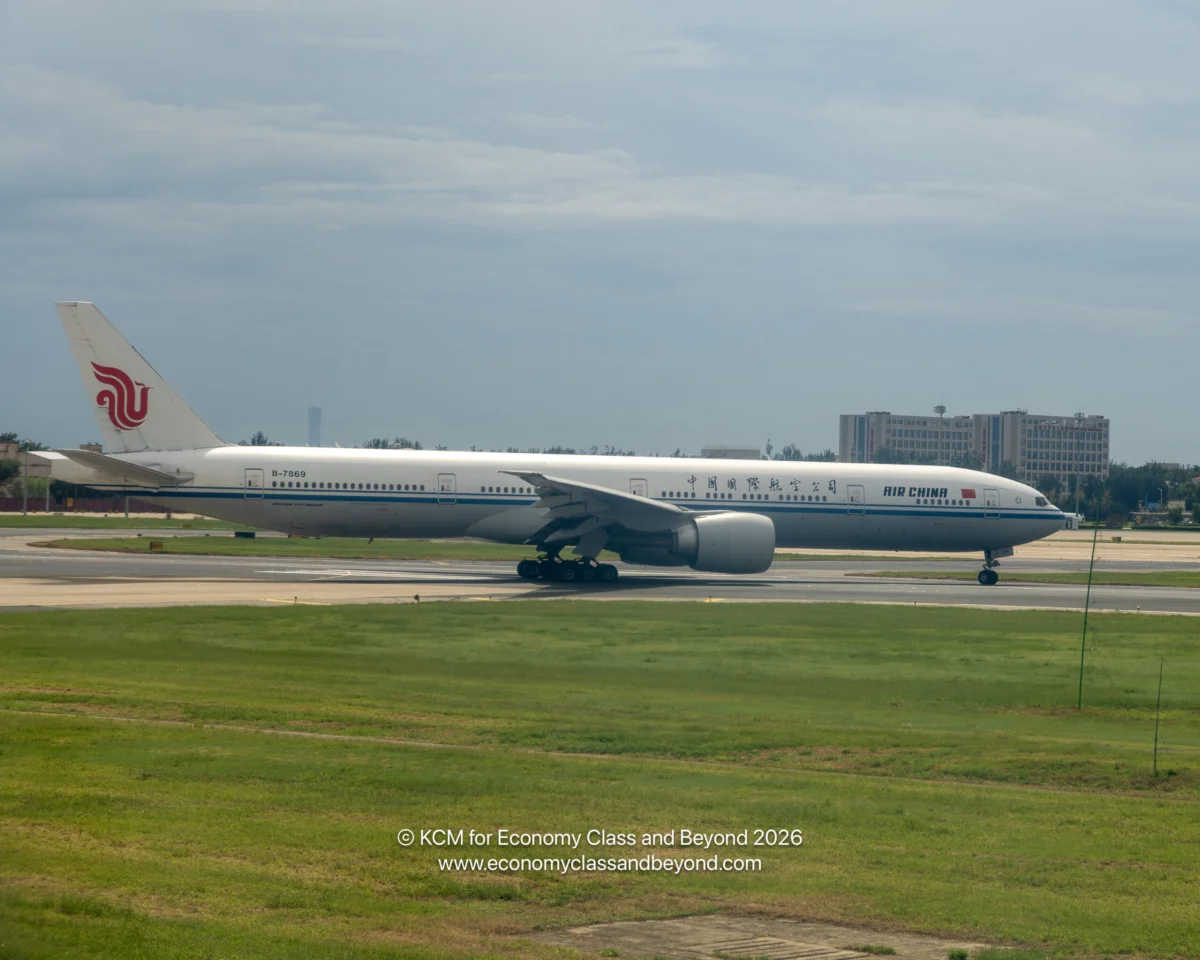
Beijing Capital International Airport remains one of the busiest and most dynamic aviation hubs in the Asia-Pacific region, serving as a critical gateway connecting mainland China to the rest of the world. Amid the constant ballet of heavy widebody jets taxiing across the vast tarmac, the majestic profile of an Air China Boeing 777-300ER recently captured attention as it aligned with the active runway, preparing for yet another long-haul transcontinental journey. This weekly showcase of aviation photography highlights not only the aesthetic grace of modern commercial aircraft but also the complex operational ecosystem that keeps global aviation moving forward.
Main Facts of the Air China Boeing 777-300ER Operation
The aircraft featured in this week’s aviation spotlight is an Air China Boeing 777-300ER bearing the registration code B-79869 (commonly tracked operationally as B-7869). As a cornerstone of the flag carrier’s long-haul fleet, this specific twin-engine widebody exemplifies the modern efficiency required to sustain intercontinental routes. Powered by twin General Electric GE90-115B engines—the world’s most powerful and reliable commercial jet engines—the aircraft is engineered to carry hundreds of passengers and substantial cargo loads across vast oceans and continents with optimal fuel burn and reduced emissions compared to older four-engine predecessors.
Air China utilizes its fleet of 28 Boeing 777-300ER aircraft to anchor its primary international trunk routes. These aircraft are configured to offer multi-class service, typically featuring luxurious first-class suites, comfortable flat-bed business class cabins, and ergonomic economy seating designed for ultra-long-haul comfort. Based primarily out of Beijing Capital International Airport (PEK), B-79869 is a veteran workhorse of the airline’s schedule, regularly servicing major global economic centers such as Moscow-Sheremetyevo, Rome-Fiumicino, Toronto-Pearson, and high-demand domestic connectors like Shenzhen.
Chronology and Aircraft Lifecycle
Understanding the operational journey of airframe B-79869 provides insight into the rigorous lifecycle management required by major international carriers.
November 2016: The airframe rolled off the Boeing assembly lines in Everett, Washington, and was formally delivered to Air China, entering active commercial service during a period of significant international route expansion for the airline.
2016 through 2020: The aircraft maintained a high-utilization schedule, plying key routes across Europe, North America, and Asia, proving its reliability across diverse weather patterns and varying operational environments.
2020 through 2022: Like the rest of the global aviation fleet, B-79869 navigated the unprecedented disruptions and shifting border restrictions brought on by the global health crisis, occasionally being repurposed for cargo-only flights or reduced-frequency passenger operations to maintain vital global supply chains.
2023 to Present: Following the full reopening of international borders and the resurgence of global travel demand, the aircraft returned to a robust, full-time international flying schedule, connecting Beijing to vital global capitals and financial hubs. Nearing its tenth year of continuous service, the airframe remains in pristine operational condition, undergoing routine heavy maintenance checks in accordance with civil aviation regulatory standards.

Supporting Data: Air China Widebody Fleet Dynamics
Air China maintains a diverse and modern widebody fleet designed to optimize capacity and range flexibility across its expansive global network. The airline strategically deploys a mix of twin-engine and legacy aircraft to balance high-density trunk routes with thinner, point-to-point international services.
The current widebody inventory of Air China includes:
- Boeing 777-300ER: 28 aircraft, serving as the backbone for high-capacity long-haul missions.
- Airbus A330-200 and A330-300: Providing versatile mid-to-long-range capacity across Asian and regional markets.
- Airbus A350-900: Representing the modern generation of fuel-efficient composite aircraft for ultra-long-haul European and North American routes.
- Boeing 787-9 Dreamliner: Utilizing advanced aerodynamics and passenger-comfort features for mid-to-long-haul operations.
- Boeing 747-400 and Boeing 747-8i: Iconic jumbo jets occasionally deployed on high-density VIP, domestic, and flagship international routes.
This diverse fleet mix allows Air China to dynamically adjust capacity based on seasonal demand fluctuations, yield management strategies, and bilateral aviation agreements between China and foreign regulatory bodies.
Operational Insights from Beijing Capital International Airport
Beijing Capital International Airport (PEK), historically the primary aviation hub for China’s capital city, operates under immense logistical coordination. Even with the subsequent opening of the mega-sized Beijing Daxing International Airport (PKX), Capital Airport continues to handle massive volumes of international and domestic traffic.
The choreography required to move an aircraft like the Boeing 777-300ER from its gate position to the active departure runway involves close synchronization between flight deck crews, ground handlers, ramp controllers, and Air Traffic Control (ATC). For a heavy aircraft weighing upwards of 350 metric tons at maximum takeoff weight, pushback clearance, taxiway routing, and engine run-up procedures demand absolute precision. Pilots must calculate precise takeoff performance data—taking into account temperature, runway length, wind velocity, and total payload—to ensure safe rotation and climb gradients.
Broader Impact and Industry Implications
The continuous operation of flagships like the Boeing 777-300ER underscores the ongoing recovery and resilience of the international aviation sector. As airlines balance the imperative to modernize fleets with environmental sustainability goals, the role of reliable twin-engine widebodies remains paramount. While newer aircraft types such as the Boeing 777X and Airbus A350-1000 gradually enter the global marketplace, the current generation of 777-300ERs continues to shoulder the heavy lifting of global connectivity.
For passengers, the aircraft represents the familiar comfort of modern long-haul travel, offering dependable schedules and high-capacity transport that drives international trade, tourism, and diplomatic exchange. As B-79869 and its sister ships taxi past the terminals of Beijing Capital Airport day after day, they embody the enduring spirit of global mobility—bridging continents and bringing distant cultures closer together one flight at a time.









Leave a Reply