
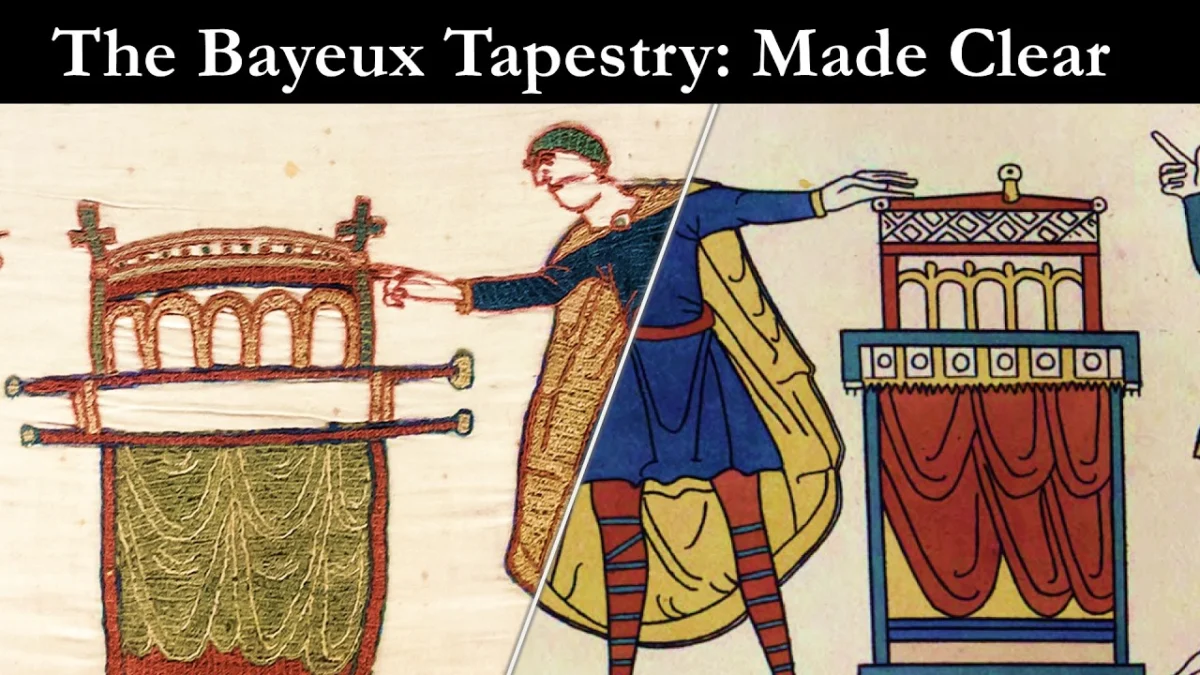
As visitors flock to the British Museum to witness one of the most celebrated artifacts of the medieval world, a new digital presentation offers an unprecedented look into the narrative woven over nine centuries ago. Titled Deep Down History, a newly released immersive video presentation delivers a comprehensive, scroll-like exploration of the Bayeux Tapestry, transforming the famous 70-meter embroidered cloth into a continuous, dynamic visual chronicle. Capitalizing on early color reproductions by nineteenth-century illustrator Charles Stothard, the project presents the historic artifact as an uninterrupted narrative scroll for the very first time, allowing modern audiences to trace the dramatic events of the Norman Conquest of England in 1066 from its origins to the decisive Battle of Hastings.
The Bayeux Tapestry has long captivated historians, artists, and the general public alike. Far more than a static military banner or a simple decorative hanging, the artifact functions as an elaborate visual chronicle detailing the complex political tensions, shifting loyalties, and fateful decisions that reshaped the British Isles and Western Europe. By leveraging modern digital presentation techniques alongside historical scholarship, the latest deep-dive video aims to bridge the gap between academic medieval studies and contemporary digital storytelling.
Unraveling the Narrative: From Edward the Confessor to the Battle of Hastings
The visual narrative captured within the embroidery begins well before the clash of armies on the battlefield, setting the stage in the waning days of Anglo-Saxon England. The story opens at the court of King Edward the Confessor, a monarch whose lack of a direct heir created a precarious power vacuum that left the English crown vulnerable to competing claims.
Viewers of the new digital scroll follow the fateful journey of Harold Godwinson, the powerful Earl of Wessex, as he travels across the English Channel to Normandy. According to the Norman perspective embedded within the tapestry’s design, Harold’s mission involved swearing a solemn oath of fealty to Duke William of Normandy, promising to support William’s claim to the English throne. However, the narrative swiftly turns toward conflict when King Edward dies in January 1066. Despite his prior oath—or perhaps because of the shifting political winds in Winchester—Harold Godwinson accepts the crown and is consecrated as King of England.
Upon learning of Harold’s coronation, Duke William regards the act as a grievous betrayal and an illegal usurpation of power. The tapestry meticulously documents the monumental logistical preparations undertaken across Normandy, depicting the mass felling of trees, the construction of an invasion fleet, the gathering of provisions, and the mobilization of thousands of troops and warhorses. The journey culminates in the invasion of England, the landing at Pevensey, and the harrowing combat of the Battle of Hastings on October 14, 1066, which resulted in the death of King Harold and the triumphant rise of William the Conqueror.
Beyond Politics: Hidden Details, Humor, and Medieval Subtext
While the overarching political narrative of the Norman Conquest forms the spine of the Bayeux Tapestry, historians emphasize that the true richness of the artifact lies in its margins and minute details. The embroidery is densely populated with intricate borders featuring Aesop’s fables, agricultural scenes, mythological beasts, hunting motifs, and cryptic visual puns that offer a rare window into eleventh-century daily life.
Scholars analyzing the digital reproduction note that the tapestry operates on multiple levels simultaneously. Alongside the grand historical propaganda designed to justify William’s invasion to contemporary and future audiences, the embroiderers embedded subtle humor, clever visual commentary, and sharp moral warnings. The prominent depiction of Harold Godwinson’s broken oath serves as a central thematic anchor, acting as a medieval cautionary tale regarding the severe consequences of oath-breaking in a deeply pious and feudal society. Furthermore, technical aspects of the embroidery—such as the specific use of laid and couched work, stem stitch, and authentic vegetable-dyed wool yarns—reveal the sophisticated textile artistry of high medieval workshops, which many researchers believe were located in Anglo-Saxon England rather than Normandy.
A Technological Milestone: Preserving and Presenting Stothard’s Work
The decision to base the new immersive video on the early color reproductions of Charles Stothard marks a significant methodological choice in the presentation of the artifact. Stothard, an accomplished nineteenth-century English antiquary and artist, undertook the painstaking task of recording the tapestry in color before modern restoration efforts altered parts of the original wool work. By translating Stothard’s historical documentation into a seamless, scrolling digital format, the creators of Deep Down History offer viewers a perspective that bridges the gap between early modern antiquarian research and twenty-first-century digital media.
This release arrives at a time of heightened public interest, coinciding with the high-profile exhibition of the Bayeux Tapestry materials at the British Museum. Over the past decade, technological advancements have radically transformed how scholars and enthusiasts interact with the artifact. High-resolution digitization projects have previously allowed users to zoom in to the level of the individual wool thread, revealing the physical texture and aging process of the linen foundation and colored embroidery. Online construction apps have even enabled amateurs to design their own custom panels in the distinct style of the eleventh-century masterpiece. The new video builds upon these digital milestones by re-establishing the linear momentum of the original scroll, allowing audiences to experience the narrative precisely as its medieval creators intended it to be read: as a continuous, unfolding sequence of events.
Broader Impact and Educational Implications
The release of this immersive exploration holds substantial value for educational institutions and the broader public understanding of medieval history. As history curricula increasingly incorporate digital humanities and multimedia resources, tools that present complex historical sources in accessible, visually engaging formats are proving indispensable. Educators note that students who might struggle to engage with dense academic texts often find deep historical resonance through the vivid storytelling, character motivations, and dramatic visual tension embedded within the tapestry.
Moreover, the digital presentation underscores ongoing academic debates surrounding the creation and provenance of the artifact. Commissioned likely by Bishop Odo of Bayeux, the half-brother of William the Conqueror, the tapestry remains a subject of intense scholarly inquiry regarding its exact place of origin, the identity of its designers and makers, and the degree of artistic freedom granted to the anonymous embroiderers—traditionally believed to be Anglo-Saxon women renowned across Europe for their exceptional needlework (opus anglicanum).
As the physical artifact and its digital iterations continue to draw millions of viewers worldwide, projects like Deep Down History ensure that the intricate threads of 1066 remain vibrant, relevant, and accessible to modern generations. By marrying nineteenth-century antiquarian documentation with cutting-edge digital curation, the presentation breathes new life into a 900-year-old masterpiece, reaffirming its status as an enduring cornerstone of European cultural heritage.








Leave a Reply