
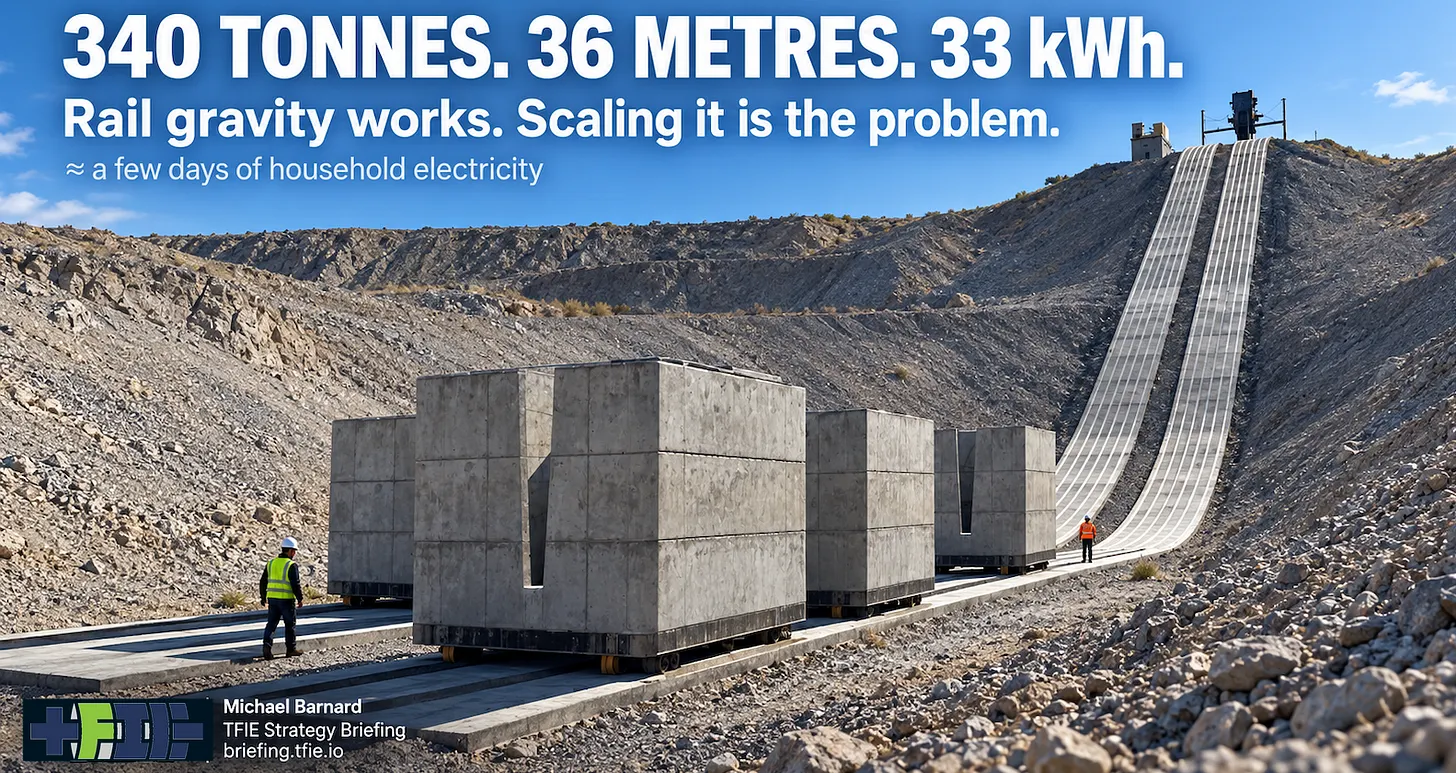
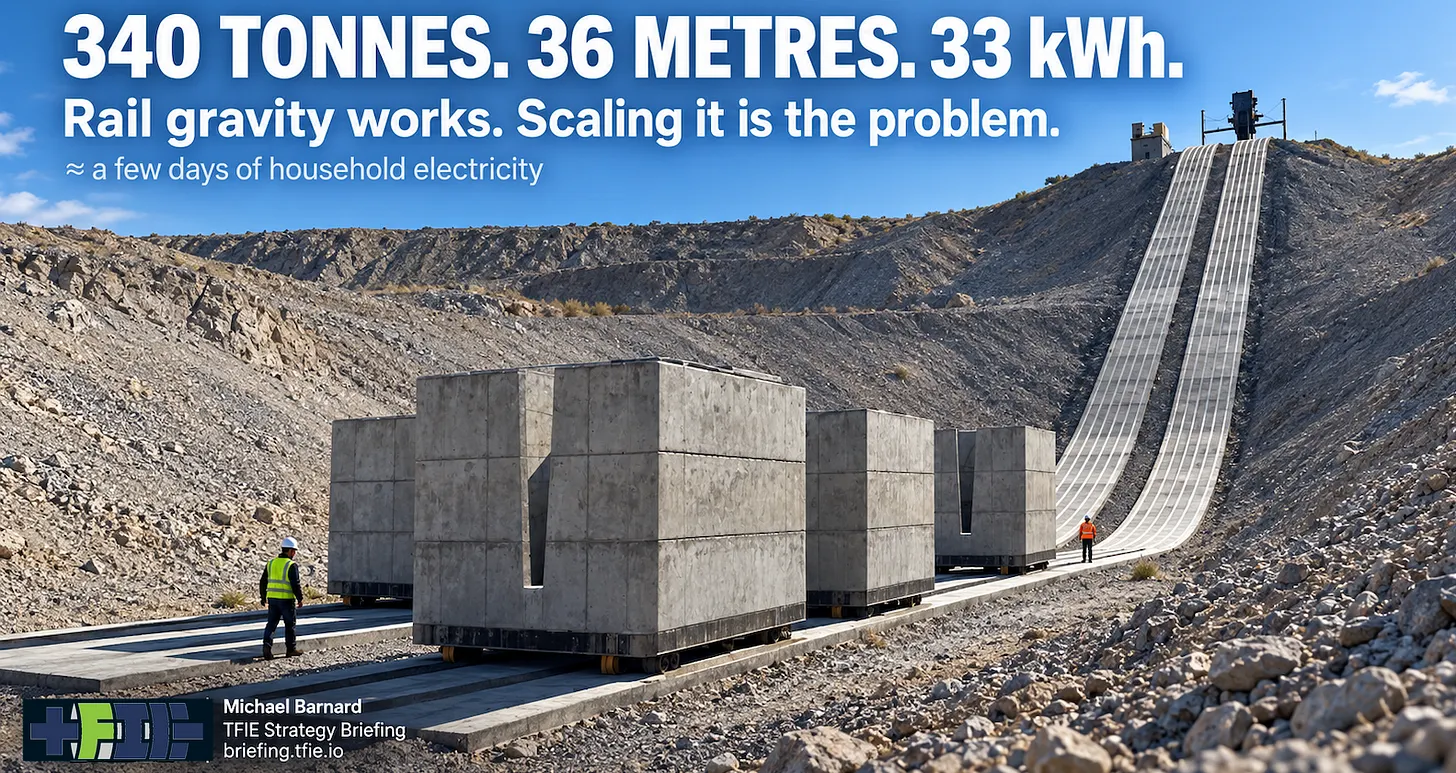
Recent operational data from the ARES North America demonstration at the Gamebird Pit in Nevada has provided a definitive look at the performance metrics of rail-based gravity energy storage. While the system successfully verified the mechanical feasibility of moving heavy masses up and down an incline to generate and store electricity, the results underscore the significant physical and economic hurdles inherent in this storage architecture. According to documentation from Sandia National Laboratories, the system moved a pair of mass cars—weighing approximately 340 tonnes—through an elevation change of about 36 metres. Despite the immense weight of the equipment, the total gross stored energy amounted to only 33 kilowatt-hours (kWh).
This demonstration has reignited a broader industry debate regarding the efficiency and scalability of mechanical gravity storage compared to established, high-density alternatives like lithium-ion batteries and closed-loop pumped hydroelectric storage.
The Physics of Mechanical Energy Storage
The fundamental limitation of solid-mass gravity storage lies in the basic principles of gravitational potential energy: energy storage is the product of mass, gravity, and height. To achieve meaningful utility-scale storage, one must either move massive amounts of material over significant vertical distances or create systems of immense scale.
The Gamebird Pit demonstration utilized a 55% grade slope, with a stationary motor and chain-drive mechanism providing the power to move the 340-tonne load. While the system is capable of producing several megawatts of power for short bursts—as power is defined as energy delivered per unit of time—the total energy capacity remains constrained by the limited elevation change of only 36 metres. For grid-level applications requiring hundreds of megawatt-hours (MWh) of capacity, this physics-based constraint necessitates a footprint and an inventory of heavy machinery that grows exponentially with the desired output duration.
Chronology and Project Context
The ARES (Advanced Rail Energy Storage) concept has been under development for over a decade, aiming to provide a mechanical alternative to electrochemical batteries. The transition from theoretical white papers to physical field demonstrations has been a long-term goal for the company.
- 2010s: ARES begins conceptual development of rail-based gravity storage, seeking to leverage industrial-grade mining equipment for energy arbitrage.
- 2024: Industry analysts and energy experts begin publishing critical assessments regarding the low energy density of solid-mass systems, contrasting them with the plummeting costs of lithium-ion technology.
- 2026 (January): Sandia National Laboratories releases technical documentation detailing the performance of the Gamebird Pit demonstration in Nevada.
- 2026 (Mid-Year): Industry stakeholders begin evaluating the commercial viability of the system, noting that the machinery required for long-duration storage may outweigh the economic benefits of the cheap "ballast" (the rock or concrete-filled cars) used to store the energy.
Comparative Analysis of Energy Storage Architectures
To understand the position of rail gravity storage in the modern energy mix, it is necessary to compare its material-handling requirements with other prominent storage technologies.
Closed-Loop Pumped Hydroelectric Storage (PHS)
Pumped hydro utilizes the same gravitational physics as rail-based systems but operates with a significantly more efficient architecture. Water acts as the working fluid, requiring no individual chassis, bearings, or mechanical maintenance for each increment of mass. Once the reservoirs and conduits are constructed, the system provides a robust, long-duration storage solution that is not hampered by the mechanical complexity of thousands of moving parts.
Lithium-Ion Battery Systems
Lithium-ion technology operates on a different paradigm: manufacturing is centralized in permanent, high-output factories. Developers receive standardized, modular battery packs that can be deployed rapidly. This eliminates the need for project-specific heavy-equipment manufacturing at every site. Furthermore, as seen in the 2026 long-duration procurement auctions in the United Kingdom, battery systems are increasingly capable of meeting the multi-hour duration requirements that were previously considered the exclusive domain of mechanical systems.
The "Machinery-to-Energy" Ratio
The primary criticism of rail-based storage is the requirement for a massive, custom-built industrial plant to service the gravity storage site. To store 400 MWh of energy—a requirement for a 20 MW plant operating for 20 hours—the system would require moving hundreds of thousands of tonnes of material.
If one scales the elevation to a more effective 400 metres to improve energy density, the logistical requirement remains staggering. Each mass carrier must be built, maintained, and marshaled. Because these systems are mechanical, the failure of a single segment of the track, a motor, or a chain-drive mechanism can render the entire stored energy inventory inaccessible. Unlike a reservoir of water or a field of battery modules, the "energy" in a rail system is tied directly to the health and status of the rolling stock.
Environmental and Economic Implications
A significant factor in the evaluation of any energy storage system is its embodied carbon. The production of the steel, Portland cement, and high-strength industrial components required to build a rail-based gravity plant is energy-intensive.

Experts point out that while the rock or ballast being moved is low-carbon, the machinery required to move it is not. A life-cycle analysis suggests that constructing a dedicated rail system, including the necessary grading, trackage, and heavy-duty winches, results in a significant "carbon debt." When compared to the standardized, high-density manufacturing of modern battery arrays or the civil engineering efficiency of pumped hydro, rail-based storage struggles to present a compelling case as a primary climate solution.
Official Perspectives and Future Outlook
While ARES North America has demonstrated that their drive systems can successfully navigate steep industrial inclines, the commercial viability remains the central point of contention. The U.S. Department of Energy (DOE) and national laboratories like Sandia have historically supported research into a diverse portfolio of storage technologies to ensure grid resilience. However, the data from Gamebird indicates that the mechanical hurdles are not merely engineering challenges to be solved, but fundamental scaling limitations.
The conclusion drawn by many energy analysts is that rail gravity storage occupies a difficult niche. It suffers from the geographic dependence characteristic of pumped hydro—requiring specific topography and large land areas—while simultaneously bearing the maintenance and manufacturing burdens of heavy industrial machinery.
As the energy storage market matures, the bar for new technologies continues to rise. With battery costs continuing to decline and the operational duration of electrochemical systems increasing, the "mechanical alternative" must demonstrate not just that it can work, but that it can do so at a cost, speed, and carbon intensity that beats the existing, rapidly evolving competition. For now, the Gamebird Pit demonstration serves as a definitive case study in the unforgiving physics of mass and gravity, highlighting that in the energy sector, simplicity and density are often the most valuable assets.
The industry continues to watch for whether ARES can pivot its technology toward applications where the scale of infrastructure is minimized or where specific site conditions—such as existing mining operations—provide a unique, cost-offsetting advantage. Until then, the project stands as a reminder of the distinction between technical feasibility and commercial viability in the global transition to renewable energy.







Leave a Reply