Candidates championed by former President Donald Trump achieved a decisive sweep in their Republican primaries across Arizona on Tuesday, underscoring the enduring power of his endorsement within the Grand Canyon State’s GOP. While the Republican field solidified, the Democratic primary for a crucial Phoenix-area battleground House race remained too close to call into the early hours of Wednesday morning, signaling a contentious general election season ahead. These results set the stage for a series of high-stakes contests in November that will not only shape Arizona’s political landscape but could also prove instrumental in determining control of the U.S. House of Representatives.
The Enduring Force of Trump’s Endorsement in Arizona GOP
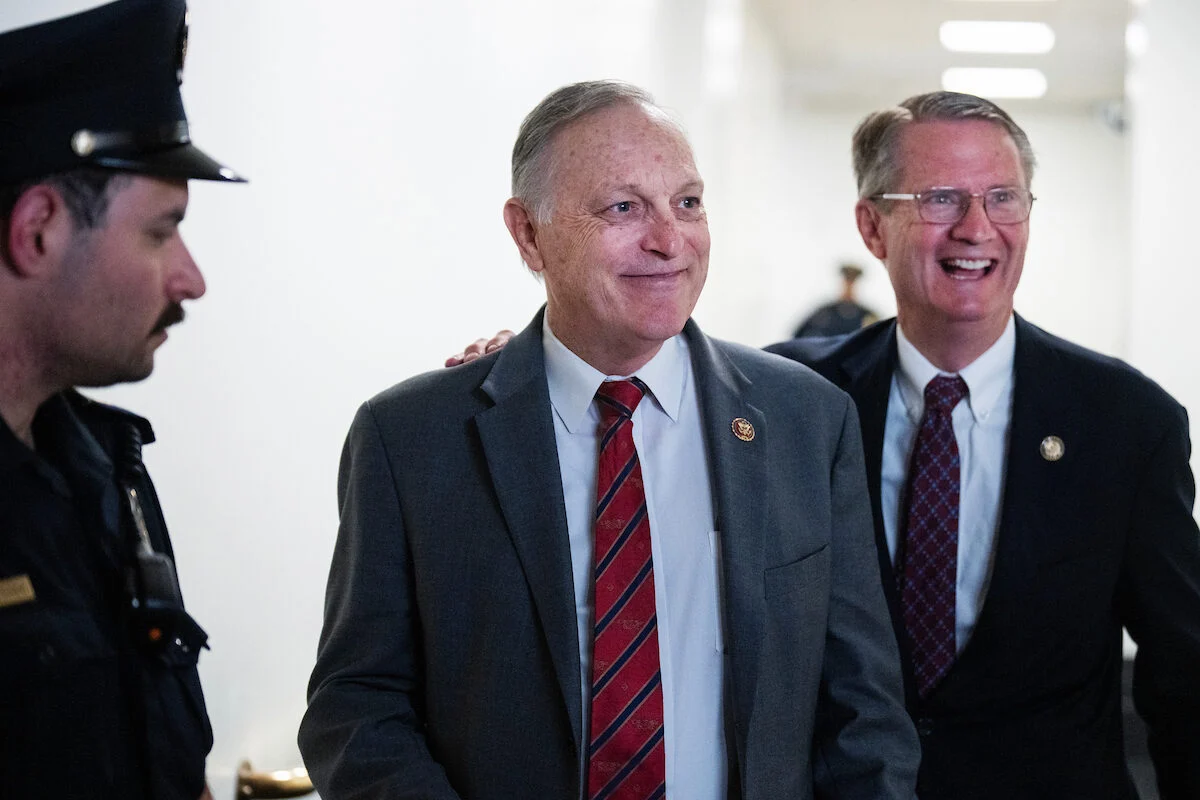
The Republican gubernatorial primary to challenge incumbent Democratic Governor Katie Hobbs saw voters overwhelmingly back Rep. Andy Biggs, a staunch anti-establishment conservative and former formidable chair of the hard-line House Freedom Caucus. With approximately 75 percent of the precincts reporting, Biggs commanded a dominant lead, securing 73 percent of the vote in a four-way field, according to The Associated Press. His closest rival, Rep. David Schweikert, lagged significantly behind with only 15 percent. Biggs’ victory was not merely a win but a resounding affirmation of a conservative, America First agenda within the state’s Republican party, a testament to his alignment with former President Trump’s political philosophy. Governor Hobbs, meanwhile, faced no opposition for the Democratic nomination, allowing her to conserve resources and focus on the impending general election battle against Biggs.
Biggs’ successful gubernatorial bid means he will vacate his seat in Arizona’s 5th Congressional District, a deep-red suburban stronghold located southeast of Phoenix. This created another opportunity for a Trump-backed candidate to emerge victorious. In the Republican primary for AZ-05, Mark Lamb, a former Pinal County sheriff, triumphed over homebuilder Daniel Keenan. Lamb’s win, however, was not without significant controversy, casting a shadow over what would otherwise be a straightforward path in a district that former President Trump carried by a substantial 20 points in 2024.
Controversy and Victory: The 5th District’s Tumultuous Primary
Mark Lamb’s primary campaign for the 5th Congressional District was embroiled in scandal during its final weeks. An investigation by The Arizona Republic newspaper unearthed serious allegations, claiming Lamb had used threats to suppress accusations of sexting and had shared homophobic and racist texts. These revelations sparked widespread concern and drew criticism from various quarters. Despite the gravity of the allegations, which Lamb vehemently dismissed as "lies" and politically motivated attacks, his base of support held firm. With 75 percent of the vote tallied, Lamb led Keenan with 59 percent to 41 percent, ultimately securing the nomination.
Lamb’s victory in the primary sets up a general election contest against Democrat Elizabeth Lee, a progressive candidate who successfully navigated a three-way primary herself. While the 5th District’s strong Republican lean (Trump’s 20-point margin in 2024) makes it a challenging target for Democrats, the controversies surrounding Lamb could potentially energize Democratic voters and create an unexpected dynamic in a district traditionally considered safe for the GOP. Observers note that while the district’s demographics heavily favor a Republican, a tarnished candidate could face headwinds, particularly if the allegations continue to garner media attention and sway independent voters. The general election campaign will undoubtedly see Democrats attempting to capitalize on these controversies, while Lamb will likely focus on his conservative credentials and national issues.
The Pivotal 1st Congressional District: A Battleground Emerges
The race to succeed Rep. David Schweikert in Arizona’s 1st Congressional District stands out as one of the most closely watched contests in the state, deemed pivotal to the Democratic Party’s aspirations of flipping the House majority in the upcoming fall elections. This battleground seat, situated northeast of Phoenix, reflects the shifting political landscape of Arizona, where suburban voters often determine the outcomes of statewide and congressional races.
On the Republican side, retired NFL kicker and sports commentator Jay Feely emerged victorious, defeating two opponents to claim the GOP nomination. With 76 percent of the vote counted, Feely garnered just under 50 percent, surpassing former state Rep. Joseph Chaplik, who secured 35 percent, and technology executive John Trobough, who finished with 15 percent. Feely’s political trajectory saw an interesting pivot; he initially launched a campaign to succeed Andy Biggs in the 5th District but, with the explicit encouragement of former President Trump, shifted his focus to Schweikert’s seat in December. Trump’s backing undoubtedly provided a significant boost to Feely’s campaign, demonstrating the former president’s strategic involvement in shaping Republican primary outcomes. Feely’s name recognition from his sports career, combined with his conservative platform and Trump’s endorsement, proved a winning combination for the Republican nomination.
However, the Democratic primary in AZ-01 proved far more contentious and remained uncalled as of 5 a.m. Eastern time on Wednesday. This tight contest pitted former state Rep. Amish Shah, who was the 2024 Democratic nominee and lost to Schweikert by a mere 4 points, against former broadcast journalist Marlene Galán-Woods and two other candidates. With 77 percent of the vote in, Shah held a narrow lead, reflecting a deeply divided primary electorate.
The Democratic primary for AZ-01 was marked by significant external intervention and internal party friction. Marlene Galán-Woods received substantial backing from the Democratic Congressional Campaign Committee (DCCC), the House Democrats’ campaign arm, which also poured considerable financial resources into her campaign. This decision by the DCCC to pick sides in a primary race drew sharp criticism from Shah and other prominent Arizona Democrats, including Rep. Adelita Grijalva. Critics argued that such intervention undermines the democratic process within the party and favors establishment-preferred candidates over grassroots contenders. Galán-Woods, a former Republican herself, also garnered support from Arizona Senator Mark Kelly, the campaign arm of the Congressional Hispanic Caucus, and EMILY’s List, a powerful organization dedicated to electing pro-choice Democratic women. Her late husband, Grant Woods, served two terms as Arizona attorney general, adding a layer of established political legacy to her campaign.
Conversely, Amish Shah assembled a diverse coalition of support, boasting endorsements from a host of current and former state legislators. Notably, Shah received the backing of former state House Speaker Rusty Bowers, a Republican who gained national recognition for his steadfast refusal to succumb to pressure from former President Trump and his allies in 2020 to overturn Joe Biden’s victory in Arizona. Bowers’ endorsement of Shah, a Democrat, was a powerful symbolic statement, emphasizing integrity and democratic principles over partisan lines, and likely resonated with voters concerned about the future of democratic institutions. Like Shah, Galán-Woods was also making a repeat run for the 1st District, having finished third in the 2024 Democratic primary, highlighting the persistent ambition and investment in this critical district. Inside Elections with Nathan L. Gonzales, a respected non-partisan handicapper, rates the general election race for the 1st District as a "Toss-up," underscoring its pivotal role in the national battle for House control.
Other Key Congressional Contests Across Arizona
Beyond the high-profile gubernatorial and 1st District races, several other congressional primaries and general election matchups were solidified across Arizona, each carrying its own significance for the state’s political landscape and the national balance of power.
In the blue-leaning 4th District, anchored in Tempe, a vibrant suburban city in the Phoenix metropolitan area, Democratic Rep. Greg Stanton successfully fended off a challenge from his left flank. Stanton’s victory bucked a trend seen in other states, where several House colleagues faced upset defeats in primaries from more progressive challengers in New York and Colorado last month. With 77 percent of the vote reported, Stanton, a former Phoenix mayor with a strong local political base, led progressive organizer Kai Newkirk by a significant margin of 77 percent to 33 percent, according to the AP. This outcome demonstrates Stanton’s ability to maintain broad support within his district’s Democratic electorate despite national pressures from the progressive wing of the party. He will now advance to face physician and Navy veteran Zuhdi Jasser, who ran unopposed for the Republican nomination, in a district that is expected to remain Democratic in the general election.
November matchups were also determined earlier in two other competitive Arizona races, where the major-party candidates ran unopposed in their respective primaries, allowing them to focus solely on the general election campaign. In the 6th District, covering the state’s southeastern corner, Rep. Juan Ciscomani, considered one of the chamber’s most vulnerable Republicans, will face Democratic Marine veteran JoAnna Mendoza. Ciscomani, a freshman representative, secured his seat in a tight contest in 2024, and his district remains a prime target for Democrats looking to expand their majority. Inside Elections also rates this race as a "Toss-up," indicating another fiercely contested battleground.
Finally, in the sprawling 2nd District, which encompasses northeastern and central Arizona and the exurbs of Phoenix and Tucson, Republican Rep. Eli Crane will face a rematch with Democrat Jonathan Nez, the former Navajo Nation president. Crane had defeated Nez by a 9-point margin in 2024, and the district is largely considered more favorable to Republicans. Inside Elections rates this contest as "Likely Republican," suggesting Crane has a strong advantage, but Nez’s established profile and strong ties within the Native American community could still make for a competitive race.
Broader Implications for Arizona and National Politics
The Arizona primary results offer a clear snapshot of the state’s complex and often contradictory political identity. The decisive victories of Trump-backed candidates in the Republican primaries underscore the former president’s continued, formidable influence over the GOP base, signaling that his populist, anti-establishment message remains a potent force. This trend could prove both an asset and a liability for Republicans in the general election. While it energizes the party’s core, it may alienate crucial independent and moderate suburban voters who have increasingly become swing factors in Arizona’s statewide elections. The state’s status as a perennial swing state, pivotal in presidential elections and down-ballot contests alike, means that candidate quality and campaign messaging will be scrutinized even more intensely.
For Democrats, the internal divisions highlighted by the DCCC’s intervention in the 1st District primary raise questions about party unity and strategy moving forward. While the DCCC’s aim is to back candidates deemed most electable, such actions can foster resentment and disengagement among segments of the party, potentially hindering efforts to coalesce support behind a single nominee. The general election will demand a united front, particularly in "Toss-up" districts where every vote will count.
Looking ahead to November, Arizona is poised to be one of the most significant battlegrounds in the nation. The gubernatorial race will test the strength of the state’s Democratic incumbent against a formidable conservative challenger. Meanwhile, the congressional races, particularly in AZ-01 and AZ-06, will play a critical role in the broader national struggle for control of the U.S. House. The outcomes in these races will reflect not only local dynamics and candidate appeal but also national political currents, voter enthusiasm, and the ever-evolving demographic shifts within Arizona. The primary elections have set the stage; the general election will now determine the political trajectory of this crucial Western state.