
The study, published in Nature Astronomy, synthesizes years of multi-wavelength observations from a global network of telescopes spanning the United States, Australia, India, and South Africa, alongside space-based assets. By analyzing tidal disruption events (TDEs), the researchers have effectively "sped up" the cosmic clock, allowing them to observe the life cycles of supermassive black holes in a matter of years rather than the millennia typically required to witness significant astrophysical shifts.
The Mechanism of Cosmic Destruction and Creation
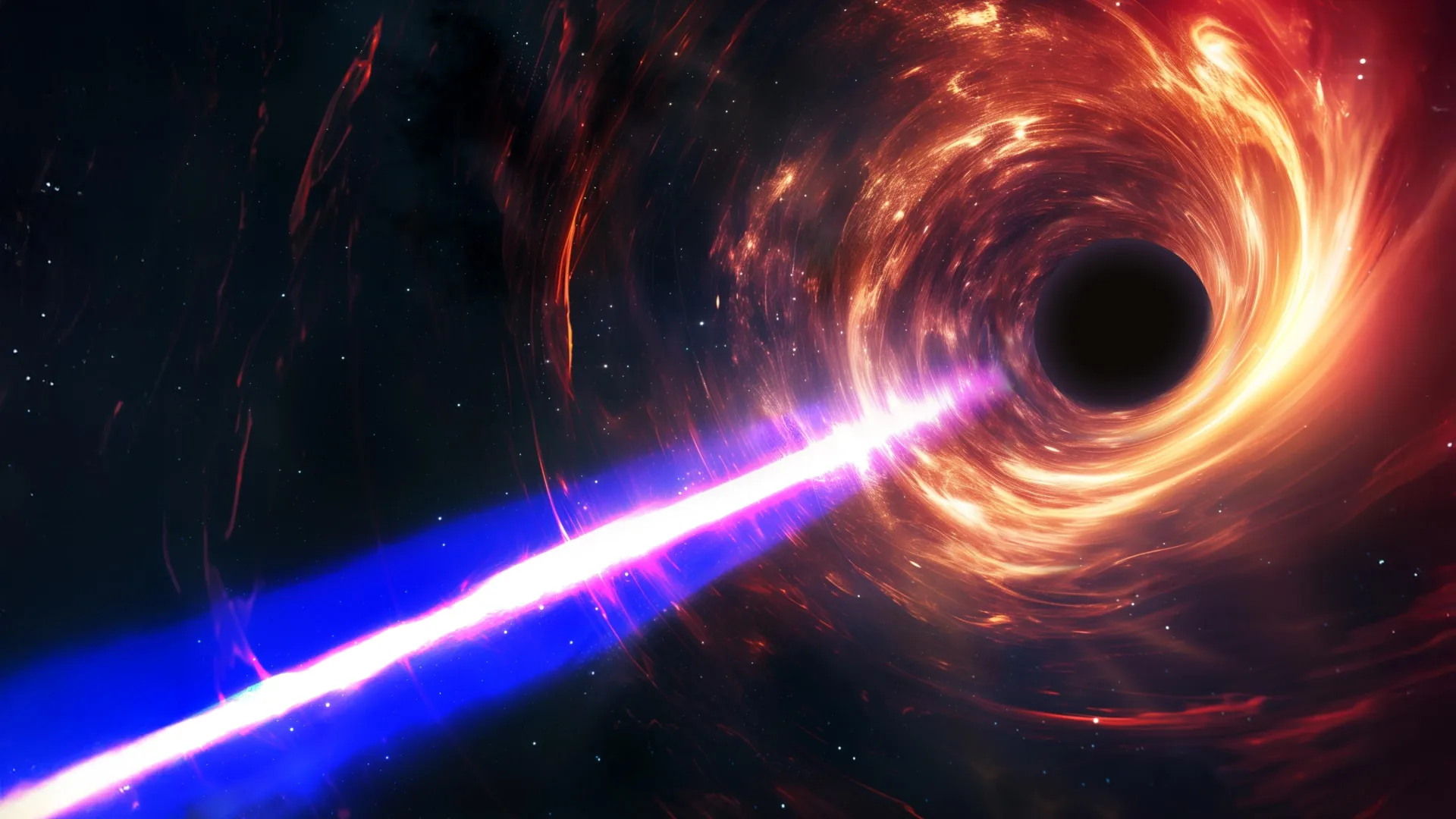
Tidal disruption events occur when a star drifts too close to the event horizon of a supermassive black hole. The sheer magnitude of the gravitational gradient—the difference in pull between the side of the star facing the black hole and the side facing away—teaches us that space is not merely empty. It is a dynamic, violent theater. As the black hole shreds the star, the resulting debris does not simply vanish into the abyss; much of it forms a swirling accretion disk.
Contrary to the popular analogy of the black hole as a "cosmic vacuum cleaner," the reality is far more chaotic. A significant portion of the stellar material is violently ejected back into the interstellar medium through powerful, collimated outflows known as jets. These jets can extend across thousands of light-years, transporting energy and matter that fundamentally shape the evolution of their host galaxies.
The core of the research team’s inquiry focused on a long-standing mystery in high-energy astrophysics: the inconsistent timing of these eruptions. While some black holes initiate radio-loud jets immediately following the destruction of a star, others remain dormant for months or even years, only to suddenly "fire up" without warning. Mummery and Goodwin’s collaboration, which reportedly began as a casual discussion during an astrophysics conference in Madrid, led to the hypothesis that the same "critical accretion" rules observed in smaller stellar-mass black holes might govern their gargantuan counterparts.
Chronology and Methodology: Deciphering the Accretion Rate
To test this hypothesis, the researchers compiled data from twenty separate TDEs. They filtered these events, selecting ten high-quality datasets where they could precisely correlate the black hole’s mass-feeding rate with the timing of its radio emissions. The researchers analyzed the behavior of these objects across the electromagnetic spectrum, utilizing optical, ultraviolet, X-ray, and radio data to map the lifecycle of the post-disruption activity.
Their analysis identified two distinct phases of jet production. The first phase occurs during the immediate aftermath of the disruption, characterized by an exceptionally high consumption rate. However, the more intriguing discovery lies in the second phase, which occurs between hundreds and thousands of days post-disruption. The data revealed that this delayed jet formation consistently triggers when the black hole’s accretion rate drops to approximately two percent of its "Eddington limit."
The Eddington limit is the theoretical tipping point where the outward pressure of radiation generated by the black hole’s heat balances the inward gravitational collapse of the surrounding material. For decades, it has been known that stellar-mass black holes within our own Milky Way galaxy undergo state transitions at this precise two-percent threshold. The fact that supermassive black holes follow the same rule suggests a scale-invariant physical law, implying that the fundamental mechanics of accretion-driven jet production are universal.
The Scientific Significance of the Two-Percent Threshold
The identification of this two-percent threshold is a landmark finding in the field of galactic evolution. It suggests that despite the vast differences in mass—ranging from ten solar masses to several billion—the physics of the immediate environment surrounding the event horizon is governed by the same fluid dynamics and electromagnetic principles.
"We really wanted to figure out this massive puzzle," noted Mummery. "Why do some supermassive black holes blast out radio jets right after shredding a star, while others just sit there looking completely dormant, only to suddenly fire up their jets months or even years later?"
The discovery provides a standardized framework for future observations. By understanding that jet formation is a function of the accretion rate relative to the Eddington limit, astronomers can now shift from reactive to proactive monitoring. This has profound implications for the efficiency of modern astronomy. Major observatories, such as the upcoming Square Kilometre Array (SKA), require precise targeting to justify the immense cost and time associated with deep-space observation. Predicting when a black hole is "primed" to erupt allows for the strategic allocation of these resources, ensuring that global telescope networks are focused on the right patch of sky at the right time.
Broader Implications and Future Observatories
The implications of this research extend far beyond the classification of black hole behavior. Because these jets are capable of injecting vast amounts of energy into the surrounding galactic environment, they serve as a primary mechanism for "feedback." This feedback can heat up or blow out the gas that would otherwise form new stars, effectively regulating the growth of the galaxy itself. By predicting the timing of these outflows, researchers can better understand how black holes act as the "thermostats" of the universe, preventing galaxies from growing too large or consuming their fuel too quickly.
Furthermore, this study demonstrates the power of multi-messenger and multi-wavelength astronomy. By combining the strengths of terrestrial telescopes—which provide the high-resolution radio and optical data necessary to track the jet—with space-based assets that monitor the high-energy X-ray signatures of the accretion disk, the team was able to construct a comprehensive temporal map of the event.
As the scientific community prepares for the launch of the Square Kilometre Array in 2028, the predictive power of this model will likely be put to the test on a grand scale. The SKA will provide unprecedented sensitivity, allowing for the detection of even fainter and more distant TDEs than current technology permits.
"We hope that our work will pave the way for even more profound discoveries about our universe," Mummery added. His sentiment reflects a growing consensus in the field: the era of "serendipitous discovery" in black hole physics is transitioning into an era of "predictive astrophysics." By applying the universal law of the two-percent Eddington threshold, astronomers are now better equipped to turn the once-mysterious "burps" of supermassive black holes into a predictable, observable, and quantifiable component of the cosmic life cycle.
Ultimately, this study serves as a testament to the idea that the universe, for all its complexity and the vast scales involved, operates according to elegant, repeatable, and discoverable laws. Whether it is a small black hole in the local neighborhood of the Milky Way or a titan in a galaxy millions of light-years away, the rules of the engine remain the same. The "cosmic vacuum cleaner" is not a mindless entity; it is a finely tuned machine, and we are finally beginning to read the manual.









Leave a Reply