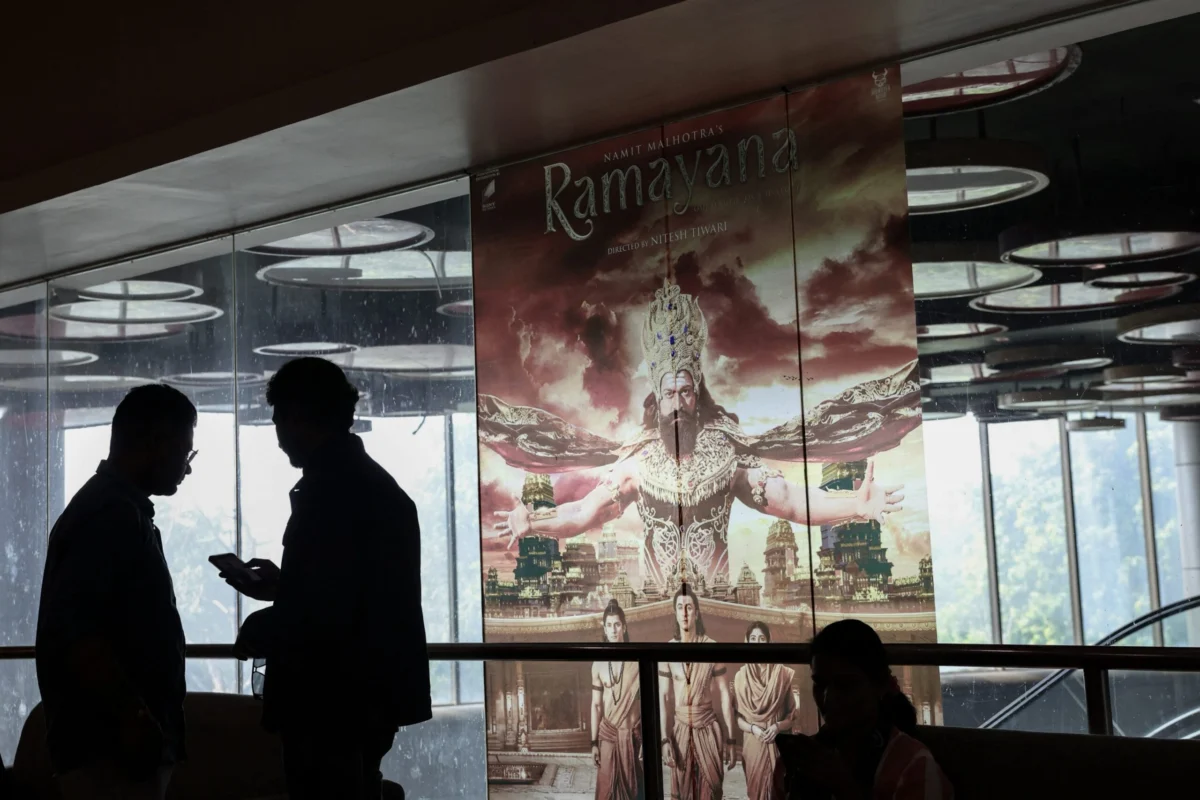
India’s film industry has entered uncharted financial and cultural territory with the release of Ramayana: Rise of a Legend, a massive two-part mythological epic boasting a staggering reported budget of 40 billion Indian rupees (approximately $420 million). Directed with international distribution in mind, the production represents the most expensive cinematic venture in the history of Indian filmmaking. Adapting the ancient Sanskrit epic—a sacred Hindu scripture that chronicles Prince Rama’s arduous quest to rescue his wife, Sita, from the demon king Ravana—the filmmakers are betting heavily that a deeply rooted religious narrative can transcend domestic boundaries to become a true global blockbuster.
However, the path to international acclaim is fraught with financial pressures, polarizing critical reviews, and contemporary controversies surrounding the integration of artificial intelligence in post-production. As the film rolls out across international territories, its commercial and cultural reception will serve as a definitive stress test for the global ambitions of Bollywood and the broader Indian entertainment sector.
Chronology and Release Timeline
The global rollout of Ramayana: Rise of a Legend has been meticulously planned to maximize international visibility, anchored by high-profile premieres and strategic multi-territory distribution windows:
- July 28: Producer Namit Malhotra issues a formal statement outlining the creative vision behind the project, emphasizing the universal humanity and enduring values of the source material.
- October 27: The production holds its high-profile global premiere in Los Angeles, drawing mixed-to-positive reactions for its visual splendor while eliciting early critiques regarding its pacing and musical score.
- November 5: The first installment, Ramayana: Rise of a Legend, officially debuts globally.
- November 6: The film expands to North American theaters via standard theatrical distribution channels tracked by Box Office Mojo.
- Mid-November: The film crosses the $100 million threshold globally, driven largely by domestic Indian audiences while making historic inroads in Western markets, notably topping the box office in the United Kingdom and Ireland.
Box Office Performance and Data Analysis
Financially, Ramayana occupies an unprecedented tier in South Asian cinema. Industry tracking indicates that the film grossed an impressive $55.7 million globally during its opening weekend alone. To date, total worldwide box office receipts have surpassed $100 million.
Nevertheless, a closer examination of the numbers reveals a stark geographic divide: approximately $67 million of the total gross has been generated domestically within India. While these figures represent formidable earnings for any regional release, the sheer magnitude of the $420 million budget means the film faces an exceptionally high threshold to achieve profitability.
Despite the heavy reliance on domestic revenue, the film has achieved notable milestones abroad. It made history as the first Indian production to claim the number-one spot at the United Kingdom and Ireland box office, outperforming several competing international releases. In North America, distributors implemented a dual-version release strategy to cater to varied audience preferences. The original Hindi-language cut runs for a sprawling three hours and 15 minutes, complete with traditional musical sequences. Simultaneously, an English-dubbed version was deployed, trimmed by approximately 30 minutes with songs removed to align more closely with conventional Western feature-length pacing.
Historical Context of Global Ambitions in Indian Cinema
The pursuit of international crossover success is not a modern phenomenon for the Indian film industry, though the strategic framework has evolved dramatically over the decades.
In the early post-independence era, filmmakers such as Raj Kapoor achieved staggering international acclaim. Kapoor’s 1951 masterpiece Awara resonated deeply with audiences in the Soviet Union, Eastern Europe, China, Turkey, and North Africa. Similarly, Mehboob Khan’s 1952 epic Aan and the Academy Award-nominated Mother India (1957) proved that Indian narratives could captivate non-diaspora populations worldwide.
During the 1980s, commercial hits like Disco Dancer (1982) found massive popularity in the Soviet Union, while action-heavy spectacles like Mard (1985) captured audiences in West Africa. As the global diaspora expanded through the 1990s and 2000s, romantic dramas such as Dilwale Dulhania Le Jayenge (1995) and Kal Ho Naa Ho (2003) established a reliable economic foundation centered on overseas Indian communities.
In recent years, the focus shifted toward Asian markets, most notably China. Sports drama Dangal (2016) shattered expectations by grossing more than $190 million in China, while Secret Superstar (2017) followed suit with $117.7 million. Ramayana, however, represents a distinct pivot: rather than relying on contemporary social drama or romance, it attempts to export a foundational religious epic through the prism of modern, Hollywood-style blockbuster aesthetics.
Academic and Industry Perspectives
Media scholars and industry experts have offered varied assessments regarding the viability of Ramayana’s global strategy.
Tejaswini Ganti, a New York University professor specializing in Indian cinema, notes the historical precedent set by mid-century classics while acknowledging the distinct nature of contemporary distribution models. Meanwhile, Philip A. Lutgendorf, a University of Iowa professor specializing in Indian language and culture, points out that Indian producers have long harbored ambitions for a definitive international crossover hit.
"The strategy behind Ramayana’s release at this time seems to be to capitalize on the success of epic sci-fi, fantasy, and superhero films and film franchises," Lutgendorf observes. He highlights that the narrative structure of the epic—featuring a clear-cut, polarized moral universe—serves as a natural vehicle for the CGI-driven fantasy spectacles that currently dominate global entertainment and gaming markets. However, Lutgendorf remains cautious, stating that it remains to be seen whether Hindu mythological archetypes will resonate broadly with international viewers unfamiliar with the underlying theology.
The Controversy Over Artificial Intelligence
Beyond its financial stakes and cultural aspirations, Ramayana has sparked considerable debate concerning its utilization of artificial intelligence during post-production.
Promotional materials released by the studio highlighted the deployment of "Brahma AI," described on official platforms as an AI-native operating system designed to manage and organize enterprise content. The technology was utilized to facilitate the film’s massive localization effort, preparing dubbed versions in nearly 40 languages.
Addressing the controversy during the Los Angeles premiere, Director Nitesh Tiwari clarified the scope of the technology’s application. He emphasized that all dialogue and character performances were originally recorded by human actors, and that AI was strictly employed to adjust visual lip-syncing for international language tracks.
"As far as AI is concerned, it’s only been used to get the lip-sync so that we can present the film to the world in their language," Tiwari explained.
Despite these assurances, the implementation of automated tools drew sharp criticism from Western reviewers. Outlets such as IGN published critical assessments, with one reviewer writing: "A majestic epic falls victim to clunky action, eye-sore CGI, and awkward AI lip-syncing in what is, unfortunately, just a Part 1." Such critiques underscore the delicate balance modern filmmakers must strike when utilizing emerging technologies to scale production for global markets without alienating audiences sensitive to aesthetic authenticity.
Broader Industry Implications
As the entertainment industry monitors the box office trajectory of Ramayana: Rise of a Legend, the ultimate takeaways extend far beyond the balance sheet of a single studio.
If the film successfully overcomes its massive budgetary hurdles and connects with non-traditional Western audiences, it could pave the way for a new wave of high-budget mythological adaptations from South Asia. Studios across Mumbai and Hyderabad would likely feel emboldened to leverage advanced computer-generated imagery and localized AI dubbing tools to target worldwide theatrical markets aggressively.
Conversely, should the film fall short of its ambitious financial targets, it may serve as a cautionary tale regarding the limits of exporting culturally specific sacred texts to generalized global audiences accustomed to Western intellectual property. For now, Ramayana stands as a monumental gamble—a high-stakes convergence of ancient scripture, modern technology, and unyielding global cinematic ambition.