
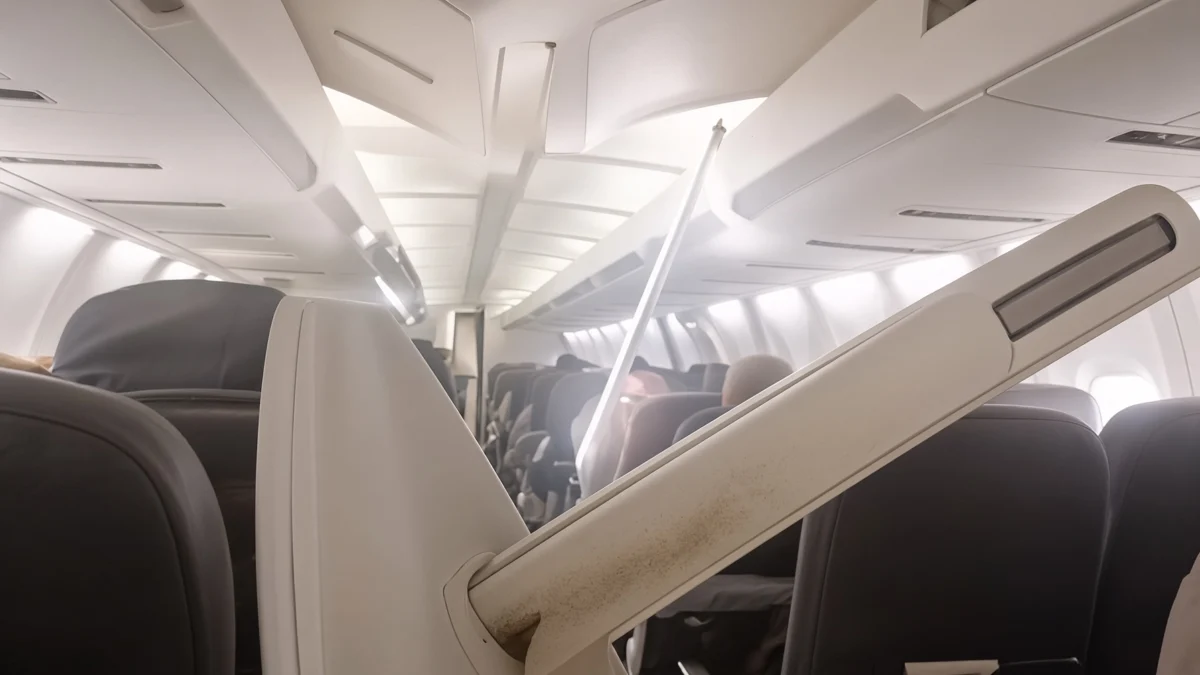
Passengers aboard a Sepehran Airlines flight from Mashhad to Kermanshah experienced a terrifying ordeal on Monday when significant sections of the aircraft’s cabin interior detached and collapsed onto the passenger seating area mid-flight. The incident, which occurred aboard a Boeing 737-300, forced the flight crew to declare an emergency and execute an immediate return to the point of origin, Mashhad International Airport. While officials reported that there were no fatalities or significant physical injuries among the passengers and crew, the structural failure has reignited urgent debates regarding the safety of Iran’s aging civilian aviation fleet and the impact of long-standing international sanctions on aircraft maintenance.
Chronology of the Incident
The flight, operated by the Iranian carrier Sepehran Airlines, departed Mashhad on Monday bound for Kermanshah. According to preliminary reports from local news agencies, the sequence of events began shortly after takeoff. It is believed that the aircraft suffered a burst tire during the initial climb-out phase. The resulting vibration and structural stress reportedly led to subsequent damage to one of the aircraft’s engines.
As the aircraft struggled to maintain its flight path, the integrity of the cabin’s ceiling panels was compromised. Video footage captured by passengers, which has since circulated widely on social media platforms, shows the cabin lights remaining functional even as overhead panels, insulation, and service equipment dangled precariously over the passenger seats. Passengers were observed gripping the seatbacks in front of them and ducking to avoid the debris as the aircraft navigated the emergency descent. The pilot initiated a return to Mashhad, where the aircraft landed safely, though the runway used for the emergency landing was subsequently closed to clear debris and inspect for potential damage to the tarmac.
Aircraft Profile and Technical Background
The aircraft involved in the incident is identified as EP-FSU, a Boeing 737-300 that first entered service in July 1996. Now 30 years old, the jet represents a class of aircraft that has become increasingly difficult to maintain for Iranian carriers. The 737-300 is a "classic" variant of the Boeing narrow-body family, and its continued operation in Iran relies heavily on the sourcing of legacy parts that are no longer supported by original equipment manufacturers (OEMs) due to comprehensive U.S.-led sanctions.
Technical analysts suggest that the collapse of the cabin interior was likely exacerbated by mechanical resonance. When an aircraft engine suffers damage that leaves a rotating assembly out of balance, the resulting high-frequency vibrations can exceed the structural design thresholds of interior fittings. While passenger service units (PSUs) are designed to withstand normal flight loads, extreme vibration can cause the retaining mechanisms to fail. While this specific incident involved a 30-year-old airframe, historical safety directives—such as a 2016 Federal Aviation Administration (FAA) proposed airworthiness directive—highlighted that older 737 models have historically struggled with PSU detachment during extreme events, leading to the recommendation of stronger retaining lanyards to prevent injury during emergency scenarios.
Escalating Sanctions and Aviation Maintenance
The incident occurs against a backdrop of tightening international financial restrictions. On September 8, 2026, just six days prior to the emergency landing, the United States Department of the Treasury expanded its sanctions regime against Iranian airlines, including Sepehran Airlines. The Treasury’s Office of Foreign Assets Control (OFAC) issued a notice effectively halting the previous, more flexible licensing policy that had allowed for emergency repairs and safety-of-flight equipment to be procured for Iranian commercial carriers.
The new policy, formalized on September 10, adopts a "presumption of denial" for all Iran-related license requests. Exceptions are now restricted to cases where the law requires them or where there is an immediate, verified threat to human life or environmental safety. This shift marks the culmination of a long-term erosion of the "safety-of-flight" channel that had been kept open following the 2018 withdrawal from the Joint Comprehensive Plan of Action (JCPOA).

The impact of these sanctions on the Iranian civilian fleet has been severe. By late 2021, officials within the Iranian Aviation Association estimated that more than 50% of the country’s civilian aircraft were grounded due to a lack of certified spare parts, avionics, and engines. Carriers have increasingly turned to illicit procurement networks, front companies, and clandestine shipping routes to acquire necessary components. However, these methods are rarely capable of providing the comprehensive technical support or standardized maintenance manuals required to keep aging airframes operating at international safety standards.
Broader Implications for Civil Aviation
This incident is not an isolated occurrence for Sepehran Airlines. The carrier was involved in another significant incident on August 25, when a different 737 experienced a runway excursion at Mashhad Airport. The repetitive nature of these incidents points to a systemic fragility within the Iranian aviation sector.
The primary concern among global aviation safety observers is the "cannibalization" of aircraft. As spare parts become unobtainable, airlines often strip functional components from grounded jets to keep their operational fleet flying. While this allows for temporary service, it creates a "hollowed-out" fleet where the underlying airframes are subjected to undocumented repairs and components that have exceeded their service life cycles.
Furthermore, the lack of transparency in the maintenance logs of such aircraft makes it nearly impossible for regional civil aviation authorities to conduct accurate risk assessments. When an aircraft like the one involved in the September 14 incident experiences a burst tire and subsequent engine damage, the primary safety protocols are designed to rely on redundant systems. If the secondary systems—such as interior structural integrity—are also compromised due to deferred maintenance or fatigue, the result is a significant increase in risk to passengers.
Strategic Dilemmas and Future Outlook
The current U.S. strategy, while aimed at curbing the Iranian regime’s ability to utilize civilian aircraft for the transport of weapons and military personnel, presents a complex humanitarian and safety dilemma. Advocates for a more nuanced approach suggest that a total blockade of civil aviation components, regardless of the end-user’s political activities, creates an inevitable risk to the traveling public.
The argument for a controlled, transparent mechanism for the import of "non-dual-use" aviation safety items—such as tires, navigation equipment, and cabin structural components—remains a point of contention. Opponents of such a policy argue that any aviation parts provided to state-aligned carriers like Sepehran could be diverted or that the financial gain from commercial operations supports the regime’s broader illicit activities.
As it stands, the aviation sector in Iran is caught in a deteriorating loop. The combination of an aging fleet, limited access to technical support, and intensified economic pressure has made civil flight increasingly hazardous. Unless there is a shift in the current diplomatic or logistical landscape, industry analysts expect a continuation of mechanical failures. The September 14 incident serves as a stark warning: as the technical capacity to maintain these aircraft wanes, the margin for error during routine flights is vanishing. For the passengers of Sepehran Airlines and other domestic carriers, the future of safe air travel in the region remains increasingly uncertain, dependent on a precarious balance of limited parts and the aging airframes that currently carry them.








Leave a Reply