
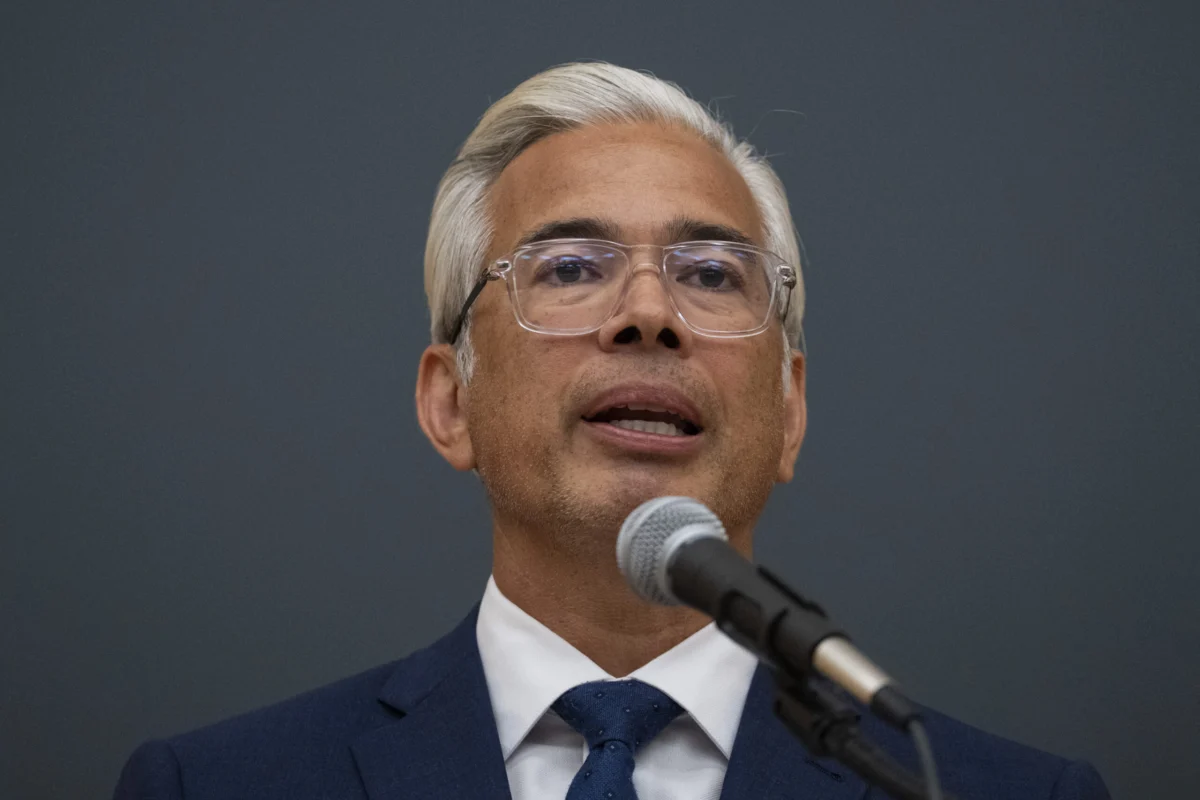
California Attorney General Rob Bonta stood before a crowded room of reporters on Monday, defending a high-stakes antitrust settlement that effectively clears the path for the merger between media titans Paramount and Warner Bros. The 45-minute press conference served as a calculated effort to frame the agreement as a strategic victory, despite the absence of the "robust structural remedies" that had been the cornerstone of his office’s legal posture since the litigation began in July.
The settlement, which involves a 12-state coalition, marks the end of a contentious period of legal maneuvering that threatened to upend the current landscape of the entertainment industry. While Bonta maintained that the deal secures independent monitoring and promises a surge in Hollywood-based production, the path to this resolution was paved with intense political pressure, corporate threats, and a growing divide between state regulators and organized labor.
A Departure from Initial Legal Goals
When the 12-state coalition initially filed suit in July, the core objective was clear: the regulators sought structural changes to the merger—most notably divestitures—to prevent the consolidation of market power. Specifically, Attorney General William Tong of Connecticut had publicly championed the divestiture of major news assets, including CBS and CNN, arguing that such a move was essential to preserve the integrity of independent journalism.
However, the final agreement contains no such structural mandates. Bonta, while describing the outcome as "strong," candidly admitted that his personal preference was to block the merger entirely. "I don’t think these two companies should merge," Bonta stated during the briefing. "But that’s not something that we are focused on with our resolution here."
This concession highlights the pragmatic shift required to navigate the complexities of antitrust litigation. The absence of the term "robust structural remedies" in the final settlement suggests that the coalition reached a point where the risks of a protracted trial outweighed the potential for a complete victory. Bonta emphasized that courtrooms "always have risk," and that the uncertainty inherent in a prolonged legal battle was becoming a liability for the California economy.
Chronology of a High-Stakes Dispute
The road to this settlement was marked by a rapid escalation of tensions. In the weeks leading up to the resolution, Paramount engaged in a scorched-earth strategy to force the coalition’s hand. The company, citing the economic burden of the antitrust challenge, threatened to relocate significant portions of its operations to Tennessee—a move that would have dealt a devastating blow to the California film industry’s labor force.
Furthermore, Paramount sought a court order to compel the 12-state coalition to pay $1.88 billion in damages, arguing that the delay caused by the lawsuit was strangling its business viability. This aggressive legal posture, combined with mounting pressure from Governor Gavin Newsom, federal officials like Xavier Becerra, and various labor unions, created a suffocating environment for the Attorney General.
By the weekend, the situation reached a breaking point. The Writers Guild of America (WGA), which had pursued its own independent antitrust lawsuit against the merger, opted to settle. In a statement, the WGA noted that while the terms were insufficient to protect writers, the cost of continuing the fight without the support of the states was unsustainable. Bonta, notably isolated at the podium on Monday, clarified that the WGA’s decision to settle was entirely independent of the states’ negotiations.
Economic Implications and Industry "Certainty"
A primary justification provided by the Attorney General for the settlement is the promise of economic stability for Los Angeles. Paramount has committed to a five-year freeze on the sale of its Southern California production lots and has pledged to increase domestic production levels. Bonta argued that this "locks in a massive upside" for an industry that has been plagued by volatility.
This approach stands in stark contrast to the Disney-Fox merger of 2019, which received minimal antitrust scrutiny and ultimately resulted in significant layoffs and a reduction in overall film production. Bonta repeatedly drew comparisons between the two, asserting that the new settlement serves as a safeguard against the "downside" of consolidation. By codifying production commitments, the state believes it has transformed a potential monopoly into a managed partnership that prioritizes local labor.
However, the economic data surrounding such mergers remains complex. While production commitments provide a short-term boost, critics argue that the long-term impact of media consolidation—higher prices for consumers, reduced diversity in content creation, and diminished leverage for independent creators—remains unaddressed by the current settlement.
The Dissenting Voices: A Fractured Coalition
The consensus within the 12-state coalition appears fragile. William Tong’s public expression of disappointment underscores the rift among the Attorneys General who once stood united. For proponents of media pluralism, the failure to force the divestiture of CBS and CNN is viewed as a missed opportunity to protect the "ethical and independent journalism" that acts as a check on corporate power.
Bonta, however, brushed off questions regarding these internal disagreements, noting that all 12 states eventually signed on to the settlement. When pressed for a timeline or a "smoking gun" moment that unlocked the deal, he struggled to provide a clear narrative, describing the final days of negotiation as a period of "deep and robust conversations" where the distinction between days had become blurred.
Analysis: The Shifting Landscape of Antitrust Law
The Paramount-Warner Bros. resolution signals a notable shift in how state-level regulators are approaching corporate consolidation in the digital age. Traditionally, antitrust law focused heavily on price competition. Today, the focus is expanding to include labor protections, regional economic impact, and the preservation of specific industry ecosystems.
By securing commitments on production levels and facility usage, the California Attorney General’s office is attempting to pivot toward a model of "behavioral oversight" rather than "structural dismantling." Whether this strategy will prove effective remains to be seen. Critics argue that behavioral remedies—monitoring and promises—are notoriously difficult to enforce over a five-year period. If Paramount fails to meet its production targets, the state will be forced to return to the courtroom, potentially facing a company that is significantly more entrenched and powerful than it is today.
Moreover, the settlement raises broader questions about the role of state Attorneys General in federal antitrust enforcement. With the federal government often seen as slow or politically hampered in its response to media consolidation, state leaders like Bonta are increasingly stepping into the vacuum. However, as this case demonstrates, state-level intervention is often vulnerable to the very corporate threats—such as relocation and litigation costs—that these companies are designed to wield.
Looking Ahead
As the dust settles, the entertainment industry faces a period of transition. The merger will proceed, and the immediate threat of a massive legal trial has been averted. For Hollywood workers, the promise of sustained domestic production provides a degree of relief, yet the underlying anxiety regarding the consolidation of power in the hands of a few media conglomerates persists.
The settlement is not the end of the conversation but rather the beginning of a new phase of oversight. With independent monitors tasked with tracking the merger’s compliance, the state of California has effectively entered into a long-term administrative relationship with the new entity. The success of this settlement will be measured not by the press conference held on Monday, but by the tangible outcomes in the years to come—specifically, whether the promised "upside" of production manifests, or if the lack of structural remedies leads to the very homogenization of the industry that critics feared.
For now, Rob Bonta and his counterparts in the 12-state coalition have chosen a path of managed consolidation. In the high-stakes world of modern antitrust, they have opted for the certainty of a deal over the risks of a trial, gambling that they can regulate a giant they were unable to stop.









Leave a Reply