
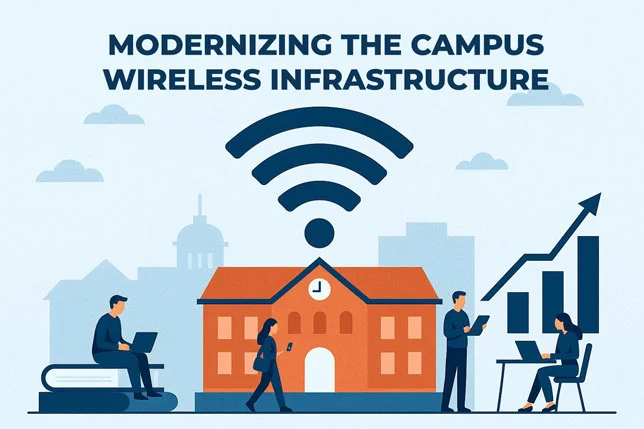
The release of Cisco’s inaugural "State of Wireless" report in April 2026 has provided a data-driven roadmap for this transition. According to Gary DePreta, Cisco’s Senior Vice President of U.S. Public Sector, the current climate requires a paradigm shift in how IT leaders view their infrastructure. The focus has moved from "connectivity for connectivity’s sake" to building a "future-ready state" capable of absorbing the shocks of rapid technological evolution, particularly the massive data demands of artificial intelligence and the high-density requirements of modern research facilities.
The Drivers of Full-Scale Modernization
The impetus for these multi-year modernization projects is rooted in three primary catalysts: the surge of AI-driven applications, the saturation of bandwidth by Bring Your Own Device (BYOD) policies, and the explosive growth of research data repositories.
In the academic sphere, artificial intelligence has moved from a theoretical tool to a classroom staple. Generative AI and machine learning models, which often require real-time cloud processing, have placed an unprecedented strain on upstream and downstream speeds. Furthermore, the hybrid learning model—a holdover from the early 2020s that has since become a permanent fixture—requires seamless video conferencing capabilities that can handle hundreds of concurrent streams within a single dormitory or lecture hall without latency spikes.
The sheer volume of devices per student has also reached a critical mass. In 2026, the average student arrives on campus with an average of 4.5 connected devices, ranging from smartphones and laptops to wearable health monitors and IoT-enabled dorm accessories. This density necessitates a wireless fabric that can manage high-interference environments while maintaining consistent throughput.
A Chronology of Campus Connectivity: From Ethernet to Wi-Fi 7
To understand the current state of infrastructure, it is essential to view the timeline of connectivity within higher education. The evolution has been rapid, moving through distinct phases over the past two decades:
- The Wired Era (Pre-2010): Most institutions relied on physical Ethernet ports in dorms and libraries. Wireless access was a luxury, often limited to specific "hotspots" in common areas.
- The Expansion Era (2010–2018): Wi-Fi 4 (802.11n) and Wi-Fi 5 (802.11ac) became the standards. Universities focused on "blanket coverage," ensuring that a signal could be found in every corner of the campus, though capacity was often limited during peak hours.
- The Performance Era (2019–2024): The introduction of Wi-Fi 6 and 6E brought the 6GHz band into play, offering more spectrum and lower latency. This period saw the first attempts at "smart campus" initiatives, integrating building management systems into the wireless network.
- The Modernization Era (2025–Present): With the rollout of Wi-Fi 7, institutions are no longer just expanding; they are rebuilding. Modernization today involves integrating 5G cellular offloading, AI-native network management, and Zero Trust security architectures into a single, cohesive ecosystem.
Supporting Data and the Impact of Wi-Fi 7
The Cisco "State of Wireless" report highlights several key data points that illustrate why a "ground-up" approach is necessary. Preliminary findings from the 2026 study suggest that institutions that have completed full modernizations report a 40% increase in operational efficiency within their IT departments. This is largely due to the implementation of AI-managed networks that can self-heal, identifying and mitigating interference or hardware failures before they impact the end-user.
Furthermore, the integration of Wi-Fi 7 technology has introduced Multi-Link Operation (MLO), allowing devices to send and receive data across different frequency bands and channels simultaneously. For a university, this means that a medical student performing a remote, high-resolution VR surgery simulation can maintain a jitter-free connection even as thousands of other students nearby access the network for standard coursework.
Data from the report also indicates that research-heavy institutions are seeing a 300% increase in data throughput requirements every two years. Modernized infrastructures are being built with 100G and 400G backbones to ensure that the "last mile" of wireless connectivity does not become a bottleneck for the terabytes of data generated by modern physics, genomics, and climate science programs.
Official Responses and Strategic Perspectives
The move toward modernization has garnered significant support from university administrators and technology leaders. Gary DePreta emphasizes that the ultimate goal of these investments is the "experience." In his dialogue with industry analysts, DePreta notes that the technical specifications of a router or an access point are secondary to the "super-positive experience" they enable for students and faculty.
"It’s not about the technology or tools; it’s about delivering the best experience possible," DePreta stated. This sentiment is echoed by Chief Information Officers (CIOs) across the country. Inferred reactions from the broader academic community suggest that the Return on Investment (ROI) for these projects is being measured not just in uptime, but in student retention and recruitment. A campus with "dead zones" or lagging connectivity is increasingly seen as a campus that is falling behind academically.
Administrators are also viewing wireless modernization as a prerequisite for institutional safety. Modern networks support sophisticated geolocation services that can provide emergency responders with precise locations during campus-wide alerts, a feature that has become a top priority for boards of trustees and parents alike.

Broader Impact and Implications for the Future
The implications of this shift extend far beyond the borders of the campus. As universities modernize, they become testing grounds for the "Smart City" technologies of the future. The data gathered from these dense, high-capacity environments provides invaluable insights into how urban centers might eventually manage their own digital infrastructures.
There is also a significant social implication regarding digital equity. By providing a robust, high-speed wireless fabric across the entire campus—including outdoor spaces and subsidized housing—universities are leveling the playing field for students from diverse socioeconomic backgrounds. Modernization ensures that the quality of a student’s education is not limited by the quality of the device they can afford or the data plan they can maintain.
However, this transition is not without its challenges. The cost of a full-scale modernization is substantial, often requiring multi-million dollar allocations over several fiscal years. IT leaders must balance these costs against other pressing needs, such as aging physical infrastructure or faculty compensation. To mitigate this, many institutions are looking toward "Network-as-a-Service" (NaaS) models, allowing them to shift capital expenditures (CapEx) to operational expenditures (OpEx) while ensuring their hardware remains current.
Security remains another critical pillar of the modernization movement. As the number of "headless" IoT devices and BYOD hardware increases, the attack surface of the university expands. Modernization efforts now almost universally include the implementation of Zero Trust Architecture (ZTA), where every device, whether belonging to the Dean or a visiting freshman, must be continuously verified. This level of security was nearly impossible on the legacy architectures of a decade ago.

Conclusion: Navigating the AI-Driven Horizon
As the April 2026 Cisco report circulates through the halls of academia, the message is clear: the time for incrementalism has passed. The universities that will thrive in the late 2020s are those that view their wireless infrastructure as the lifeblood of their institution.
By embracing a comprehensive modernization strategy, colleges are doing more than just speeding up their internet. They are creating a foundation for the next generation of pedagogical innovation, from AI-tutors to global collaborative research. The focus on "experience" over "infrastructure" marks a maturing of the digital campus, where technology fades into the background, and the pursuit of knowledge takes center stage, powered by a silent, invisible, and invincible wireless web.
The transition is a complex undertaking, involving not just technical prowess but strategic vision. As Gary DePreta and other industry leaders suggest, the ROI on a modernized network is found in the success of the students it serves and the breakthroughs of the researchers it supports. In the race toward a future defined by data, the campus wireless network is no longer just a utility—it is the engine of the modern university.









Leave a Reply