
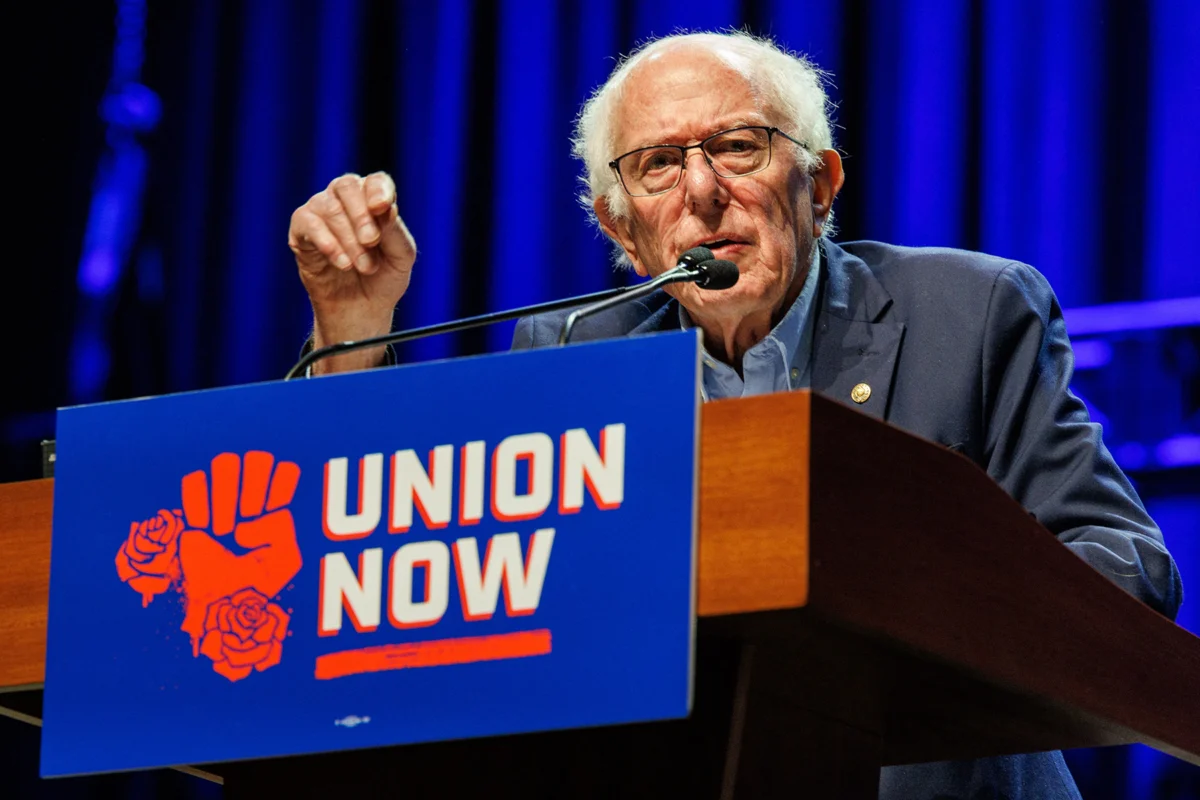
The burgeoning landscape of organized labor, grappling with the seismic shifts of a rapidly advancing industrial revolution, was the central theme at a recent rally in New York City. Spearheaded by the launch of Union Now, a new nonprofit organization founded by Sara Nelson, president of the Association of Flight Attendants-CWA, the event drew over 100 New Yorkers and a cadre of prominent labor leaders, including Randi Weingarten, president of the American Federation of Teachers. The gathering also featured New York Mayor Zohran Mamdani and Senator Bernie Sanders, both influential figures within the progressive wing of the Democratic Party, underscoring the growing urgency to address the challenges facing the American workforce.
The afternoon commenced with a performance by singer-songwriter Josh Ritter, whose rendition of Woody Guthrie’s "This Land Is Your Land," joined by Sara Nelson, evoked a poignant nostalgia for a time when organized labor held greater sway in national policy and public discourse. This moment of reflection served as a stark reminder of the precipitous decline in unionization rates across the United States. Over the past four decades, union membership has plummeted from over 20 percent to just above 10 percent. This sustained erosion of collective bargaining power has coincided with a dramatic surge in income inequality, the offshoring of millions of manufacturing jobs, and a political system increasingly influenced by the interests of the wealthy elite.
A central concern articulated by speakers, including Mayor Mamdani and Senator Sanders, was the profound impact of artificial intelligence (AI) and advanced robotics on the future of work. These technologies were framed not merely as innovations, but as potential threats to the livelihoods of countless workers. Attendees voiced a palpable mix of apprehension and indignation regarding the unchecked advancement of AI and automation. One carpenter, a member of a local union, articulated a widespread anxiety, stating that neither major political party had presented a clear, worker-centric strategy for navigating the impending wave of automation, which he characterized as a "freight train" poised to fundamentally reshape industries. The sentiment was echoed by others, with one attendee audibly expressing his discontent towards Sam Altman, a prominent figure in the AI industry, to the applause of many present.
The escalating concerns surrounding automation present a formidable challenge for organized labor as it endeavors to reclaim its historical influence. While bipartisan calls to reshore manufacturing, a traditional stronghold of unionization, are gaining traction, a significant portion of these repatriated jobs are anticipated to be automated. Evidence of this trend is apparent in the increasing adoption of "lights-out" factories in countries like China, where automation has reached a level where human intervention is minimal, and even artificial lighting is deemed unnecessary. This evolving industrial paradigm, coupled with widespread fears of job displacement across various sectors, has intensified the focus on the necessity for labor unions to wield greater power in shaping public policy.
The Genesis and Mission of Union Now
It is within this complex and challenging environment that organizations like Union Now aim to provide critical support. Sara Nelson, the driving force behind Union Now, expressed her vision for the organization to serve as a vital conduit, connecting unions and workers with essential resources to bolster their fight for fair contracts, equitable wages, and enhanced workplace protections. In an interview following the rally, Nelson emphasized the organization’s core objective: to create an additional layer of support for workers engaged in the arduous process of organizing. "If we can help them have the time and not have to be able to pick up another shift, or work a second job, and they can focus on the organizing, they can win," Nelson stated, highlighting the tangible benefits of dedicated support in unionization efforts.
Nelson’s advocacy for a revitalized labor movement reflects a broader shift in American political consciousness. The stark realities of declining union power and escalating inequality have compelled a growing segment of the population to seek political alternatives that re-center the interests of labor and working people. This vision aligns with Senator Bernie Sanders’ decades-long commitment to championing working-class issues. At 84 years old, Sanders has a unique perspective, having witnessed firsthand both the zenith of organized labor’s influence and its subsequent decline.
Senator Sanders on the Decline of Unionization and the AI Revolution
Following the rally, Senator Sanders engaged in a discussion regarding the multifaceted factors contributing to the decline of unions, the implications of AI and automation, and his outlook on the future of the labor movement.
Factors Driving Union Decline and Prospects for Revival
When questioned about the precipitous drop in unionization rates in the U.S. over the past four decades, Senator Sanders expressed a firm conviction that this trend is reversible. He attributed the decline to a confluence of factors, chief among them being trade policies such as NAFTA and Permanent Normal Trade Relations with China. These policies, he argued, led to the closure of thousands of factories, resulting in the loss of millions of well-paying jobs, many of which were unionized. The subsequent decrease in union membership was further exacerbated by the natural attrition of union workers over time.
Furthermore, Sanders highlighted what he described as an unprecedented level of "anti-union and union-busting activity" by corporate America. As the ranking member of the Health, Education, Labor, and Pensions Committee, he frequently engages with workers across the nation who are attempting to organize and secure contracts. He detailed the aggressive and often illegal tactics employed by companies to thwart unionization efforts. "These companies break the law every day," Sanders stated, emphasizing the need for robust legislation to protect workers’ rights and enable them to form unions without facing illegal opposition from employers.
The Transformative Impact of AI and Robotics on the Workforce
The pervasive discussion surrounding AI and automation at the rally naturally led to a discussion on their potential impact on the manufacturing sector, particularly in the context of reshoring jobs. Senator Sanders acknowledged the profound implications of these technologies, revealing that he was actively engaged in this issue, with plans for a significant event in Washington focusing on AI and robotics and their effects on the working class.
Sanders characterized the current technological shift not as a mere economic transformation, but as the "most consequential, by far, industrial revolution in the history of the world." He posited that it dwarfs the transition from agriculture to industry in its speed and scope. The critical question, he emphasized, is who will ultimately benefit from these advancements. Will the gains accrue solely to the billionaires investing heavily in AI, whose primary objective is often to reduce labor costs by displacing workers? Or will this technology be harnessed to improve the standard of living for all? This, Sanders asserted, is the central struggle of our time.
Addressing the notion of job losses being inevitable, Sanders reframed the issue as a contest over the distribution of benefits derived from AI and robotics. He posed a hypothetical scenario: if robots can assist workers, leading to a reduction in the workweek from 40 to 20 hours with no loss in pay, would that be detrimental? He argued that it would not be, underscoring that the crucial determinant is who reaps the rewards of this technological progress. The imperative, he stressed, is to ensure that working people benefit, rather than solely the wealthiest individuals and corporations.
Unions as a Cornerstone of Democracy
Senator Sanders unequivocally linked the strength of organized labor to the health of democracy itself. He observed that democracy is currently under assault from multiple fronts, citing Donald Trump’s authoritarian tendencies as a clear example. However, he cautioned that the threats extend beyond a single political figure. The influence of a "corrupt campaign finance system," where billionaires wield unchecked financial power to manipulate electoral outcomes, poses another significant danger.
To counter these forces, Sanders argued for the necessity of a "strong, organized political force" capable of advocating for a vibrant democracy characterized by "one person, one vote." He asserted that the trade union movement represents the most potent force for achieving this goal, ensuring that the needs of working people are heard and that the nation is not governed by an oligarchy controlled by the wealthy and powerful.
Navigating Ideological Divides within the Democratic Party
In response to a question about a segment of the Democratic Party that advocates for policies focused on supply constraints, deregulation, and affordable construction, often embracing an "abundance" ideology, Senator Sanders acknowledged the need for government efficiency. He drew upon his experience as a mayor and a senator to affirm that bureaucracy can indeed be a hindrance, and that government must strive to be efficient and productive, particularly with a dedicated and well-compensated workforce.
However, Sanders firmly rejected the notion that deregulation alone can address the crises confronting the working class. He characterized such an idea as "absurd." Instead, he reiterated his conviction that a political movement, spearheaded by the working class and trade unions, is essential. This movement must champion an agenda that prioritizes the needs of all, encompassing universal healthcare, raising the minimum wage to a living wage, and the construction of millions of affordable housing units.
Broader Implications and Future Outlook
The launch of Union Now and the discussions at the rally signal a critical juncture for the labor movement. The decline in union density over the past four decades has been demonstrably correlated with rising income inequality and a weakening of the middle class. The resurgence of labor organizing efforts, supported by new initiatives and prominent political figures, suggests a potential turning point.
The challenge posed by AI and automation is unprecedented in its potential to reshape economies and societies. The debate over whether these technologies will lead to widespread job displacement or unlock new opportunities for improved living standards hinges on policy decisions and the strength of collective bargaining. As Senator Sanders articulated, the struggle is fundamentally about who benefits from these advancements.
The role of organized labor in safeguarding democratic principles is also a crucial consideration. In an era of increasing economic concentration and political polarization, a robust labor movement can serve as a vital counterweight, advocating for policies that benefit the majority rather than a select few. The success of initiatives like Union Now, and the broader efforts to re-energize the labor movement, will likely have profound implications for the future of American economic and political life. The path forward demands a concerted effort to ensure that the benefits of technological progress and economic growth are shared equitably, and that the voices of working people are not only heard but are central to the nation’s decision-making processes.









Leave a Reply