
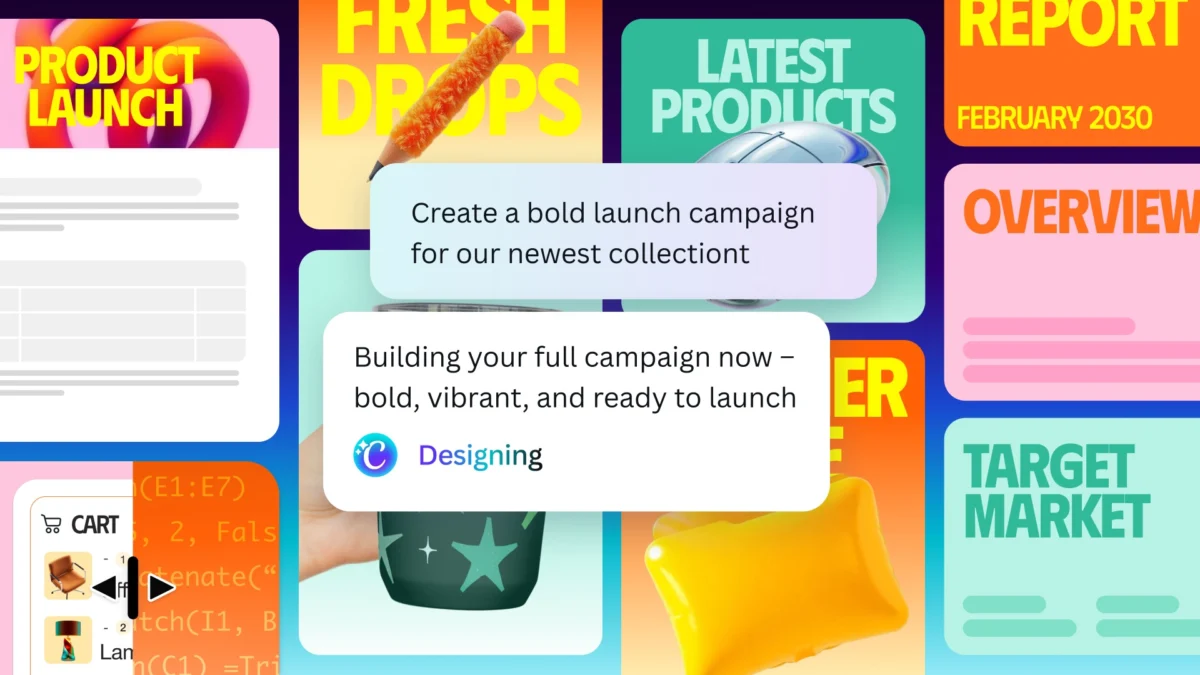
Canva, the global visual communication platform, has announced the launch of Canva AI 2.0, a significant update to its artificial intelligence assistant designed to fundamentally transform how users create and interact with design. The core promise of this new platform iteration aligns with the broader industry trend of agentic AI: users can now describe complex tasks to the AI assistant, which then plans the execution, selects and utilizes the appropriate tools, and retains user preferences for future tasks. This evolution is particularly pivotal for design professionals and small businesses, who increasingly seek predictable, automated workflows to streamline the creation of content and media assets.
The Dawn of Agentic AI in Creative Workflows
The concept of agentic AI represents a paradigm shift from simple command-response systems to intelligent assistants capable of autonomous planning and execution. In essence, an agentic AI is designed to understand high-level goals, break them down into actionable steps, interact with various tools and APIs, and learn from past interactions to refine its performance. For the creative industry, this means moving beyond generative AI tools that produce static outputs, towards dynamic systems that can actively participate in the design process, from ideation to final polish.
This shift is driven by the growing demand for efficiency and scalability in content creation. Designers, marketers, and entrepreneurs are constantly under pressure to produce high-quality visuals across multiple platforms. Traditional design workflows, while offering immense creative control, can be time-consuming and repetitive. Agentic AI aims to alleviate this burden by automating mundane tasks, suggesting creative directions, and enabling rapid iteration, thereby freeing up human creativity for more strategic and nuanced aspects of design.
Canva’s Strategic Leap with AI 2.0
With Canva AI 2.0, the company is leaning heavily into this agentic paradigm, embedding its advanced AI model at the heart of the design process. Users can now articulate their design needs through simple text prompts, and the bot will autonomously call upon the necessary tools within Canva’s extensive ecosystem to generate editable designs. This goes beyond mere image generation; the assistant will present several design options, each constructed with multiple layers. This layered approach is a critical differentiator, providing users with unparalleled flexibility to tweak and refine different aspects of the final product, ensuring that the AI-generated starting point can be precisely molded to their vision.
Canva’s journey into AI integration is not new. Over the past year, the company has steadily worked towards making its AI assistant central to user workflows, introducing features such as sophisticated image generation and website creation tools. The current update builds on this foundation, pushing the boundaries of what an AI assistant can achieve within a design environment. The underlying AI model orchestrates various elements—from text fonts and layouts to image selection and color palettes—to produce coherent and aesthetically pleasing designs that are fully customizable. This represents a significant advancement from earlier AI tools that often delivered static, uneditable outputs, requiring users to rebuild or heavily modify designs from scratch.
Expanding the AI Assistant’s Reach and Intelligence
Canva AI 2.0 introduces a suite of enhancements designed to make the assistant more integrated, intelligent, and proactive across a user’s digital ecosystem.
- Seamless Integration and Contextual Awareness: A key update includes new integrations with popular productivity and communication platforms such as Slack, Gmail, Google Drive, Calendar, and Zoom. Users can opt to allow the AI bot to access and analyze data from their emails, conversations, files, and meeting notes. This contextual awareness is transformative, enabling the AI to generate more relevant and personalized designs by understanding the user’s current projects, communication styles, and upcoming events. For instance, if a user has an upcoming meeting scheduled in Google Calendar, the AI could proactively suggest relevant presentation templates or social media posts related to the meeting’s topic, drawing information from associated emails or documents.
- Enhanced Capabilities and Automation: The assistant now boasts a web research skill, empowering it to browse the internet to gather information pertinent to a design task. This means users can prompt the AI to "create a social media campaign for a new coffee shop, researching current trends in cafe branding," and the AI can leverage its web browsing capabilities to inform its design suggestions. Furthermore, a new scheduling feature allows users to instruct the AI bot to automate repeatable tasks in the background. While this feature will initially only create drafts for user review and posting, it signifies a major step towards fully automated content pipelines, allowing businesses to maintain a consistent online presence with minimal manual effort.
- Refining Core AI Tools: Beyond new features, Canva is also refining its existing AI capabilities. Its AI code generator, for instance, can now import HTML, making it easier for users to bring external web elements into their Canva projects or generate more complex web designs. Similarly, users can now employ text prompts to describe the kind of spreadsheets they wish to generate, further simplifying data visualization and organization within the platform.
Under the Hood: Performance and Efficiency Gains
The improvements in Canva AI 2.0 are not just functional; they also extend to significant enhancements in the efficiency and performance of its underlying AI models. The company reports substantial gains, claiming that its Lucid Origin image-generation model is now five times faster and 30 times cheaper to operate. Similarly, its 12V image-to-video model has seen impressive improvements, becoming seven times faster and 17 times cheaper. These efficiency gains are crucial for several reasons: they translate directly into faster generation times for users, lower operational costs for Canva, and enable the deployment of more complex AI functionalities without compromising speed or accessibility. Faster, cheaper models mean that more users can leverage advanced AI features more frequently, making sophisticated design tools more democratized and responsive.
A Fiercely Competitive AI Design Landscape

Canva’s latest update arrives amidst a rapidly intensifying competitive landscape within the creative software industry, where major players are all racing to integrate advanced AI capabilities. This week, Adobe, a long-standing titan in creative software, launched its Firefly AI assistant. This new assistant is designed to leverage the extensive suite of Creative Cloud applications, enabling users to complete complex tasks by orchestrating different Adobe programs. For example, a user could ask Firefly to create a marketing banner, and the AI could use Photoshop for image manipulation, Illustrator for vector graphics, and InDesign for layout, all seamlessly.
Similarly, Figma, a dominant force in collaborative design, baked in support for AI agents into its platform last month with an MCP (Multi-Modal Collaboration Platform) server. This move signals Figma’s intent to allow AI agents to interact directly with design files and collaborate with human designers, potentially automating parts of the UI/UX design process, from wireframing to prototyping.
The aggressive push by these industry giants underscores the strategic importance of AI in the future of design. For users, this competition translates into rapid innovation and a broadening array of sophisticated tools. For the companies, it’s a battle for market share and the loyalty of creative professionals and businesses looking for the most efficient and powerful solutions. The integration of agentic AI is not merely an incremental update; it’s a foundational shift that promises to redefine the interaction between humans and creative software.
Canva’s "Final Mile" Advantage and Strategic Vision
Despite the robust competition, Canva’s co-founder and COO, Cliff Obrecht, articulated a clear strategic advantage for the platform. Obrecht noted that while many companies are striving to merge diverse workflows, businesses, particularly small and medium-sized enterprises (SMBs), often prefer to execute the final steps of editing, collaboration, and publishing directly on Canva.
"I think a lot of small businesses start and end their day, and they’ll do a lot of their workflows completely, in Canva," Obrecht stated. He emphasized Canva’s strong interoperability with other leading AI models, saying, "We also work incredibly well with Anthropic, Google and OpenAI, so if someone is doing their agentic workflows in those products, they can call Canva, get content, and they can get it back into those LLMs. But they always need to end up doing the final mile of editing, collaboration and deployment. That’s where we really are strong."
This "final mile" strategy positions Canva not just as a creation tool, but as the indispensable platform for refining, collaborating on, and ultimately deploying visual content. It acknowledges that while AI can generate compelling starting points, the human touch in fine-tuning, brand alignment, and team collaboration remains paramount. By integrating seamlessly with broader AI ecosystems while maintaining its stronghold on the crucial last stages of the design process, Canva aims to be the connective tissue that bridges initial AI ideation with professional-grade output and distribution. This strategy leverages Canva’s intuitive interface and collaborative features, which have made it a favorite among non-designers and small teams, extending its utility even to those who begin their creative process in more complex or specialized AI environments.
Market Trajectory and Future Outlook
Canva’s strategic advancements in AI are underpinned by robust financial performance. While a significant portion of its revenue traditionally comes from individual users and small teams, its enterprise business segment is demonstrating exceptional growth, boasting a promising 100% year-on-year increase. This growth trajectory highlights Canva’s successful expansion beyond its core user base into larger organizations, which are increasingly adopting the platform for scalable and collaborative design solutions.
The company, most recently valued at a staggering $42 billion according to PitchBook, is operating within a thriving global creative software market projected to reach approximately $15 billion by 2028, with AI integration being a primary growth driver. Canva’s strong market position and accelerating enterprise adoption suggest a compelling path forward. Obrecht further indicated that the company is likely to go public next year, an anticipated move that would solidify its status as a major player in the tech and design industries. An initial public offering (IPO) would provide Canva with additional capital for continued innovation, market expansion, and potential acquisitions, further fueling its ambition to dominate the visual communication space. The successful integration of cutting-edge AI features like those in AI 2.0 is expected to be a key narrative in its public offering, showcasing its commitment to future-proofing its platform and driving sustained value for users and investors alike.
Implications for the Creative Industry and Professionals
The advent of agentic AI in platforms like Canva AI 2.0 carries profound implications for the creative industry and professionals worldwide.
- Empowering Designers and Small Businesses: For individual designers and small businesses, these tools represent a significant leap in productivity. Tasks that once took hours, like generating multiple design variations for A/B testing or creating diverse social media assets, can now be accomplished in minutes. This democratizes high-quality design, making professional-grade visuals accessible to a broader audience without requiring extensive technical skills or specialized software training. It allows smaller teams to compete more effectively with larger organizations by leveraging AI to scale their creative output.
- The Evolving Role of the Designer: Rather than replacing human designers, agentic AI is poised to evolve their roles. Designers may transition from executing every detail to becoming creative directors, curating AI outputs, providing strategic oversight, and focusing on the higher-level conceptual and emotional aspects of design that AI cannot fully replicate. The emphasis shifts from manual creation to prompt engineering, critical evaluation, and strategic refinement. This necessitates a new skill set for designers, including understanding AI capabilities, ethical considerations, and how to effectively collaborate with intelligent systems.
- Ethical Considerations and Future of Work: The rapid advancement of AI also brings ethical considerations to the forefront. Questions surrounding intellectual property for AI-generated content, bias in AI models, and the potential impact on creative jobs are ongoing discussions within the industry. Canva’s approach of generating editable drafts and emphasizing human oversight for scheduled tasks demonstrates a recognition of the need for human accountability and control in AI-driven workflows. As AI becomes more autonomous, ensuring transparency, fairness, and ethical deployment will be paramount.
- The Path Forward for Agentic Design: Looking ahead, the trajectory of agentic design suggests even more personalized and predictive capabilities. Future iterations might involve AI agents learning individual design preferences so thoroughly that they can anticipate needs, proactively suggest content, and even manage complex multi-stage design projects from concept to distribution, all while maintaining a consistent brand voice. The integration of AI into design is not a static event but a continuous evolution, promising a future where creative processes are more intuitive, efficient, and ultimately, more powerful.
Canva AI 2.0 is currently launching in a research preview this week, with plans to make it available to all users in the coming weeks. This release marks a pivotal moment in the evolution of creative technology, underscoring Canva’s commitment to leading the charge in making sophisticated design tools accessible and intuitive for everyone, from individual creators to large enterprises. These innovations, and many more, are often subjects of discussion at industry events such as the TechCrunch event scheduled for October 13-15, 2026, in San Francisco, California, where the future of technology continues to unfold.










Leave a Reply