The Chinese automotive market reached a historic inflection point in October 2026, with electric vehicles (EVs) accounting for 68% of all new vehicle registrations. This milestone, characterized by a massive migration away from traditional internal combustion engine (ICE) vehicles, signals a structural shift that industry analysts believe could lead to the complete electrification of the Chinese passenger vehicle market well before 2035. While the overall automotive market faced a contraction of 27% year-over-year (YoY), totaling approximately 1.6 million units, the divergence between fuel types was stark: while plug-in vehicles saw a 14% dip, pure ICE vehicle sales collapsed by 44%.

The composition of the 68% share reflects a maturing market, with 45% attributed to battery electric vehicles (BEVs) and 23% to plug-in hybrid electric vehicles (PHEVs). This performance has raised the cumulative EV share for the 2026 calendar year to 59%, a 5% increase over the full-year figures recorded in 2025. With BEV-only market penetration reaching 40%—up from 33% last year—the trajectory suggests that the world’s largest automotive market is undergoing a rapid, permanent transition.
The Chronology of an Industrial Shift
The decline of the ICE sector has been accelerating throughout 2026, driven by a combination of high fuel prices, government subsidies for green technology, and an unprecedented wave of new EV model launches that prioritize both software integration and price-to-performance ratios.
In early 2026, the Chinese government reaffirmed its commitment to carbon neutrality targets, prompting local manufacturers to intensify their R&D spending. By the second quarter, traditional legacy automakers began struggling to maintain their market positions, as domestic EV startups and established players like BYD and Geely flooded the market with models tailored to specific consumer segments. By October, the shift had become undeniable, with the top 10 best-selling vehicles in the nation being exclusively electric or plug-in hybrids. This trend, which began as a niche movement in major coastal cities, has now achieved critical mass across Tier 2 and Tier 3 cities, effectively relegating the gasoline-only engine to the margins of the domestic automotive landscape.
Segment Analysis and Consumer Preferences
Market data from October reveals a significant disconnect between manufacturer output and consumer demand. While approximately 56% of new SUVs launched in 2026 were designed as large, heavy vehicles exceeding five meters in length, the market data shows a strong preference for smaller, more efficient hatchbacks and compact crossovers.

The B-segment, or subcompact category, emerged as the most competitive and hottest segment in October. Three of the top four best-selling vehicles in China currently belong to this category, underscoring a consumer shift toward practical, affordable urban mobility. Conversely, the C-segment remains one of the few areas where legacy ICE vehicles retain a foothold, though even here, their dominance is waning. The Toyota RAV4, for instance, managed to secure a second-place finish in the segment behind the Nevo Q05, highlighting that while some legacy brands remain relevant, they are increasingly forced to compete in a field dominated by local electrified alternatives.
Key Performance Drivers: The Top Models
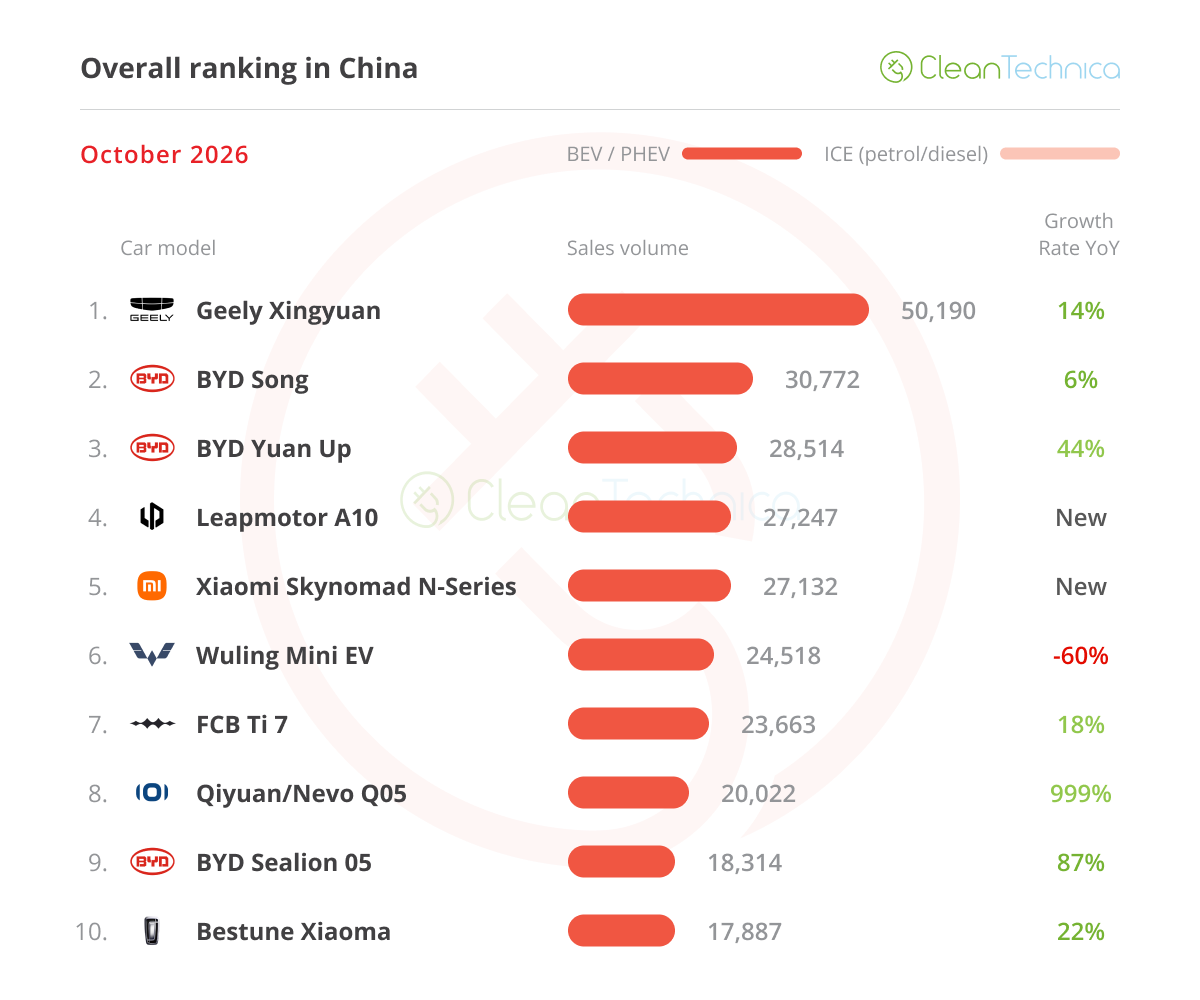
The market is currently defined by a "value-for-money" race, where models like the Geely Xingyuan are setting new benchmarks. The Xingyuan, which recorded 50,190 registrations in October—a 14% increase YoY—has positioned itself as a direct competitor to BYD’s popular Seagull. The success of the Xingyuan highlights the aggressive pricing strategies now standard in the market, with entry-level pricing often hovering around the $10,000 mark.

BYD continues to exert influence across multiple categories. The BYD Song, a midsize SUV, remains a cornerstone of the company’s success, recording 30,772 registrations in October. The latest iteration of the Song, which incorporates advanced lidar technology and high-speed DC charging capabilities, demonstrates that Chinese manufacturers are no longer just competing on price, but are increasingly leading in technological implementation. Similarly, the BYD Yuan Up has seen a 44% YoY increase in sales, proving the effectiveness of the company’s strategy to offer premium-adjacent features in a compact, affordable crossover package.
Startups are also demonstrating agility. Leapmotor’s A10 has become a standout performer, with 27,247 registrations in October. By avoiding the generic "white product" design language and offering a distinct aesthetic combined with a $10,000 starting price, the A10 has captured a significant portion of the budget-conscious, tech-savvy demographic.

The entry of Xiaomi into the full-size SUV segment with the Skynomad N-Series further complicates the market for legacy manufacturers. Recording 27,132 registrations in only its second month on the market, the N-Series has effectively cannibalized sales from traditional premium luxury brands, proving that consumer loyalty is shifting toward brands that offer superior digital ecosystems.
The Declining Fortunes of Foreign OEMs
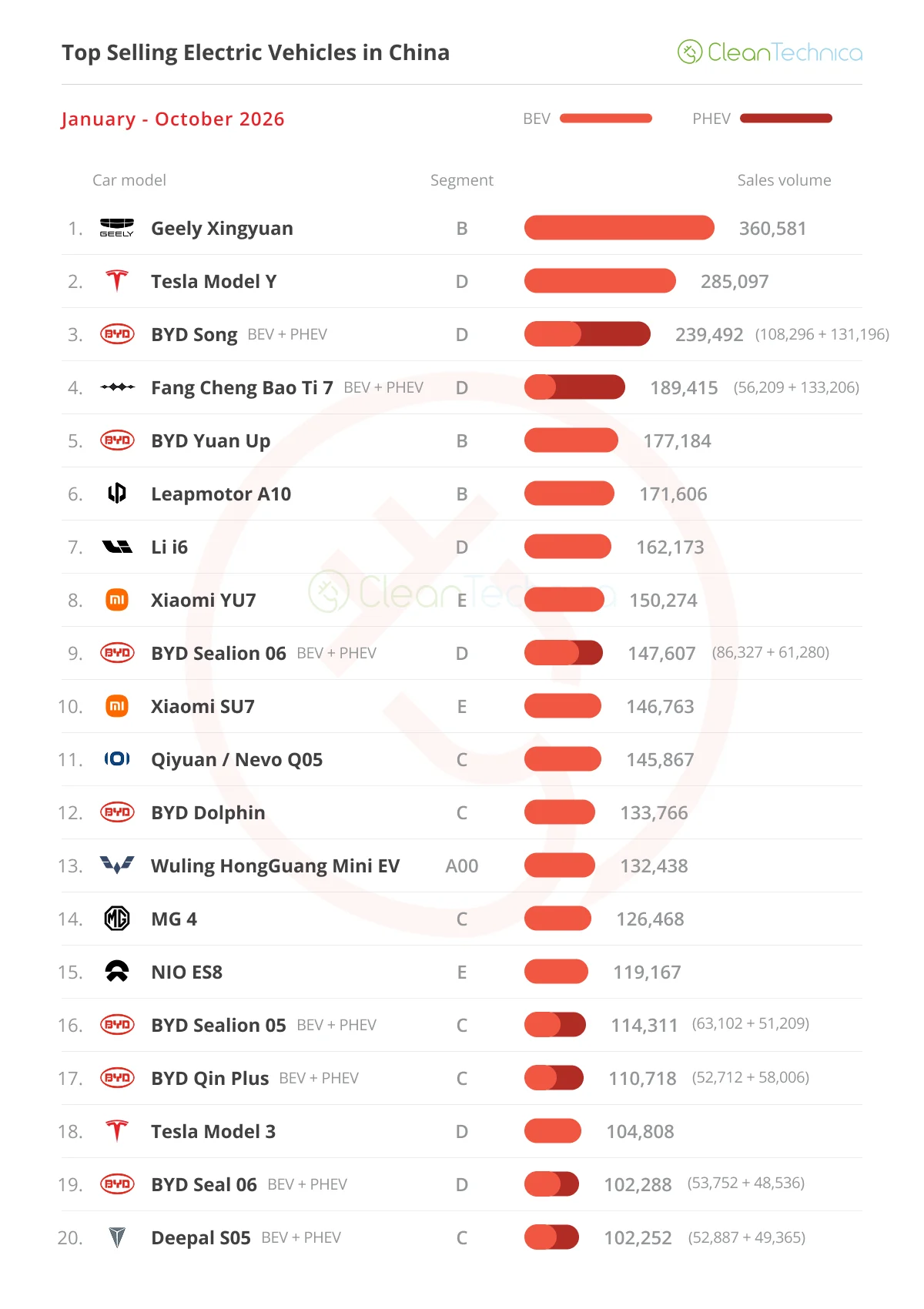
The "sea of red" in the manufacturer rankings paints a grim picture for many foreign automakers. Nissan reported a 70% decline in sales for October, while Honda saw a 51% drop. Even the once-dominant Tesla has struggled, with the Model Y seeing a 60% decline YoY and the Model 3 plummeting by 85%.

Volkswagen, however, has shown potential signs of a turnaround. The introduction of the China-developed ID.Aura T6 has allowed the German automaker to gain a foothold in the competitive crossover market, marking the first time in recent history that a foreign-developed EV has successfully challenged the volume of local competitors. Whether this is a sustainable trend or a temporary market correction remains to be seen, as VW continues to face intense pressure from domestic brands that can iterate on software and hardware at a significantly faster pace.
Strategic Implications and Future Outlook
The rapid rise of the EV market in China serves as a global case study for the decarbonization of the transport sector. The transition is no longer solely driven by environmental policy but by market forces: consumers are choosing EVs because they offer better value, higher technology, and lower operating costs compared to their ICE counterparts.

For the global automotive industry, the implication is clear: the Chinese market has largely moved beyond the "early adopter" phase. The consolidation of market share among a few dominant players—namely BYD, Geely, and emerging startups like Leapmotor—suggests that the window for legacy ICE manufacturers to pivot is closing.
As of October 2026, BYD maintains a commanding 21.9% share of the total market, followed by Geely at 11.8%. The rise of Leapmotor, which now holds a 6.7% market share, indicates that the competitive landscape remains fluid, but increasingly hostile to companies that cannot produce competitive, mass-market electric vehicles.

In the coming months, the focus for analysts will be on whether the current pace of electrification can be sustained as the market reaches saturation. With the Chinese government likely to maintain support for infrastructure development and the industry continuing to drive down the cost of battery technology, the "ICE extinction" is no longer a speculative theory—it is a measurable, ongoing industrial phenomenon. The success of smaller, localized, and highly digitized vehicles suggests that the future of mobility in China will be defined by accessibility and integration, leaving the internal combustion engine to become a relic of the previous century.