
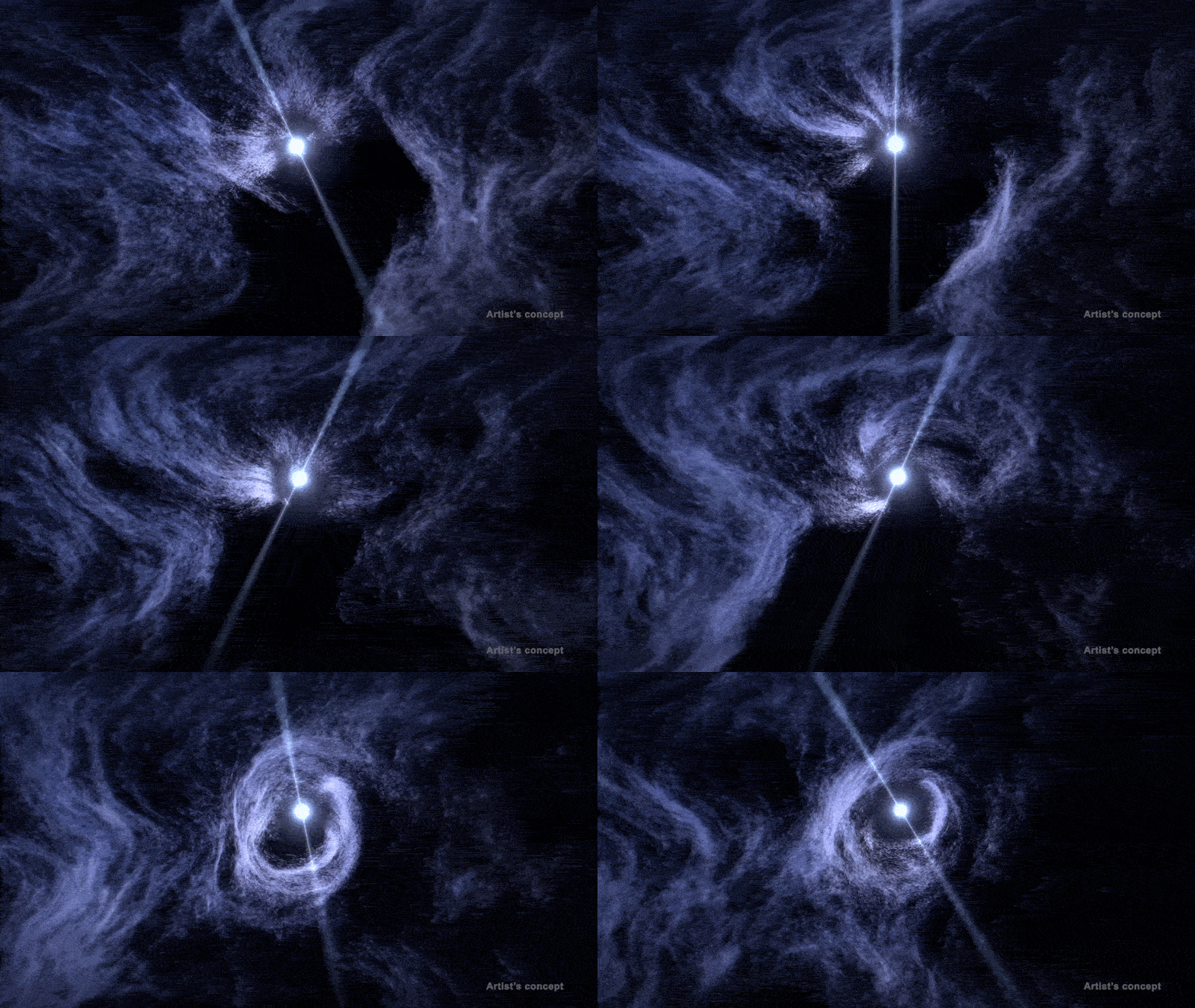
Deep within the Milky Way, approximately 13,000 light-years from Earth, an extraordinary celestial dynamic is unfolding between two vastly different stellar remnants. Astronomers studying a unique binary star system designated as BP Crucis have uncovered the driving force behind a series of mysterious, repeating X-ray flares. The phenomenon, described colloquially by researchers as an ongoing cosmic "fart," involves massive stellar winds emitted by a hypergiant star feeding an ultradense neutron star. This unprecedented observation provides astrophysicists with critical insights into the extreme gravitational and magnetic interactions that govern high-mass X-ray binary systems.
The binary system houses two distinct stellar entities locked in a volatile gravitational dance. The primary component is Wray 977, a luminous blue hypergiant star possessing a mass and volume roughly 60 times greater than that of our sun. Surrounding this stellar behemoth is a powerful, dense stellar wind—a continuous outflow of gas and plasma driven off the hypergiant’s surface. Orbiting within this turbulent environment is the secondary component, GX 301-2, a neutron star. Neutron stars represent the collapsed cores of massive stars that have exhausted their nuclear fuel and ended their lives in catastrophic supernova explosions. Often referred to in astronomical literature as "zombie stars" because they are technically dead remnants devoid of active nuclear fusion, these objects pack a mass greater than the sun into a sphere only about 20 kilometers across, creating gravitational and magnetic fields of unfathomable intensity.
The Mechanics of Stellar Feeding
The interaction between Wray 977 and GX 301-2 is governed by accretion, a process wherein the gravity of the compact neutron star pulls in material from its much larger companion. However, unlike systems where a star smoothly transfers mass to a companion via a stable disk, the relationship in BP Crucis is erratic and violent. The blue hypergiant’s powerful stellar wind regularly sweeps past the neutron star, but the density and velocity of this wind are far from uniform.
As the neutron star traverses its eccentric, 41.5-day orbit around Wray 977, it plunges periodically through dense streams of gas ejected by the hypergiant. These episodic injections of stellar material—essentially colossal burps of gas streaming from the hypergiant—overwhelm the neutron star’s magnetic field defenses. The infalling matter is funneled violently toward the neutron star’s magnetic poles, accelerating to a significant fraction of the speed of light. Upon slamming into the ultra-dense surface, the kinetic energy of this gas is instantly converted into high-energy radiation, manifesting as brilliant pulses of X-rays that beam across interstellar space toward Earth.
Chronology of the Discovery
The investigation into the BP Crucis system represents decades of cumulative astrophysical research, culminating in the recent high-resolution data analysis.
In the late 20th century, orbiting X-ray observatories first detected fluctuating high-energy emissions from the region of the sky designated as GX 301-2. Early observations established that the X-ray source was variable, showing regular periodicity linked to an orbital motion. However, the precise mechanisms governing the irregular, massive flares that occasionally spiked above the baseline signal remained poorly understood due to limitations in spatial and spectral resolution.
By the early 2000s, advanced space telescopes, including NASA’s Chandra X-ray Observatory and the European Space Agency’s XMM-Newton, began capturing higher-fidelity data of the system. These instruments allowed astronomers to map the geometry of the binary system with unprecedented precision, confirming that the neutron star’s orbit is highly elliptical and that it makes its closest approach, or periastron, deep within the stellar wind of Wray 977.
In the years leading up to the most recent study, continuous monitoring by modern high-energy satellites captured the prelude and aftermath of specific mass-transfer events. Researchers meticulously tracked how changes in the density of the hypergiant’s stellar wind directly correlated with delays and intensity shifts in the X-ray flares observed on Earth. The recent findings synthesize decades of archival data with fresh, real-time observations, finally painting a complete picture of how the hypergiant’s unstable mass loss drives the neutron star’s erratic behavior.
Supporting Data and Observational Metrics
The scale of the BP Crucis system highlights the extreme physics at play. Wray 977 boasts a luminosity hundreds of thousands of times greater than that of the sun, shedding mass at rates that far exceed ordinary stellar winds, such as the solar wind emitted by our star. The hypergiant loses millions of tons of matter every single second through these ferocious outflows.
Meanwhile, the neutron star GX 301-2 exerts a surface gravity roughly 100 billion times stronger than Earth’s gravity. When the dense plumes of gas from Wray 977 intersect with this intense gravitational well, the accretion rate spikes dramatically. Data captured during peak flare events indicate that the X-ray luminosity increases by orders of magnitude over a matter of hours. Spectral analysis of the emitted X-rays reveals distinct emission lines corresponding to iron and other heavy elements, confirming that the infalling matter is being shock-heated to temperatures of tens of millions of degrees Kelvin as it impacts the neutron star’s crust.
Scientific Consensus and Expert Analysis
Astrophysicists analyzing the data have emphasized the value of BP Crucis as a natural laboratory for testing theories of stellar evolution and magnetohydrodynamics. Dr. Elena Vance, an astrophysicist specializing in high-energy binary systems who was not directly involved in the primary study, noted the significance of the findings for understanding stellar lifecycles.
"Systems like BP Crucis are exceptionally rare because they catch a very brief, highly dynamic phase of stellar evolution," Vance stated. "We are witnessing the direct consequences of unstable mass-loss from a supergiant interacting with one of the most extreme objects in the universe. The regularity of the orbit combined with the chaos of the stellar wind creates a unique laboratory where we can test our models of accretion physics under extreme conditions that can never be replicated in a terrestrial laboratory."
Furthermore, theoretical modelers have pointed out that studying these systems helps bridge the gap between stellar physics and high-energy astrophysics. The dynamics observed in BP Crucis demonstrate that massive stars do not shed their mass in neat, predictable layers; rather, the process can be episodic, violent, and heavily influenced by external gravitational partners.
Broader Impact and Future Implications
The implications of these findings extend well beyond the specific quirks of the BP Crucis system. High-mass X-ray binaries serve as crucial waypoints for understanding the chemical enrichment of the galaxy. The material driven off stars like Wray 977, enriched by nuclear fusion products over millions of years, is returned to the interstellar medium, where it eventually forms the building blocks for subsequent generations of stars and planets.
Additionally, the behavior of neutron stars in these binary configurations offers indirect clues about the behavior of matter under extreme densities—conditions that approach the limits of nuclear physics. By measuring how efficiently a neutron star can capture and process infalling matter from a stellar wind, physicists gain better constraints on the equation of state for degenerate matter.
As space agencies continue to deploy next-generation X-ray observatories with enhanced sensitivity and timing capabilities, astronomers expect to uncover many more subtle details regarding the interactions between hypergiant winds and neutron stars. Future observation campaigns will likely focus on tracking the velocity profiles of Wray 977’s stellar wind in real-time, matching those measurements against simultaneous X-ray outbursts captured by orbiting telescopes. Through these continued efforts, the mysterious, volatile relationship between the blue hypergiant and its zombie companion will continue to yield valuable secrets about the most energetic corners of our universe.










Leave a Reply