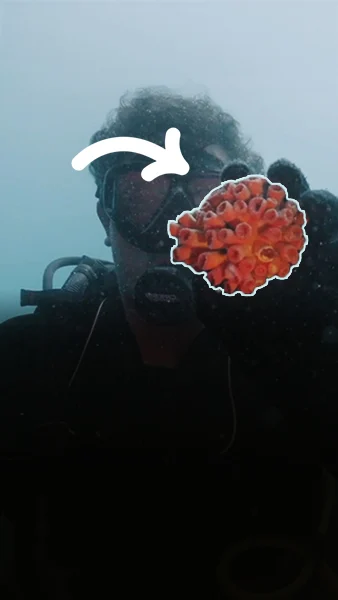
Off the sun-drenched shores of Rio de Janeiro’s world-famous Ipanema beach, a desperate underwater battle is being waged beneath the waves. While beachgoers enjoy the scenic coastline, a dedicated team of Brazilian scientists and volunteer divers are actively destroying coral reefs just a few kilometers offshore. However, this seemingly counterintuitive act of ecological destruction is, in fact, a vital rescue mission. Led by Brazilian biologist Adriana Gomes, the team is systematically targeting and removing colonies of sun coral (Tubastraea spp.), an aggressive invasive species that threatens to destabilize local marine ecosystems, displace native species, and devastate biodiversity within a protected offshore marine area.
The strategy relies on raw determination and manual labor. Armed with scrapers, chisels, and mesh bags, Gomes and her crew of volunteer divers descend to the concrete and steel pylons of an offshore oil platform—artificial structures that have inadvertently become heavily colonized hotspots for the invasive organism. By scraping the bright orange polyps directly from the underwater infrastructure, these conservationists are attempting to roll back a decades-long ecological invasion before it permanently alters Brazil’s coastal waters.
The Background and Origin of the Sun Coral Crisis
To understand the scale of the challenge facing Gomes and her volunteers, it is necessary to examine how the sun coral arrived in Brazilian waters and why its spread has become a national environmental emergency. Native to the Indo-Pacific region, including the warm waters of the Indian and Pacific Oceans, Tubastraea species were first documented in Brazilian waters more than forty years ago, during the early 1980s.
Marine biologists believe the species was inadvertently introduced to South American waters through commercial shipping. Sun coral larvae can attach themselves to the hulls of cargo vessels, oil tankers, and drilling rigs, or survive within ballast water discharged into foreign ports. Once introduced to a new environment, invasive species often thrive if they encounter favorable conditions and a lack of ecological checks and balances.
This was precisely the case in Brazil. In its native habitat, the sun coral’s population is kept in check by a variety of natural predators, including specialized fish species, crustaceans, and diseases that have evolved alongside the coral over millennia. However, in the tropical and subtropical waters of the southwestern Atlantic, these natural predators are entirely absent. Free from predation and boasting a high reproductive rate—capable of both sexual and asexual reproduction—the sun coral began to colonize artificial and natural hard substrates with alarming speed.
Over the past four decades, the invasion has expanded from initial isolated sightings in Rio de Janeiro state to thousands of kilometers of the Brazilian coastline, stretching from Santa Catarina in the south all the way to northeastern states like Maranhão.
The Ecological Threat to Native Marine Life
The unchecked proliferation of sun coral represents a severe threat to the native biodiversity of Brazil’s marine ecosystems. Unlike soft corals or certain sponges that integrate relatively harmoniously into local food webs, the sun coral is a formidable competitor for space and resources.
Marine researchers point out that Tubastraea forms dense, sprawling colonies that grow rapidly over rocky reefs, artificial platforms, and even living colonies of native corals. Because the sun coral is a hardy and aggressive feeder—capturing plankton with its tentacles day and night—it easily outcompetes native filter-feeders for sustenance. As the invasive colonies expand, they physically smother native marine wildlife, including indigenous coral species, sponges, hydroids, and tunicates, effectively creating underwater monocultures that drastically reduce regional biodiversity.
Furthermore, offshore oil and gas platforms, which are ubiquitous along the Campos and Santos basins off the coast of Rio de Janeiro, provide ideal artificial habitats for the sun coral. The vertical steel and concrete structures act as stepping stones, allowing the invasive larvae to drift along ocean currents from one platform to another, eventually spreading to pristine natural islands and protected marine reserves such as the Cagarras Islands Archipelago near Ipanema.
A Race Against Time: The Chronology of the Intervention
The fight against the sun coral has evolved significantly over the years, transitioning from academic observation to active, boots-on-the-deck environmental management.
During the 1980s and 1990s, the presence of sun coral was largely viewed as a localized curiosity by marine researchers. However, by the early 2000s, monitoring programs revealed that the organism was spreading exponentially along the southeastern Brazilian coast. Environmental agencies and academic institutions began mapping the invasion, publishing alarming data regarding its ecological footprint.
By the 2010s, it became evident that passive monitoring and academic studies were insufficient to halt the spread. Government bodies, non-governmental organizations (NGOs), and research laboratories initiated localized removal campaigns. It was within this climate of urgency that marine biologists like Adriana Gomes mobilized citizen-science initiatives.

In recent years, Gomes and her team established systematic removal protocols. Working in coordination with regulatory bodies and industry stakeholders—including agreements to access offshore oil and gas infrastructure—the volunteer dive teams began conducting targeted eradication sweeps. The process is grueling and meticulous. Divers must scrape the coral down to the bare substrate to ensure no surviving tissue remains to regenerate. Every fragment removed must be carefully collected in mesh bags to prevent broken pieces from drifting away and establishing new colonies elsewhere on the sea floor.
The Logistics of Manual Eradication
The methodology employed by Gomes and her volunteers is deceptively simple, yet it requires rigorous discipline and specialized training. Manual removal is currently one of the few viable methods for controlling sun coral on complex structures like oil platforms, where chemical treatments or large-scale mechanical dredging would cause catastrophic collateral damage to surrounding marine life.
Volunteers undergo specialized training in marine conservation, invasive species identification, and safe diving practices around industrial offshore infrastructure. Working at depths ranging from a few meters to over thirty meters, the divers use specialized scrapers and chisels to pry the calcified bases of the coral colonies away from the metal and concrete pylons.
The challenges of this work are manifold. Strong ocean currents, fluctuating visibility, and the logistical hurdles of operating near heavy industrial installations make every dive physically demanding. Additionally, because the sun coral can regenerate from microscopic tissue remnants left behind on a substrate, the divers must achieve near-surgical precision during their underwater sweeps.
Statements and Perspectives from the Scientific and Industrial Communities
While the public often expresses surprise at the notion of environmentalists destroying coral, marine scientists and conservation experts universally support the intervention.
"We are not destroying a coral reef; we are dismantling an ecological invader that is actively destroying our native marine heritage," explains Dr. Carlos Eduardo Ferreira, a marine ecologist specializing in Brazilian reef systems. "If we do not intervene manually and aggressively, the native ecosystems of Rio’s coastal waters will be irreparably altered within a generation."
Representatives from environmental oversight bodies, such as Brazil’s Chico Mendes Institute for Biodiversity Conservation (ICMBio), have increasingly recognized the necessity of public-private partnerships in tackling biological invasions. While energy companies operating offshore platforms bear a legal responsibility to monitor and mitigate environmental impacts, grassroots initiatives led by biologists like Gomes provide the agile human resources required to conduct hands-on eradication dives.
Industry stakeholders have shown a growing willingness to cooperate with conservation teams, granting researchers access to platform legs and providing logistical support. Corporate social responsibility frameworks within the Brazilian energy sector now frequently incorporate biodiversity protection measures, recognizing that unchecked invasive species can create long-term regulatory and environmental liabilities.
Broader Implications and Future Outlook
The battle being fought off the coast of Ipanema highlights a broader, global crisis regarding marine bioinvasions. As international shipping traffic intensifies and ocean temperatures rise due to climate change, marine ecosystems worldwide are becoming increasingly vulnerable to invasive species. Organisms that once found certain waters too cold or too distant can now establish breeding populations far beyond their historic ranges.
For Brazil, the sun coral crisis serves as a cautionary tale and a test case for future marine management. The lessons learned by Adriana Gomes and her team—ranging from the efficacy of manual removal techniques to the mobilization of volunteer divers—are being documented and shared with other coastal nations grappling with similar biological pollutants.
However, researchers are quick to emphasize that manual removal is ultimately a mitigation strategy, not a permanent cure. Unless stricter ballast water regulations are enforced globally, and unless hull-cleaning protocols become mandatory and rigorously inspected at international ports, new waves of invasive species will continue to threaten fragile marine habitats.
As the sun sets over the iconic skyline of Ipanema, the work beneath the surface pauses—only to resume with the next favorable tide. For Adriana Gomes and her dedicated team of volunteers, every successful dive represents a small victory in a relentless war of attrition, buying precious time for Brazil’s native marine wildlife to survive in an increasingly interconnected and vulnerable ocean.