The rapid integration of generative artificial intelligence into software development lifecycles has introduced a profound paradox: while engineering leaders are eager to harness the productivity gains offered by AI agents, they are simultaneously grappling with the significant security and operational risks these tools present to their cloud infrastructure. According to the State of AI in Cloud Development 2026 report, published by LocalStack, a staggering 79% of enterprise software teams have granted AI agents direct access to cloud environments, even as 97% of those same respondents acknowledge deep-seated anxieties regarding the safety of such practices.
This report, based on insights from 309 developers and managers at organizations with more than 1,000 employees, highlights a growing tension between the drive for faster code delivery and the stringent security postures required to protect modern, cloud-native enterprise environments.

The Landscape of AI-Driven Cloud Development
The transition toward AI-assisted development has been swift. In just a few years, the role of AI has shifted from a simple code-completion tool to an autonomous agent capable of interacting with cloud service providers (CSPs) like AWS, Google Cloud, and Microsoft Azure. These agents are tasked with spinning up infrastructure, running automated tests, and debugging complex configurations.
LocalStack, which provides a local emulation platform for AWS services, notes that this phenomenon is particularly pronounced in large-scale enterprises. Among the organizations surveyed, those with more than 5,000 employees are the most aggressive adopters, with 84% granting agents some level of cloud access. In contrast, mid-sized organizations (between 1,000 and 5,000 employees) report a slightly more cautious 72% adoption rate.
The utility of these agents is clear: 65% of surveyed teams reported that their code output has at least doubled since adopting AI, with nearly a third of respondents claiming a fivefold increase in productivity. However, this massive influx of generated code has not translated linearly into higher release velocity. The data suggests that only about 61% of AI-generated code successfully reaches a production environment, implying that a significant portion of the output is discarded, requires substantial manual refactoring, or fails during the integration and security review stages.
A Chronology of Escalating Risks
The integration of AI into the software development life cycle (SDLC) can be viewed in three distinct phases over the last three years.
In 2024, the focus was primarily on "copilot" style tools—assistants that suggested snippets of code within an IDE. During this phase, security risks were largely confined to the local machine, as the AI had no inherent connection to cloud environments.
By 2025, the focus shifted toward "agentic" workflows. AI agents began to receive API keys and IAM (Identity and Access Management) roles, allowing them to communicate directly with staging and testing environments to perform autonomous verification of infrastructure-as-code (IaC) templates.
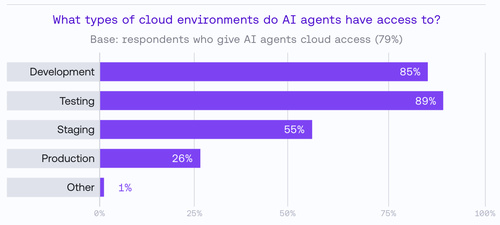
By 2026, the current year of the survey, the scope has expanded to include direct production access in some instances. The survey reveals that 26% of organizations granting cloud access to agents have extended this privilege to production environments. This shift represents a significant escalation in potential risk, moving beyond ephemeral development sandboxes into the core operational backbone of the business.
The Anatomy of Enterprise Concerns
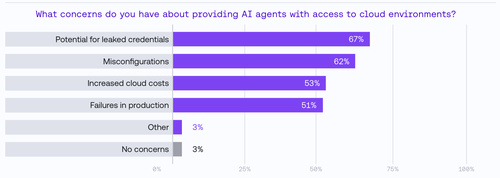
Despite the clear productivity incentives, the anxiety among technical leadership remains near-universal. The 97% of respondents who expressed concerns identified several primary vectors of risk:
- Credential Leaks (67%): This remains the top priority. If an AI agent is compromised or if its configuration scripts are inadvertently pushed to public repositories, the associated cloud credentials could allow unauthorized actors to gain entry to the broader network.
- Configuration Drift and Misconfigurations (62%): AI agents often lack the nuanced understanding of organizational security policies. A well-intentioned agent might open an S3 bucket to the public or create an overly permissive IAM role to "solve" a connectivity issue, creating a latent security vulnerability.
- Unchecked Cloud Costs (53%): AI agents are not inherently budget-conscious. Without guardrails, an agent might spin up thousands of high-compute instances for a stress test, resulting in "bill shock" at the end of the billing cycle.
- Production Instability (51%): The risk of an agent performing an irreversible action in a production environment, such as dropping a database table or deleting a critical load balancer, is a primary driver of skepticism among site reliability engineers (SREs).
Even among the cohort that has fully committed to giving agents access, these concerns do not evaporate. Among those who "always" grant access, 92% still harbor reservations. This indicates that organizations are not ignoring the risks but are instead attempting to manage them through "shadow" governance and incremental adoption, often without a fully mature security framework in place.

The Role of Local Development Environments
LocalStack’s role as a survey provider is contextualized by its own technology, which allows developers to emulate cloud environments locally. The prevailing logic for many organizations is that by shifting the AI’s interaction to a local emulator, the security risk is mitigated. If the AI makes a critical error or executes a harmful command, it happens within a contained local sandbox rather than in the live, billable, and sensitive public cloud environment.
However, the survey makes it clear that local emulation is not the only path forward. Many organizations are choosing to bypass the emulation layer, connecting their agents directly to cloud-based development and staging accounts. While this provides a higher degree of fidelity between development and production, it significantly widens the attack surface.
Implications for DevOps and Security Operations
The findings present a sobering reality for Chief Information Security Officers (CISOs). The "AI-first" development mentality is outpacing the development of "AI-security" guardrails.
From an analytical standpoint, the reliance on AI for production-level tasks poses a challenge to the "Shift Left" security philosophy. Traditionally, security was integrated into the early stages of development. Now, with AI agents generating code and infrastructure, the security focus must shift further left to the "Agentic layer." This involves implementing strict IAM policies specifically for non-human identities, auditing AI-generated infrastructure changes before they are applied, and enforcing budget caps at the API level.
Furthermore, the gap between the amount of code produced and the amount shipped suggests that AI may be contributing to a "technical debt bubble." If 39% of AI-generated code is not making it to production, that code must still be reviewed, managed, or deleted by human engineers, potentially negating the very productivity gains that motivated the adoption of the agents in the first place.
Moving Toward Secure AI Adoption
Industry analysts suggest that the current state of AI cloud development is in a "Wild West" phase. As organizations mature, they are expected to implement more robust identity management for AI entities. This includes:

- Scoped Permissions: Granting agents access only to the specific resources they need, rather than broad "administrator" or "developer" roles.
- Human-in-the-Loop (HITL) Requirements: Requiring manual approval for any infrastructure changes suggested by an agent that occur in staging or production.
- Ephemeral Environments: Using automation to spin up cloud environments for the agent and tearing them down immediately after the task is completed, minimizing the window of opportunity for attackers to exploit an agent’s credentials.
The LocalStack survey underscores that while AI is fundamentally transforming how software is built, the transition is far from seamless. The industry is currently operating on a high-risk, high-reward model. The path toward a sustainable future for AI-augmented cloud development will likely require a shift in focus from merely increasing the speed of output to establishing ironclad governance and observability protocols that keep pace with the agents themselves.
As organizations continue to integrate these tools into their workflows, the 2026 landscape serves as a reminder that technological capability does not equate to operational security. For the foreseeable future, the human element—the architect, the CISO, and the developer—must remain the final authority in the cloud, even when the code is written by an algorithm.