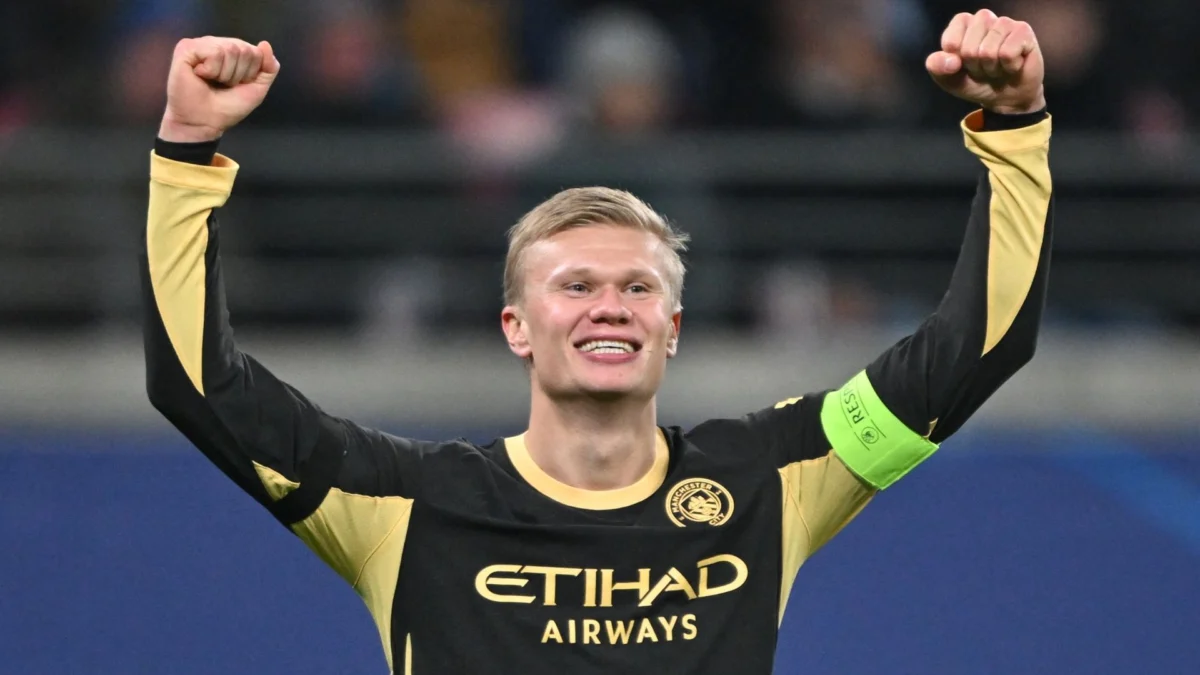
The UEFA Champions League returned to the Red Bull Arena this week, delivering a high-octane encounter that underscored both the clinical brilliance of Erling Haaland and the lingering defensive fragilities currently plaguing Enzo Maresca’s Manchester City. In a match that ebbed and flowed with chaotic intensity, City emerged with a crucial 3-2 victory, propelled by a late winner from their talismanic Norwegian striker, who continues to find the back of the net against the German side with remarkable consistency.
The result serves as a vital restorative measure for the Citizens, who arrived in Germany following a disappointing domestic setback against Brighton. While the win elevates City to seventh in the tournament’s newly formatted league phase table, the performance raised significant questions regarding their defensive stability and the form of goalkeeper Gianluigi Donnarumma.
A Chronology of Chaos
The match began with a sense of tactical tension, as RB Leipzig sought to exploit the space behind City’s high defensive line. Christoph Baumgartner and Antonio Nusa provided early threats, constantly testing the resolve of the visitors’ backline. However, the deadlock was broken in the most fortuitous of circumstances. A low delivery into the penalty area prompted a defensive collapse from Leipzig’s Castello Lukeba, who inadvertently turned the ball into his own net, gifting Manchester City a lead they had not entirely earned through creative play.
The second half shifted the narrative entirely. Donnarumma, who had looked shaky throughout the first period, produced a momentary flash of brilliance to deny Baumgartner, but his composure evaporated mere seconds later. Ridle Baku, stationed on the right flank, exploited the narrow angle at the near post to beat the Italian international, leveling the score and igniting a frantic sequence of events.
With the game becoming a transition-heavy battle, City reclaimed the initiative. Iliman Ndiaye, demonstrating vision and precision, delivered a pinpoint cross into the box, allowing Enzo Fernandez to rise highest and power a header home. The lead lasted only 180 seconds. A relentless Leipzig side responded almost immediately through Nusa, who fired a low, clinical strike into the bottom right corner, leaving Donnarumma helpless and the score locked at 2-2.
The decisive moment arrived 12 minutes from time. Following the introduction of Jeremy Doku, who injected pace into the City attack, Elliot Anderson threaded a low ball across the face of goal. Haaland, who had been largely peripheral for the majority of the contest with only a handful of touches, ghosted into the six-yard box to tap home the winner. A late effort from David Raum that struck the woodwork and a counter-attacking attempt from Rayan Cherki ensured a white-knuckle finish, but City held firm to claim the points.
The Haaland Factor and Tactical Nuance
Erling Haaland’s strike marked his 13th goal in just nine appearances against RB Leipzig, a staggering statistic that cements his status as the primary tormentor of the Bundesliga outfit. His ability to remain dormant for long stretches of a match before delivering a lethal blow remains the hallmark of his game.
Reflecting on his record against the German side, Haaland was characteristically blunt. "I think it is the most I have scored against a club," he noted. "I have played so many times against them in the Champions League with City and Borussia Dortmund too. Leipzig is a good team, so I am happy."
Beyond his individual exploits, Haaland was quick to praise newcomer Elliot Anderson, whose assist proved vital. "He has had an amazing start to his City career. It is not easy to come in, you need to adapt to new players and a new coach, so he has been impressive."
However, Haaland’s assessment of the team’s collective performance was marked by a call for greater clinical ruthlessness. "I’m not sure how many touches I had today, not the most, but the most important thing is that I managed to help the team win. I think we need to step up a bit. When we were 1-0 up, we needed to go for the second goal and then the third. We have to work on that."
Defensive Fragilities and Donnarumma’s Struggles
The primary talking point following the final whistle centered on the performance of Gianluigi Donnarumma. The goalkeeper’s inability to command his penalty area has become a recurring theme in City’s European campaign. His culpability in Leipzig’s first goal, where he appeared caught between coming for a cross and holding his line, invited unnecessary pressure.
Critics have pointed to a lack of synchronization between the goalkeeper and his center-backs. During the frantic finale, a free-kick from David Raum rattled the crossbar while Donnarumma appeared paralyzed by indecision. While he is capable of match-winning saves, his current inconsistency is a liability that could prove costly as the competition progresses into the knockout stages. For a team with ambitions of lifting the trophy, the reliability of the last line of defense is non-negotiable.
Managerial Perspective: Balancing Transition and Control
Manchester City head coach Enzo Maresca acknowledged the difficulty of the assignment, emphasizing the hostile nature of away games in the Champions League. "Tough game in some moments," Maresca stated post-match. "We controlled quite well, but some moments we struggled. Germany away is tough, so I am happy with the three points."
Maresca’s focus on the tactical transition highlights a broader issue for City this season. While they remain an offensive juggernaut, they are increasingly vulnerable to counter-attacking sides. "They are well-organized, they were aggressive and dangerous with the wingers. We needed to be careful on transition," the coach admitted. His mandate for the coming weeks will likely involve tightening the midfield structure to ensure that when the team loses possession, they are not left exposed to rapid breaks.
Broader Implications and Statistical Context
The victory moves Manchester City into a more comfortable position within the league phase standings, providing a buffer as they navigate a dense fixture list. The Champions League’s new league-wide format places a higher premium on every point, as goal difference and total points become critical for securing a top-eight finish and avoiding the playoff round.
For RB Leipzig, the result is a bitter pill to swallow. Despite matching City in intensity and creating a comparable number of high-quality chances, their inability to contain Haaland ultimately cost them. The German side remains a dangerous proposition, but their defensive lapses, epitomized by the own goal, suggest they lack the experience required to close out matches against elite-tier opponents.
Looking ahead, Manchester City must now turn their attention back to domestic duties. The defeat to Brighton remains a fresh memory, and the defensive gaps exposed by Leipzig will surely be highlighted in scouting reports by upcoming Premier League challengers. Maresca’s side possesses the attacking firepower to overwhelm almost any opponent, but if they are to reclaim their status as the dominant force in European football, they must find a way to marry that offensive output with a more disciplined and secure defensive structure.
The road to the Champions League final is long, and while the win in Leipzig was a testament to City’s resilience, it was also a warning. The margins at the top of the game are razor-thin, and as Haaland noted, the requirement to "step up" applies to the entire squad, not just the goalscorers. For now, the three points are secured, but the work required to turn this iteration of Manchester City into a championship-winning unit is clearly still in progress.