In the hillside and peripheral neighborhoods of Recife, capital of Pernambuco state in Northeast Brazil, daily life is governed by an unrelenting struggle for basic survival. At 4 a.m., long before the urban center stirs, 27-year-old Jeyne Araújo begins a routine defined by scarcity. Tucked into the neighborhood of Ibura de Baixo in the city’s South Zone, Araújo drags heavy plastic buckets and drums across her floor. With municipal tap water flowing for only six hours a day—and often unpredictably—she must stockpile every available drop before the supply cuts out entirely.

The water that finally arrives is rarely fit for consumption. It pours out heavily chlorinated, emitting a chemical odor and frothing into a dense, soapy white foam. "It arrives so full of chlorine that you can’t do anything with it," Araújo explains.
This systemic water insecurity is not merely an inconvenience; it is a public health hazard. For six months, Araújo’s 9-year-old son, Wesley, suffered from persistent vomiting and severe stomach pain. Medical professionals at Recife’s Areias Hospital ultimately traced the boy’s intestinal infections to porridge prepared using unfiltered tap water. To safeguard her family, Araújo now allocates a significant portion of her monthly Bolsa Família welfare benefit—totaling 950 reais (approximately $180)—to purchase bottled water at 6 reais ($1.12) per jug, severely straining an already meager household budget.

Araújo’s plight exemplifies a broader, systemic crisis documented across the Pernambuco capital. According to a specialized "water map" produced by Mongabay through the cross-referencing of supply schedules from the Pernambuco Sanitation Company (Compesa) with microdata from the Brazilian Institute of Geography and Statistics (IBGE) 2022 census, water rationing in Recife is heavily stratified along racial, gender, and socioeconomic lines.
Mapping Inequality: Environmental Racism in the Urban Landscape
Experts increasingly describe the city’s bifurcated water distribution as a manifestation of environmental and water racism, wherein an individual’s skin color, gender, and postal code dictate their access to vital resources and protection from climate hazards.

An analysis of 311 surveyed locations across Recife reveals that 236 face chronic, severe supply interruptions. These shortages disproportionately affect Black and mixed-race women living in peripheral neighborhoods where average monthly per capita incomes range from 1,100 to 2,300 reais ($206 to $430).
Under benchmarks established by the National Water and Basic Sanitation Agency (ANA), service interruptions lasting six hours or longer are classified as intermittent. The regulatory framework dictates that potable water should be accessible for more than 18 hours a day—equaling at least 540 hours in a 30-day month. However, peripheral areas analyzed in Recife receive a mere fraction of this benchmark. Ibura records the lowest water access in the city, providing residents with an average of just 91 hours of water per month—roughly 17% of the regulatory minimum.

The geography of this disparity is stark. While peripheral communities ration water by the bucket, affluent coastal neighborhoods such as Boa Viagem—which boasts some of the highest real estate values in the city—along with Apipucos and Espinheiro, enjoy near-continuous service exceeding 700 hours per month. In these upper-class enclaves, where the population is predominantly white and average monthly incomes climb between 7,000 and 16,000 reais ($1,309 to $2,992), water scarcity is virtually nonexistent.
Antônio Miranda, a civil engineer and member of the Permanent Technology Committee at the Regional Council of Engineering and Agronomy (CREA), characterizes the disparity as deeply institutionalized. With nearly five decades of professional experience, Miranda notes that while wealthier residents bypass public utility failures by drilling private deep wells, installing sophisticated filtration systems, or purchasing private water trucks, peripheral communities endure a "permanent calendar of water rationing from January to January."

Structural Scarcity and Climate Vulnerability
The crisis is compounded by the region’s severe natural limitations. Pernambuco holds the lowest per capita water availability of any Brazilian state, averaging just 1.27 million liters (335,000 gallons) per capita per year—a mere 3.6% of the national average. Data from the Pernambuco Water and Climate Agency (Apac) highlights that the state’s natural water reserves mirror those of arid desert regions, a structural deficit that intensifies moving inland toward the semi-arid agreste and sertão.
This natural scarcity intersects dangerously with topographical risks. In neighborhoods like Linha do Tiro, perched on the steep hills of Recife’s North Zone, residents receive between 100 and 268 hours of water per month—less than half the federal minimum. Compounding this, the entire sector is designated by Civil Defense authorities as a high-risk (R3) or very high-risk (R4) zone for floods and landslides.

Residents face a cruel paradox: They live in constant dread of mudslides rushing down unstable hillsides during torrential downpours, yet their water taps remain dry for days at a time. For 44-year-old domestic worker Joana, who lives on the slopes of Linha do Tiro with her husband and children, the topography demands constant vigilance. During the rainy season, the family stays awake through the night monitoring the shifting earth outside their window; during dry spells, they navigate a rationing cycle of two days with water followed by three bone-dry days, occasionally stretching to 15 consecutive days without a drop from the municipal lines.
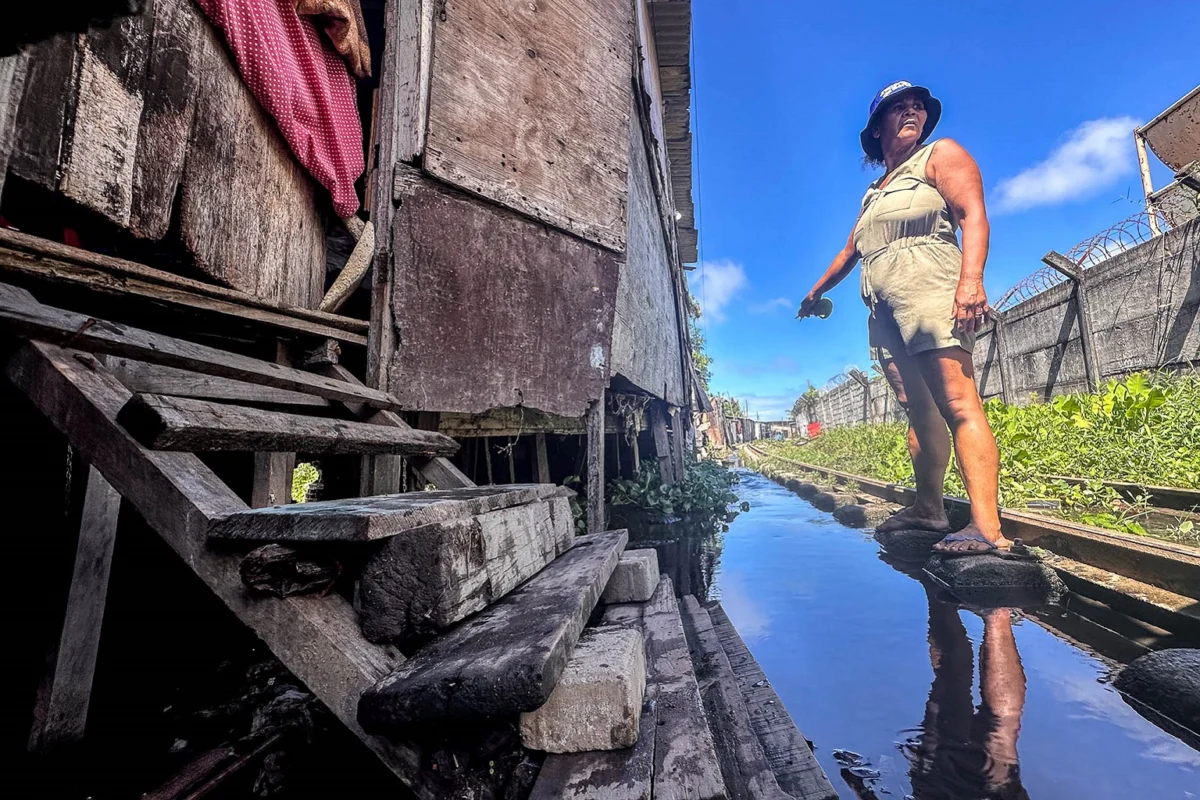
Similarly, in informal settlements like Cacique Chicão within Ibura, water insecurity converges with a complete absence of basic sanitation. Alessandra Maria da Silva, a 51-year-old unemployed kitchen assistant, has spent nine years navigating a wooden stilt shack where reaching the front door requires balancing across abandoned railway tracks suspended over pools of stagnant water and floating trash. Municipal construction projects in the area installed drainage pumps that push raw sewage directly in front of residents’ doorsteps, exacerbating health issues including chronic skin infections and gastrointestinal distress.

The Privatization Debate and Legal Frameworks
As the crisis deepens, the political landscape surrounding water management has shifted dramatically. Ahead of a reelection bid, Pernambuco Governor Raquel Lyra signed a controversial partial concession contract with BASA Saneamento in April 2026. The 35-year deal involves 17.4 billion reais ($3.3 billion) in projected investments across 151 municipalities, transferring the distribution of water and collection of sewage to the private sector.
The move has drawn intense backlash from labor groups, civil engineers, and public sanitation advocates. Anderson Quadros, president of the Association of Higher-Level Employees of Compesa (Procompesa), argues that the agreement cherry-picks the system’s most lucrative segments—distribution and billing—while leaving water extraction and production, which are the costliest and most vulnerable to climate change, under the state-run utility Compesa.

"People say the private sector will invest billions, but this target does not appear in any contractual clause. It is merely a reference figure," Quadros states, warning that private concessionaires will likely prioritize profit margins and neglect costly infrastructure projects in rugged, hard-to-reach hillside communities.
Proponents of the model argue otherwise. BASA Saneamento rejected claims of selective investment, affirming in a statement that the contract mandates 15.4 billion reais in infrastructural enhancements over its lifespan, with funds allocated via technical criteria to ensure full expansion targets are met across all 151 municipalities, including peripheral and hillside zones. The Pernambuco state government similarly defended the arrangement, asserting that no contractual provision permits differential treatment based on economic profitability.

However, critics point to historical precedents, such as a previous public-private partnership with sanitation firm BRK in Greater Recife, where critics allege the company failed to expand sewage networks up a single hillside over a 13-year period. Furthermore, concerns have been raised regarding the financial viability of Compesa, with union analysts projecting heavy operational losses under the new wholesale tariff structures established by the concession.
Environmental Degradation of Watersheds
Underpinning the daily water shortages in Recife’s urban core is the severe degradation of the broader regional watershed. Greater Recife relies primarily on seven major reservoirs—Pirapama, Tapacurá, Botafogo, Gurjaú, Duas Unas, Bita, and Utinga—alongside the Beberibe groundwater aquifer.

Maria do Carmo Sobral, a civil engineer and professor at the Federal University of Pernambuco (UFPE), warns that the metropolitan area has reached its physical limits for surface water extraction. "The last major water source was Pirapama. We have no other river to tap within a 40- to 50-kilometer radius," Sobral notes.
Protecting these remaining reserves requires strict ecological management, including the restoration of riparian forest buffers spanning at least 100 meters around reservoirs to prevent agricultural runoff, industrial waste, and sugar-cane mill effluents from polluting the raw water supply. Furthermore, experts emphasize that mitigating the crisis requires modernizing distribution infrastructure to address massive leaks, which currently result in the loss of up to 50% of all treated water before it reaches the consumer.

The Path Forward
Back in Ibura de Baixo, Jeyne Araújo remains caught between the compounding pressures of infrastructural neglect and climate vulnerability. Her household carries the psychological scars of the catastrophic May 2022 floods, during which her partner tragically died after stepping on a live wire submerged in floodwaters—an emergency where power grid shutdowns were severely delayed.
With Brazil’s federal sanitation legal framework mandating 99% population coverage for treated water and 90% for sewage collection by 2033, the state faces a narrow window to reconcile its economic policies with human rights. For thousands of residents in Recife’s marginalized zones, achieving this target is not merely a legal benchmark, but an essential prerequisite for basic dignity, health, and survival.