The European Union has reached a significant milestone in its transition toward sustainable mobility, with new research indicating that public charging infrastructure is expanding at a rate that exceeds the growth of the electric vehicle (EV) fleet in nearly every member state. According to a comprehensive analysis conducted by the advocacy group Transport & Environment (T&E), the bloc has successfully established a robust network of over 1.1 million public chargers as of the end of 2023. This figure represents a fivefold increase in infrastructure capacity since 2020, signaling that the continent is preparing for a massive surge in electric car sales projected for 2025 and 2026.
While the majority of the European Union is successfully navigating the transition, the report highlights a singular outlier: Malta. Excluding this Mediterranean island nation, every EU country is currently meeting or exceeding the binding fleet-based targets set by the European Commission. This development suggests that the legislative framework designed to eliminate "charging anxiety" is functioning as intended, providing a solid foundation for the phase-out of internal combustion engine vehicles.
The Legislative Framework: Understanding AFIR and Fleet-Based Targets
The primary driver behind this rapid expansion is the Alternative Fuels Infrastructure Regulation (AFIR), a cornerstone of the EU’s "Fit for 55" package. AFIR was designed to ensure that the rollout of charging stations remains proportional to the number of electric vehicles on the road. The regulation mandates that member states provide a minimum of 1.3 kilowatts (kW) of public charging power for every battery electric vehicle (BEV) registered in their national fleet.
By the conclusion of the first quarter of 2024, the analysis reveals that the EU as a whole had not only met this requirement but had exceeded the aggregate fleet-based target by 180%. This surplus of capacity is a strategic buffer, ensuring that even as manufacturers launch more affordable EV models in the coming years, the infrastructure will be ready to accommodate them.

The AFIR targets were implemented to solve the "chicken and egg" dilemma that long plagued the EV industry: consumers were hesitant to buy electric cars due to a lack of chargers, while private companies were reluctant to install chargers without a critical mass of EVs on the road. By mandating these targets, the EU has effectively de-risked the market for charging point operators (CPOs) and provided clarity for automotive manufacturers.
Distance-Based Requirements and the TEN-T Network
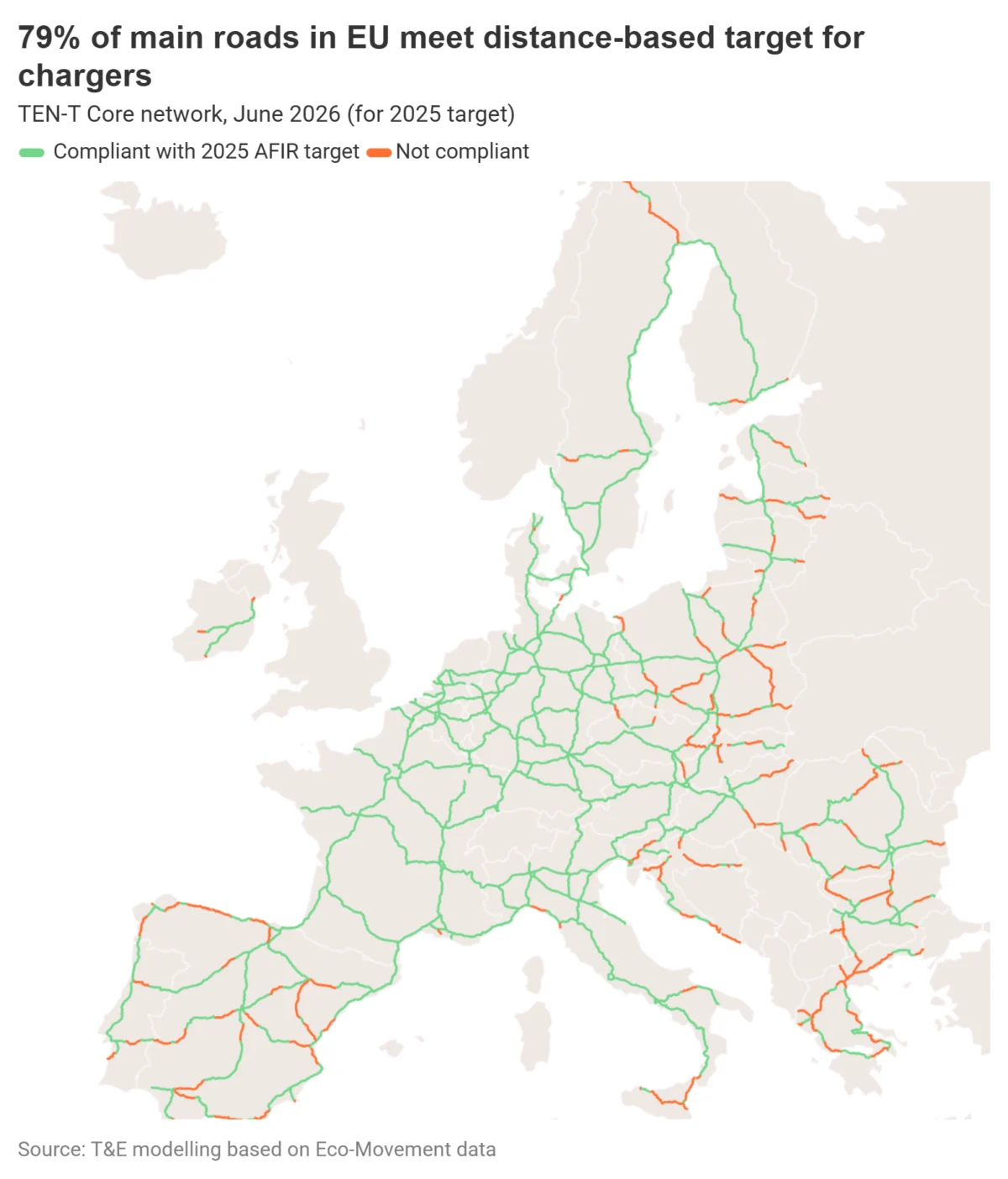
Beyond fleet-based metrics, the EU has established strict distance-based targets to facilitate long-distance travel across the continent. The AFIR law requires that dedicated fast-charging hubs, featuring chargers with a minimum output of 150 kW, be installed every 60 kilometers along the Trans-European Transport Network (TEN-T).
The TEN-T is divided into two categories: the "Core" network, which includes the most vital motorways and arteries connecting major cities and ports, and the "Comprehensive" network, which covers regional routes. The T&E research shows impressive progress in both areas:
- The Core Network: As of June 2024, 79% of the Core network had already met the ultra-fast charging requirements set for 2025. This ensures that for the vast majority of primary European transit routes, drivers of high-performance EVs can recharge their batteries in 20 to 30 minutes, mirroring the convenience of traditional refueling.
- The Comprehensive Network: The progress on regional roads is even more ahead of schedule. The analysis finds that 20 out of the 27 EU member states have already achieved their 2027 targets for the Comprehensive network, reaching these goals 18 months before the legal deadline.
Despite this overall success, certain geographical gaps remain. The remaining 21% of the Core network that lacks sufficient coverage is primarily located in Eastern European countries and Spain. However, the report notes a positive trend in these regions, as they currently boast some of the highest growth rates for ultra-fast charger installations in the world.
A Targeted Approach to Eliminating "Charging Deserts"
One of the most striking findings of the T&E report is how close the EU is to near-total compliance with its distance-based goals. The analysis suggests that the strategic installation or upgrading of just 70 charging stations across the continent could bring the EU’s compliance with the distance-based target to 90% almost immediately.

The study identifies specific "bottleneck" regions where intervention would yield the highest impact. To reach the 90% compliance threshold, the following installations are required:
- Spain: 22 additional or upgraded strategic stations.
- Poland: 11 strategic stations.
- Romania: 7 strategic stations.
By focusing on these specific locations, member states can eliminate "charging deserts" and ensure that the transition to electric mobility is equitable across both Western and Eastern Europe. The rapid growth in these areas suggests that private investment, bolstered by EU subsidies and national recovery funds, is already flowing toward these critical infrastructure gaps.
Chronology of the European Charging Revolution
The journey toward 1.1 million chargers has been marked by several key phases and legislative milestones:
- 2020: The EU had approximately 200,000 public chargers. At this stage, infrastructure was concentrated heavily in the Netherlands, Germany, and France, leading to concerns about a "multi-speed Europe" regarding EV adoption.
- July 2021: The European Commission proposed the AFIR as part of the European Green Deal, shifting from a directive (which allowed for national interpretation) to a regulation (which is directly binding for all member states).
- 2022-2023: A period of massive private capital influx. Charging point operators like Ionity, Tesla (opening its Supercharger network to non-Tesla cars), and various energy giants accelerated their rollouts.
- March 2024: The deadline for the first major assessment of AFIR compliance. The data confirmed that all nations except Malta were on track or ahead of schedule.
- June 2024: T&E releases its updated dashboard, showing that the EU is prepared for the 2025 emission target tightening, which will require automakers to sell a higher percentage of EVs.
Expert Perspectives and Market Implications
The success of the infrastructure rollout has shifted the conversation from quantity to quality. Lucien Mathieu, the Cars Director at T&E, emphasized that while the number of plugs is no longer the primary concern, the user experience still requires refinement.
"Today, EV drivers do not have far to go for a public charger," Mathieu stated. "The charging targets are working as intended and have enabled huge growth in the EV market. However, there are still challenges to be overcome in charging’s ease of use and a lack of price transparency."

Industry analysts point out that as the market moves from "early adopters" to "mass-market consumers," the demands on the network will change. Early adopters often have private driveways and home charging capabilities. The next wave of EV owners will likely include more apartment dwellers who rely entirely on the public network. For these drivers, price transparency—knowing exactly how much a kilowatt-hour costs before plugging in—and the ability to pay via standard debit or credit cards without needing multiple proprietary apps are essential requirements.
Furthermore, the surplus of infrastructure (the 180% achievement over fleet targets) is seen as a vital prerequisite for the 2025-2030 period. In 2025, the EU’s CO2 standards for car manufacturers will become significantly stricter, forcing a larger volume of electric cars into the market. If the infrastructure were merely "just enough" today, it would likely be overwhelmed by next year’s sales volume.
Analysis of the Maltese Exception
The fact that Malta is the only nation falling short of its fleet-based targets warrants a closer look. As the smallest EU member state by landmass, Malta faces unique challenges. Its high population density and historic urban architecture make the installation of large-scale charging hubs difficult. Furthermore, the island’s power grid requires significant modernization to handle the high-voltage demands of ultra-fast charging.
However, the Maltese government has recently announced renewed subsidies and infrastructure tenders to bridge this gap. Because the country’s total car fleet is small compared to giants like Germany or France, the "shortfall" in absolute numbers is relatively minor, and analysts expect Malta to reach compliance by the end of 2025 as new projects come online.
Future Outlook: Beyond the 60km Rule
As the EU moves toward its goal of climate neutrality by 2050, the charging network will continue to evolve. The focus is expected to shift toward:

- Heavy-Duty Vehicles: AFIR also includes targets for electric trucks, which require much higher power outputs (MCS – Megawatt Charging Systems). The rollout for these is currently in its infancy.
- Smart Charging and V2G: Integrating EVs into the power grid to act as mobile batteries, helping to balance renewable energy fluctuations.
- Renewable Integration: Ensuring that the electricity powering the 1.1 million chargers comes from wind, solar, and hydro sources to maximize the carbon-reduction potential of the fleet.
The T&E report concludes that the European Union has successfully built the "backbone" of an electric continent. With the infrastructure largely in place, the responsibility now falls on automotive manufacturers to bring affordable models to market and on regulators to ensure that the charging process is as seamless and transparent as visiting a traditional gas station. The data proves that the legislative "stick" of AFIR, combined with the "carrot" of a growing EV market, has created one of the world’s most comprehensive and reliable charging ecosystems.