
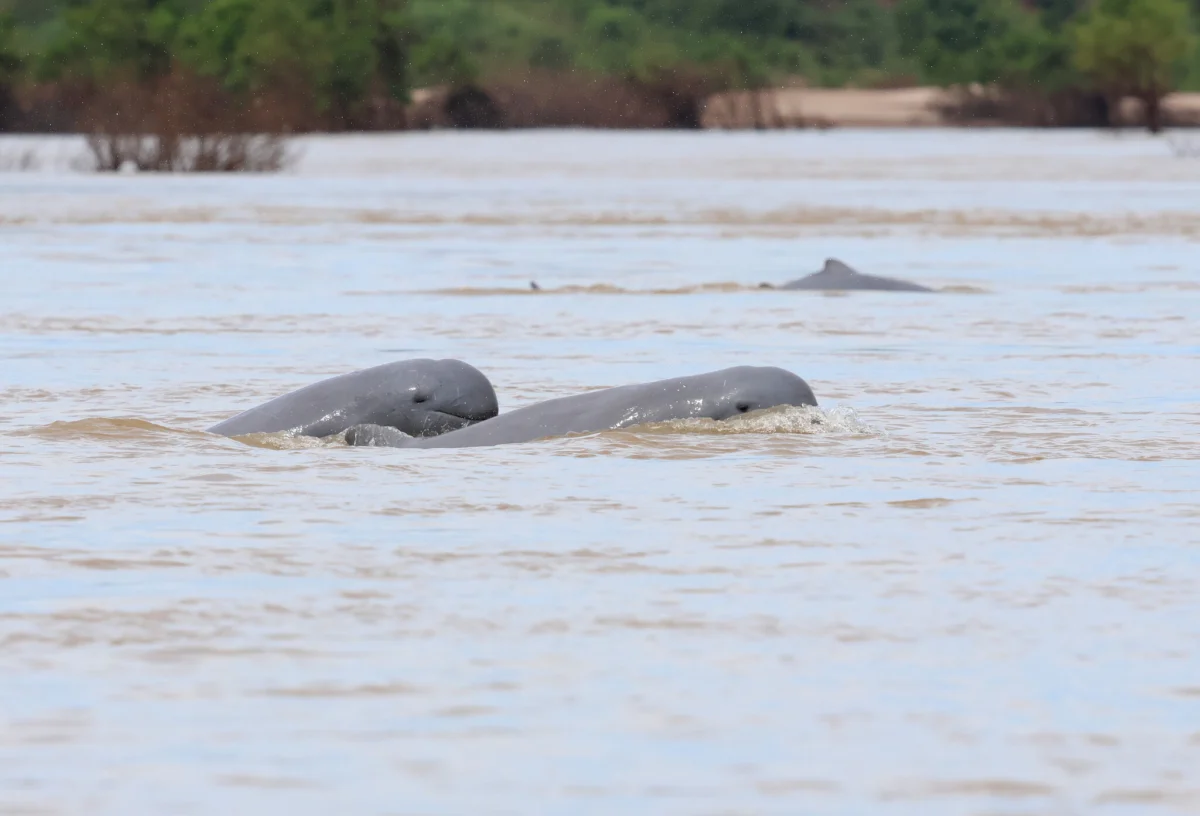
At nine in the morning, the punishing tropical sun beats down relentlessly on the expanse of the Mekong River as Heang Koeurn cuts the motor of his wooden skiff, letting the vessel bob gently on the current. He has executed this exact routine every morning for eleven consecutive years. Leaning forward with his elbows pressed firmly against his knees, his eyes scan the undulating surface of the water, searching for the familiar gray curve of a dorsal fin breaking the water’s mirror-like stillness. Finally, a gentle splash shatters the quiet, and he spots what he came for: a pod of freshwater Irrawaddy dolphins (Orcaella brevirostris), the iconic cetaceans of Southeast Asia’s greatest river.
Just meters away, a small group of international tourists squint against the glaring sunlight, pointing excitedly as one by one, the sleek, rounded heads and curved fins of the dolphins breach the surface before diving back down into the murky depths.
“Irrawaddy dolphins are very important for our community,” Koeurn says, allowing his boat to drift with the lazy current. “People here can make a modest income from tourism by driving visitors out to see the beauty and grace of the Irrawaddy dolphins.”

Yet, beneath the serene surface of these morning tours lies an alarming reality. The Mekong River—a vital ecological and economic lifeline sustaining tens of millions of people across Southeast Asia—is currently entrenched in a severe ecological crisis. This environmental degradation threatens the very survival of the Mekong’s remaining Irrawaddy dolphins, casting a long shadow over the cultural traditions and livelihoods of the river-dependent communities that have coexisted with them for generations.
A Shrinking Habitat and a Devastating Collapse
The Mekong River cuts a powerful path through northern Stung Treng province, hugging Cambodia’s porous border with Laos. This region is characterized by deep, churning pools that shelter some of the planet’s most unique and elusive aquatic species, including the critically endangered giant freshwater stingray. Among these, the Kampi pool—a staggering 60-meter-deep (nearly 200 feet) sanctuary situated in Cambodia’s Kratie province—stands as one of only three remaining deep-water refuges hosting the last surviving population of Mekong Irrawaddy dolphins.
The historical range of Orcaella brevirostris once spanned a vast territory, stretching across the rich expanse of the Mekong Delta, the expansive Tonle Sap Lake, and numerous secondary tributaries. Today, however, that range has shrunk to a fragile, fragmented 120-kilometer (75-mile) stretch of the mainstream river running through Kratie and Stung Treng provinces.
Population metrics paint a grim picture of decline. In the late 1990s, scientific estimates placed the Cambodian Mekong dolphin population at approximately 200 individuals. Decades of unmitigated pressures—ranging from targeted hunting in earlier eras to chronic bycatch in commercial fishing nets and systemic habitat degradation—have cut that number in half. While recent conservation efforts have stabilized the population slightly, the margin for error remains razor-thin.

“Dolphins are important for various reasons,” explains Ian Baird, a professor of geography at the University of Wisconsin-Madison who has extensively researched the socioeconomic and environmental impacts of large dams in the Mekong basin. “They have economic value related to ecotourism. But they also hold immense value in relation to cultural and environmental heritage.”
Baird emphasizes that these marine mammals are deeply intertwined with national and local identity. “They are a source of Cambodian national and local pride,” he notes. “Crucially, they may also inspire people to protect the river and its tributaries from the devastating impacts of more dam construction in the future.”
Across both Laos and Cambodia, Irrawaddy dolphins occupy a sacred space in local folklore and tradition. Riverside communities frequently view the animals not merely as wildlife, but as the physical manifestation of the ancestral spirits of the river—protectors of the waters who demand respect and stewardship.
The Dual Menace: Illegal Fishing Gear and Hydropower Development
Despite broad cultural reverence and decades of targeted conservation initiatives, the threats facing the species continue to compound. According to local river patrollers and fisheries experts, the primary driver of mortality is not direct, intentional poaching, but rather accidental entanglement in illegal fishing gear.

Gillnets and long-line hooks, haphazardly or deliberately set within core conservation zones, act as silent, indiscriminate traps. Dolphin calves are exceptionally vulnerable; they frequently perish when their mothers become hopelessly entangled or when the young, inquisitive calves wander blindly into invisible mesh walls.
While electrofishing is strictly prohibited across all of Cambodia, the regulatory framework governing gillnets is more localized. Gillnets are legally banned only within specific protected core habitat zones established along the Kratie-Stung Treng corridor in 2012.
The proliferation of hydropower dams has introduced an even more systemic threat to the ecosystem. To date, more than 160 operational dams choke the Mekong River and its vital tributaries, including 13 massive mainstream dams. While upstream barriers are not known to directly slaughter dolphins on contact, Baird points out that they fundamentally alter the river’s hydrology. These mega-structures disrupt natural seasonal flooding patterns, degrade seasonally flooded forests, and decimate the diverse fish communities upon which the apex predators depend for sustenance.
On the Front Lines: The Perilous Work of River Guards
At the Kampi Conservation Centre, patroller Veang Tino works tirelessly to mitigate human pressures on the dolphin sanctuary. He notes that while local villagers are increasingly conscious of the ecological stakes, outsiders routinely slip into community fishing grounds to deploy illegal gear.

“We cannot leave Irrawaddy dolphins behind, as they are the Mekong River’s ecological treasure,” Tino says, standing near a pile of confiscated gear. “The use of gillnets is the main threat to them. That is why conservation efforts must be fiercely enforced to combat these illegal fishing methods.”
The logistics of protection, however, are daunting. Patrol units are heavily concentrated around the high-profile Kampi pool, following predictable dolphin movement patterns. Conversely, illegal fishers are nimble, observing patrol schedules and adapting their tactics accordingly. Furthermore, the enforcement teams are chronically understaffed and ill-equipped.
At the Spartan Kampi river guard station—a weather-beaten structure adorned with faded hydrological maps and curling fish identification posters—patroller Kem Sophat details the physical dangers of the job. Confronting poachers can be a hazardous endeavor, as illegal fishers frequently carry firearms and have demonstrated a willingness to resort to violence to protect their illicit catches.
Compounding the danger is the meager compensation. River guards earn between $5.00 and $7.50 per day of patrolling, a sum from which they must frequently finance their own boat fuel and meals.

“We come from other parts of Kratie,” Sophat explains, gazing out over the water. “It is quite far from where we are based to do patrolling. The income is small, but it is out of the goodness of our hearts that we keep doing this job because we specialize in protecting the river.”
Law enforcement agencies have ramped up interdiction efforts when resources permit. In 2022 alone, authorities confiscated and destroyed approximately 36,000 meters (nearly 118,000 feet) of illegal gillnets, 7,000 fishing hook lines, and 500 meters of fine-mesh netting within the protected zones. Government backing has also grown; in 2025, the Ministry of Land Management officially designated the dolphin habitat zones as state-owned public land, offering a higher legal bulwark against encroachment.
The Cost of Extinction: Lessons from Anlong Chheu Teal
The catastrophic cost of failed conservation is starkly visible just upstream at the transboundary Anlong Chheu Teal dolphin pool, which straddles the border between Cambodia and Laos. Once home to a thriving pod, this stretch of the river lost its last resident Irrawaddy dolphin in February 2022.
The loss of that final male dolphin—mournfully dubbed "the lonely dolphin" by locals after it perished following entanglement in illegal fishing gear—marked the functional extinction of the species in that specific sector of the Mekong.

“Before, we had plenty of boats taking visitors out to see Irrawaddy dolphins and the other treasures of the Mekong, like the flooded forests,” says Phoy Vanna, a community leader in Anlong Chheu Teal. “Ecotourism was well-organized. But the number of tourists has plummeted since the last Irrawaddy dolphin died in 2022.”
Vanna remembers a time when the local pod counted eight individuals in 2007, a number that steadily dwindled to just three by 2018. Today, the community hall displays the bleached bones of the last dolphin as a somber memorial to the species’ vanished presence.
The economic fallout for the village has been swift and severe. Local boat operators report that overall visitor numbers have dropped by roughly 60%, with remaining tourists showing limited interest in secondary attractions like waterfalls or exposed tree roots.
Compounding the local despair is the visual reminder of industrial development. Standing at the village edge, the Don Sahong hydropower dam is clearly visible. Located less than 2 kilometers (1.2 miles) from the Cambodian border inside southern Laos, the dam has operated continuously since 2020. Scientific literature has repeatedly flagged the site as a catastrophic bottleneck for regional fish migrations throughout the Lower Mekong Basin, cutting off vital nutritional inputs for both humans and wildlife.

“When all the dolphins died, things changed for the worse,” one local boat driver laments. “It is increasingly difficult to make an honest living here.”
A Glimmer of Hope Amid Ongoing Struggles
Despite the sobering reality in border sectors, recent ecological surveys have injected a much-needed dose of cautious optimism into Cambodia’s conservation community.
By late June, government researchers and conservation partners confirmed the birth of at least six new Irrawaddy dolphin calves along the 120-kilometer protected stretch—five within Kratie province and one in Stung Treng. These births pushed the estimated total population of the Cambodian Mekong stock to approximately 118 individuals, signaling that the remnant population retains reproductive resilience.
I Sanaroth, the fisheries chief in Kampi, credits the rebound to sustained, collaborative interventions. The Fisheries Administration (FiA), operating alongside WWF-Cambodia and various international development partners, has maintained a joint conservation framework since 2014. This initiative seeks to harmonize wildlife protection with community development, offering fishing households alternative livelihoods to reduce reliance on the river’s depleted wild fisheries.

“The population of Mekong Irrawaddy dolphins has increased due to joint conservation efforts, but our work is far from finished,” Sanaroth asserts. “Authorities, with ongoing support from conservation groups, are stepping up patrols and legal prosecutions to hold illegal fishers fully accountable.”
Frances Gulland, chair of the U.S.-based Marine Mammal Commission, offers a broader philosophical and ecological perspective on the stakes involved in the fight.
“We should care about these dolphins for many reasons. Intrinsically, they are a very beautiful part of nature,” Gulland says. “If we lose them, we lose an entire species from the face of the Earth—which is akin to losing a star from the night sky. And for the communities along the Mekong, they provide essential, sustainable livelihoods through ecotourism.”
For Heang Koeurn and his fellow boatmen in Kratie, the battle lines are drawn along the gentle ripples of the morning water. Every dawn brings the same quiet ritual: casting off from the muddy banks, cutting the engines near the deep pools, and holding their breath in the hope that nature will answer with the familiar, life-affirming curve of a gray fin.








Leave a Reply