
While the unveiling of the iPhone Duo commanded the spotlight during Apple’s September 2026 product showcase, the most significant technical evolution occurred within the camera systems of the new iPhone 18 Pro and Pro Max. Apple has officially transitioned its flagship mobile imaging hardware from the industry-standard fixed-aperture lens design to a sophisticated, mechanically adjustable variable aperture system. This transition, paired with a suite of professional-grade manual controls and a new cryptographic authenticity feature, represents the most substantial overhaul of Apple’s mobile photography ecosystem in nearly a decade.
A New Era of Mobile Optics
For years, the smartphone industry has relied on computational photography—software-driven processing—to compensate for the physical limitations of tiny, fixed-aperture lenses. The iPhone 18 Pro lineup disrupts this trend by integrating a 48MP main camera sensor equipped with six laser-cut, hair-thin blades. These blades allow the device to physically shift its aperture, mimicking the functionality of traditional DSLR and mirrorless cameras.
In practical application, this hardware change provides users with granular control over light intake and depth of field. A wider aperture setting allows for superior performance in low-light environments by increasing the volume of light reaching the sensor, while simultaneously creating the natural bokeh effect prized by portrait photographers. Conversely, a narrower aperture setting ensures deep focus, which is ideal for group photography or capturing expansive landscapes where edge-to-edge sharpness is required.
The shift is a departure from the "computational-first" approach that has defined the iPhone experience since the introduction of the iPhone 11. By providing physical control over the light path, Apple is acknowledging that while AI algorithms are powerful, they cannot replicate the optical properties of a physically stopped-down lens.
Historical Context and Industry Challenges
The inclusion of a variable aperture is not entirely unprecedented in the mobile sector, though previous attempts have met with varying degrees of success. In 2018, Samsung introduced a mechanical dual-aperture system in the Galaxy S9 and S10. However, the feature was quietly phased out in subsequent iterations. Industry analysts have long cited two primary reasons for the abandonment of such systems: the extreme complexity of fitting delicate, moving mechanical parts into a chassis designed to withstand daily wear, and the perceived marginal gains in image quality compared to the rapid advancement of software-based processing.

Samsung, for instance, reportedly considered re-implementing a variable aperture system for the Galaxy S27 series as recently as early 2026. Internal reports from August 2026 indicated that the company eventually abandoned the project, citing concerns over device thickness, manufacturing costs, and the delicate nature of the mechanical components. Apple’s decision to proceed with this technology suggests a significant breakthrough in the durability of its micro-mechanical actuators, though the long-term impact on device longevity remains a topic of scrutiny for hardware engineers.
Professional Controls and Computational Upgrades
Complementing the new physical aperture is a comprehensive redesign of the Camera app’s interface. Apple has introduced a "Pro Controls" panel, which provides immediate access to shutter speed, white balance, and manual focus peaking. This move effectively repositions the iPhone 18 Pro as a legitimate tool for cinematographers and serious hobbyists who have previously relied on third-party applications to bypass Apple’s automated processing.
The inclusion of a live histogram—a visual representation of image exposure levels—allows users to identify overexposed or underexposed areas of a composition in real-time. This tool, combined with the ability to adjust shutter speed, allows users to freeze fast-moving action or introduce motion blur for creative effect, features previously reserved for dedicated camera bodies.
Video performance has also received a technical boost. The computational imaging pipeline has been recalibrated to reduce the "oversharpened" look that has often characterized mobile video. Furthermore, the integration of an AI-powered smart focus system enables the camera to lock onto and track subjects with higher fidelity, a feature that utilizes the phone’s neural engine to predict movement patterns in real-time. Cinematic mode has also been updated, allowing users to apply depth-of-field effects to footage shot at 60 frames per second, a significant upgrade over previous generations that were limited to 30 frames per second for such processing.
The Rise of Digital Authenticity: Apple Reference Image
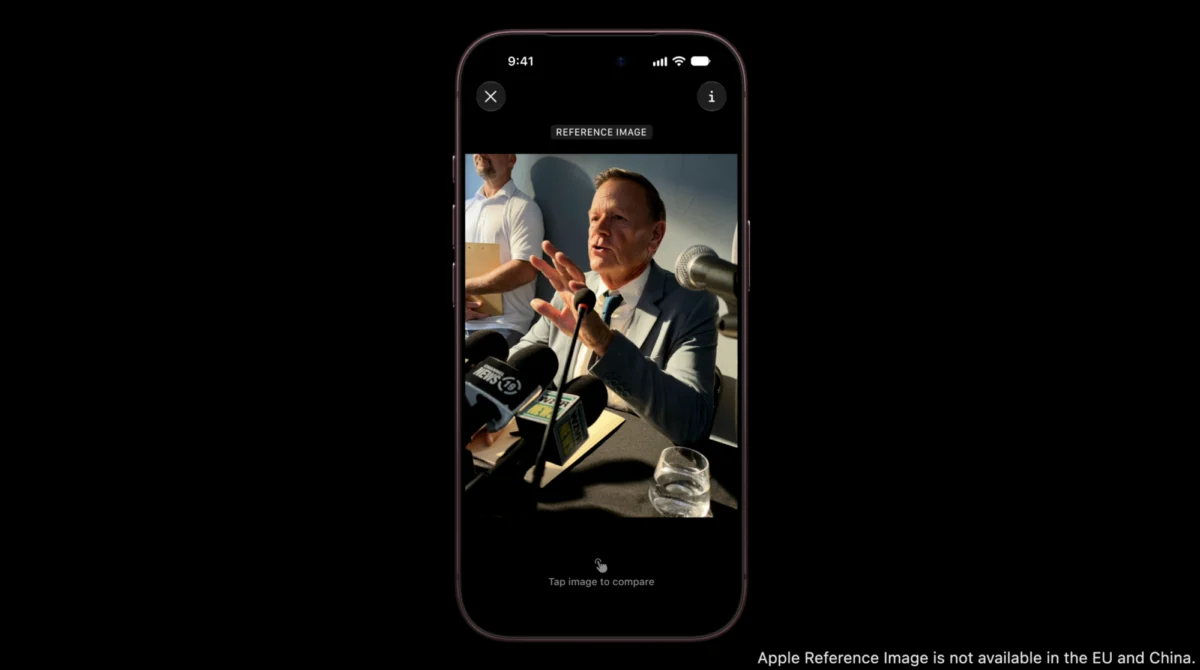
Perhaps the most forward-thinking addition to the iPhone 18 Pro is the introduction of Apple Reference Image. As synthetic media and AI-generated content become increasingly pervasive, the ability to verify the provenance of digital images has become a matter of public interest.
When a user selects the new "Reference" capture mode, the iPhone 18 Pro generates a cryptographically signed version of the raw sensor data. This file is processed through Apple’s Private Cloud Compute and stored as an unalterable digital negative. This "Reference" file exists alongside the standard processed image in the Photos app, allowing users to compare the two. The objective is to provide a chain of custody for digital media, enabling photojournalists, investigators, and concerned users to prove that a photograph has not been subjected to generative AI editing or malicious alteration.

This feature will support the SynthID watermarking standard, a proactive measure against the proliferation of deepfakes and misinformation. By embedding this technology at the sensor level, Apple is attempting to establish a new industry standard for media integrity.
Broader Implications and Future Outlook
The release of the iPhone 18 Pro signals a shift in Apple’s design philosophy. By embracing both advanced hardware (the variable aperture) and complex security architecture (Reference Image), the company is attempting to bridge the gap between consumer convenience and professional utility.
The success of the iPhone 18 Pro will likely be judged by two metrics: the mechanical reliability of the variable aperture system over the lifecycle of the device, and the adoption rate of the Reference Image feature by external platforms and media outlets. If the hardware proves robust enough to withstand the rigors of everyday use, it could force a resurgence of mechanical components in the smartphone industry.
Conversely, the success of the authenticity features will depend on the development of a broader ecosystem. For "Reference Image" to be truly effective in the fight against misinformation, social media platforms and news organizations must integrate the necessary tools to verify the cryptographic signatures attached to these files.
As the smartphone market continues to reach a point of maturity, Apple’s strategy for the iPhone 18 Pro indicates that the next phase of competition will be defined not just by raw performance, but by the integration of specialized, high-end photographic hardware and the establishment of a verifiable digital identity for the content users create. Whether these features remain a differentiator for the Pro lineup or eventually trickle down to standard models will be a key point of observation in the coming years.








Leave a Reply