
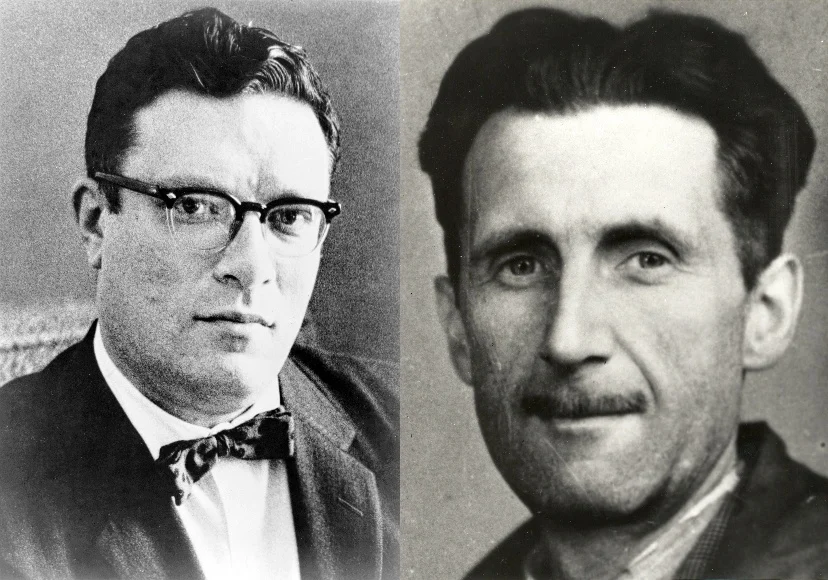
Isaac Asimov’s Critique of George Orwell’s 1984 and the Evolution of Dystopian Literature serves as a profound intersection between two of the twentieth century’s most influential intellectual figures. In 1980, as the actual calendar year 1984 approached, the legendary science fiction author and polymath Isaac Asimov was commissioned to revisit George Orwell’s seminal work. What resulted was a scathing, yet deeply analytical, review that challenged the novel’s status as science fiction while acknowledging its immense power as a political polemic. Asimov’s critique provides a unique lens through which to view the tensions between technological futurism and sociological dread, highlighting how a work written in the shadow of World War II was perceived by a mind focused on the possibilities of the twenty-first century.
The Cultural Anxiety of the Approaching 1980s
By the time Asimov penned his review for a syndicated newspaper column in 1980, "1984-ophobia" had become a documented cultural phenomenon. For decades, the year 1984 had stood as a looming deadline for the end of freedom, a temporal landmark for the inevitable rise of the "Big Brother" state. Asimov noted with a touch of irony that many who feared the date had never actually read Orwell’s book, yet they were saturated in its terminology: Newspeak, Doublethink, and Thought Police.
Asimov’s primary inquiry was centered on the transition of the year from a distant, terrifying future to a tangible, immediate present. He questioned what would happen to the collective Western psyche once January 1, 1985, arrived and the United States—and the world at large—remained fundamentally similar to its previous state, rather than a monolithic, grey-toned autocracy. This sets the stage for his deep dive into why he believed Orwell, while a brilliant writer, had fundamentally failed as a "science fiction" writer.
A Chronology of Influence and Critique
To understand the friction between Asimov and Orwell, one must look at the timeline of their respective eras. George Orwell wrote 1984 between 1947 and 1948 while battling severe tuberculosis on the remote Scottish island of Jura. The world he inhabited was one of post-war rationing, the beginning of the Cold War, and the terrifying realization of Stalin’s purges. When the novel was published in June 1949, it was a visceral reaction to the immediate past and the precarious present.
In contrast, Isaac Asimov in 1980 was at the height of his influence. The "Golden Age" of science fiction, which Asimov helped define, was characterized by an optimistic, or at least rigorous, examination of how technology—robotics, space travel, and computers—would reshape the human condition. To Asimov, the future was something to be engineered and calculated. To Orwell, the future was "a boot stamping on a human face—forever."
The chronological gap between 1949 and 1980 allowed Asimov to see the "future" that Orwell could only guess at. By 1980, the digital revolution was beginning to stir, and the geopolitical landscape had shifted from the simple binary of the early Cold War into a more complex, tri-polar reality.
The "Moscow in London" Argument: Science Fiction vs. Social Satire
Asimov’s most biting criticism was that 1984 was not an exercise in looking forward, but rather an exercise in looking eastward. He argued that the London depicted in the novel was not the London of thirty-five years into the future, but rather a version of Moscow transported to the British Isles. In Asimov’s view, Orwell did not imagine how British society would evolve; he simply superimposed the dreariness and brutality of Stalinist Russia onto the streets of Airstrip One.
From a technological standpoint, Asimov found the novel "incredibly old-fashioned." He pointed out that while Orwell featured "telescreens" that could monitor citizens, he failed to imagine any of the other myriad ways technology would change daily life. The characters in 1984 still lived in a world of mechanical buttons, low-quality paper, and heavy industry. Asimov, who had spent his career imagining positronic brains and galactic empires, felt that Orwell lacked the "scientific imagination" required to build a plausible future.
Furthermore, Asimov critiqued the "vices" of the characters. Winston Smith and his peers were portrayed as "gin hounds and tobacco addicts." Asimov noted that Orwell’s descriptions of the low-quality Victory Gin and crumbling Victory Cigarettes were eloquent but reflected the specific deprivations of 1940s wartime Britain rather than a futuristic society. He argued that a truly futuristic dystopia would likely involve more sophisticated forms of social control, such as advanced pharmacology or psychological conditioning—concepts explored more effectively by Aldous Huxley in Brave New World.
Linguistic Control and the Reality of Political Speech
One of the most famous aspects of 1984 is "Newspeak," the state-mandated reduction of the English language designed to make "heretical" thoughts impossible. Orwell’s theory was that if the word "freedom" no longer existed, the concept of freedom would eventually vanish from the human mind.
Asimov, however, disagreed with this linguistic premise. Drawing on his observations of twentieth-century politics, he argued that language is rarely weakened by compression. Instead, he observed that "political obfuscation has tended to use many words rather than few." Asimov posited that real-world authoritarianism does not limit vocabulary to stifle thought; rather, it uses "long words rather than short" and "extends rather than reduces" to bury the truth under a mountain of jargon and euphemism.
Interestingly, Orwell himself had made this very point in his 1946 essay Politics and the English Language. Asimov’s critique suggests that Orwell’s fiction (Newspeak) was actually less realistic than Orwell’s own non-fiction analysis of how propaganda functions in a democratic or semi-democratic society.
Geopolitical Savvy: The Three Superpowers
Despite his harsh words regarding Orwell’s scientific foresight, Asimov conceded that Orwell possessed significant "geopolitical savvy." The division of the world into Oceania, Eurasia, and Eastasia roughly mirrored the 1980s reality of the United States, the Soviet Union, and China.
Asimov credited Orwell for recognizing that the two major communist powers—the USSR and China—would not necessarily remain allies. This was a sophisticated insight for 1949, a time when many Western observers viewed the "Communist Bloc" as a monolithic entity. Orwell’s understanding of factionalism, likely born from his traumatic experiences during the Spanish Civil War where he saw Soviet-backed factions turn on their own allies, allowed him to predict a world of shifting alliances and perpetual, localized conflict.
However, even Asimov’s 1980 perspective had its limits. He could not have predicted that within a decade of his review, the Soviet Union would collapse, leaving the "Eurasia" of Orwell’s imagination in a state of total transformation. Nor could he have fully anticipated that the term "Orwellian" would, in the twenty-first century, be most frequently applied to the high-tech surveillance state emerging in modern China—a fusion of Orwell’s Big Brother and the very technological advancement Asimov felt Orwell had missed.
Supporting Data: The Ministry of Information and Real-World Inspiration
Historical analysis supports Asimov’s observation that Orwell’s dystopia was rooted in his immediate surroundings. The "Ministry of Truth" was famously inspired by the Senate House at the University of London, which housed the Ministry of Information (MOI) during World War II. Orwell’s wife, Eileen O’Shaughnessy, worked for the MOI, and Orwell himself produced broadcasts for the BBC’s Eastern Service.
The "Basic English" movement of the 1940s, championed by figures like C.K. Ogden and even Winston Churchill, served as a direct precursor to Newspeak. Basic English was an 850-word simplified version of the language intended as an international auxiliary tongue. Orwell, initially a cautious supporter, grew to fear that such a tool could be weaponized by a state to limit the range of human expression. The "low-quality canteen food" and "dreary atmosphere" Asimov criticized were, in fact, direct transcriptions of Orwell’s daily life at the BBC, where the austerity of the 1940s was a constant reality.
Broader Impact and Modern Implications
The dialogue between Asimov’s critique and Orwell’s vision remains relevant because it highlights the two primary ways we imagine the future: as a projection of technology or as a projection of human nature. Asimov, the technologist, saw 1984 as a failure of prediction. Orwell, the moralist, saw it as a success of warning.
In the contemporary era, we see a synthesis of both perspectives. We live in a world that is "Asimovian" in its technological infrastructure—pervasive computing, artificial intelligence, and global connectivity—but increasingly "Orwellian" in how that infrastructure is used for surveillance, data harvesting, and the manipulation of truth.
The "1984-ophobia" that Asimov described has evolved into a permanent state of digital anxiety. While the United States did not become Oceania by 1985, the mechanisms of "Doublethink" are arguably more prevalent in the age of social media algorithms and "alternative facts" than they were in the 1940s. Asimov’s critique reminds us that while the specific "gadgetry" of a dystopia may become dated, the underlying human impulse to control, and the corresponding impulse to resist, remains the central narrative of the modern age.
Ultimately, Asimov’s review serves as a testament to the endurance of Orwell’s work. Even a critic as formidable and scientifically grounded as Isaac Asimov felt compelled to engage with 1984 on a granular level. The fact that we still debate Orwell’s "predictions" today suggests that 1984 was never meant to be a roadmap of technology, but rather a mirror of the human soul under pressure—a mirror that remains as clear, and as chilling, as it was in 1949.










Leave a Reply