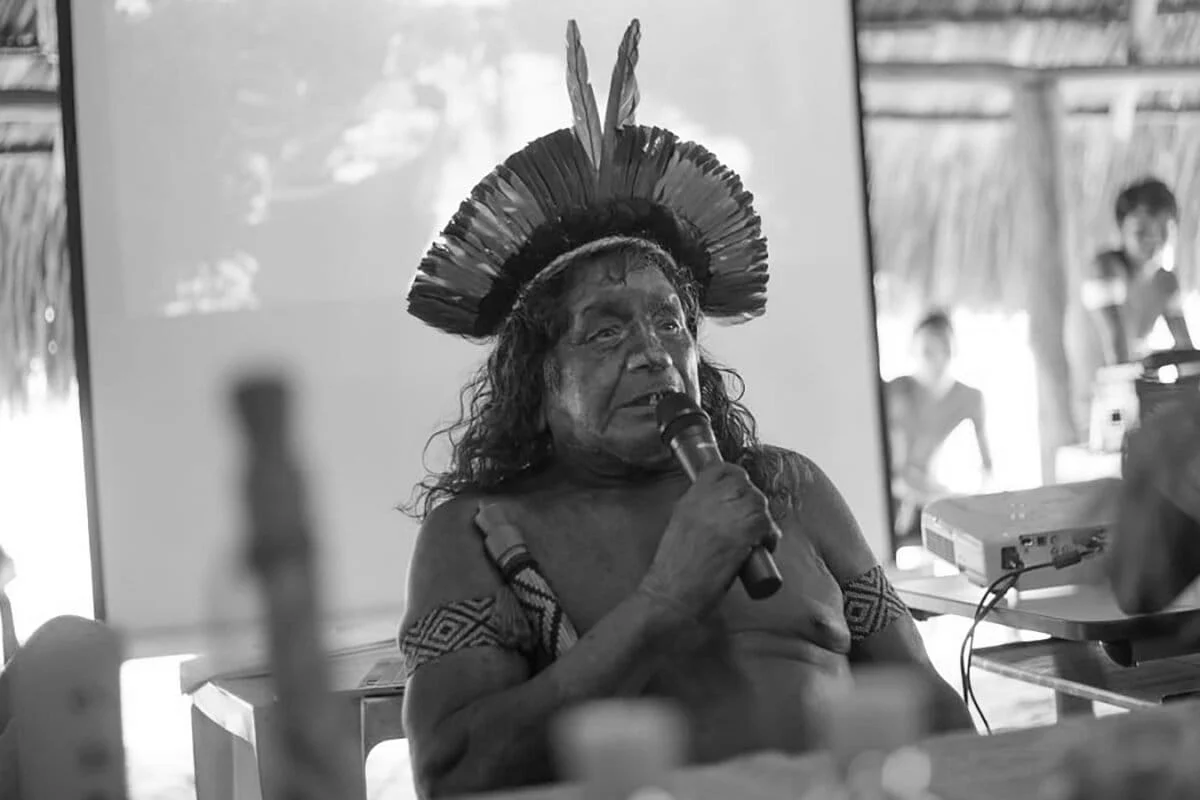
The death of Khuiusi Khisêtjê at the age of approximately 80 marks the end of an era for the Indigenous peoples of the Xingu Basin in Mato Grosso, Brazil. A man who witnessed his community dwindle to the brink of extinction and subsequently led its demographic and territorial recovery, Khuiusi passed away in Goiânia on July 3, 2024. His life served as a bridge between a pre-contact world and a modern reality where Indigenous survival depends as much on legal maneuvers and environmental advocacy as it does on traditional knowledge and ancestral songs. His final major act of leadership—moving an entire village ten kilometers deeper into the forest to escape the toxic drift of industrial soy farming—symbolized the ongoing struggle of the Khisêtjê people to maintain autonomy in an increasingly encroached-upon landscape.
The 2018 Relocation: Escaping the Agrochemical Frontier
In 2018, Khuiusi Khisêtjê made a decision that would define the final chapter of his leadership. For years, the residents of Khikatxi, a village within the Wawi Indigenous Territory, had watched the rapid expansion of the agricultural frontier. Single-engine aircraft, deployed by neighboring soy plantations, became a frequent sight, spraying pesticides that ignored the invisible borders of the Indigenous land. The consequences were immediate and devastating: residents reported persistent itching and outbreaks of diarrhea; crops in communal gardens withered; and local streams, once clear, became clouded with runoff. Even the game animals, essential for the community’s protein, began to carry the chemical scent of the plantations.
Faced with the degradation of his people’s health and environment, Khuiusi orchestrated the relocation of the village. Moving a village in the Amazon is not a simple logistical feat; it involves clearing new forest, rebuilding traditional longhouses, establishing new agricultural plots, and rerouting the daily lives of hundreds of people. For Khuiusi, who had survived multiple displacements throughout his eight decades, the move was a pragmatic necessity. It was a tactical retreat designed to preserve the biological and cultural integrity of the Khisêtjê, placing a ten-kilometer buffer of primary forest between his people and the "green desert" of the Mato Grosso soy fields.
A Legacy Born of Near Extinction
Khuiusi Khisêtjê was born at a time when his people lived largely beyond the reach of the Brazilian state, in the transition zones between the Amazon rainforest and the Cerrado savanna. However, the mid-20th century brought the "March to the West," a state-sponsored initiative to settle the interior of Brazil. This expansion brought the Khisêtjê into violent contact with outsiders, leading to catastrophic epidemics of respiratory diseases and malaria.
By the 1960s, the Khisêtjê population had plummeted to just 50 individuals. This demographic collapse resulted in the loss of a generation of elders, the traditional custodians of oral history, ritual, and ecological knowledge. Khuiusi lost his father and many of his mentors during this period, forcing him to assume leadership responsibilities at an unusually young age. His primary task was simple yet monumental: ensure the group did not disappear entirely.
Under his guidance and that of other resilient leaders, the Khisêtjê began a slow recovery. Today, the population has grown to over 700 people living in 11 different villages. This 1,400% increase in population is cited by anthropologists and human rights organizations as a rare success story in the history of Indigenous-settler relations in South America, though it remains tempered by the permanent loss of the cultural nuances held by those who died during the epidemics.
The Struggle for Wawi and Territorial Sovereignty
One of Khuiusi’s most significant political achievements was the recovery of the Wawi territory. When the Xingu Indigenous Park (now the Xingu Indigenous Territory or TIX) was created in 1961—the first large-scale Indigenous reserve in Brazil—a significant portion of the Khisêtjê’s ancestral lands was left outside the official boundaries. This excluded area, known as Wawi, contained sacred sites, ancient village locations, and the burial grounds of Khuiusi’s ancestors.
For decades, the Khisêtjê were forced to live as "guests" in the territories of other Xingu groups. Khuiusi spearheaded a multi-decade campaign to reclaim Wawi, navigating the labyrinthine bureaucracy of FUNAI (the National Indigenous People Foundation) and the Brazilian judicial system. He famously argued that the land was not a commodity to be bought or sold, but a repository of history. "The land is sacred because our relatives are buried there," he stated during a 2008 assembly.

The campaign for Wawi required Khuiusi to engage with a world he viewed with deep skepticism. Though he never became fluent in Portuguese and did not read or write the language, he became a master strategist. He partnered with the Instituto Socioambiental (ISA) and worked closely with American anthropologist Anthony Seeger. The legal demarcation of Wawi in the 1990s was a landmark victory, effectively expanding the protected corridor of the Xingu and allowing the Khisêtjê to return to their roots.
Cultural Preservation as a Political Tool
Khuiusi understood that land without culture was merely space. He was a fierce advocate for the "true songs" of the Khisêtjê—complex oral compositions that serve as maps of history and social obligation. He worked with researchers to record, transcribe, and translate these narratives, ensuring they were integrated into the curriculum of village schools.
His approach to cultural visibility was notably pragmatic. While some Indigenous leaders remained wary of "performing" for non-Indigenous audiences, Khuiusi encouraged the Khisêtjê to present their ceremonies, body paint, and songs to politicians and the public. He viewed these performances not as entertainment, but as a declaration of existence. By making the Khisêtjê visible to the Brazilian state, he made it harder for the state to ignore their rights.
Anthony Seeger, who spent decades documenting Khisêtjê music and social structure, noted that Khuiusi was a "strategic thinker" who recognized that the community’s survival depended on a "dual-literacy": a deep mastery of their own traditions and a functional understanding of the legal and political systems of the "white man’s world."
Environmental Context: The Soy Frontier in Mato Grosso
The challenges Khuiusi faced in his final years are reflective of broader environmental trends in Mato Grosso. The state is the largest producer of soy in Brazil, accounting for nearly 30% of the national harvest. However, this economic productivity comes at a high environmental cost. The "Arc of Deforestation" directly borders the Xingu Indigenous Territory, creating an "island effect" where protected forests are surrounded by vast, monocultural plantations.
Data from environmental monitoring groups indicate that the use of pesticides in Mato Grosso has surged alongside soy production. The drift from aerial spraying often travels kilometers beyond the intended target, contaminating the headwaters of the Xingu River. This chemical encroachment represents a new form of displacement; while the land is legally protected, the air and water are not, rendering parts of the territory uninhabitable. Khuiusi’s 2018 decision to move the village was a direct response to this "chemical siege," a phenomenon that continues to threaten Indigenous communities throughout the Brazilian Amazon.
Analysis of Implications and Future Outlook
The passing of Khuiusi Khisêtjê leaves a significant void in the leadership of the Xingu. He was one of the last remaining links to the pre-contact era, a man who carried the memories of a world before the forest was fragmented. However, his legacy is visible in the new generation of Khisêtjê leaders he helped train. Today, the Khisêtjê use drones to monitor their borders, produce their own films to document environmental crimes, and send their youth to universities to study law and medicine.
The Khisêtjê’s recovery from 50 to 700 people demonstrates the resilience of Indigenous social structures when provided with even a modicum of land security. Yet, the future remains precarious. The ongoing political pressure in Brazil to "flexibilize" Indigenous land rights and the global demand for soy continue to put the Xingu under immense strain.
Khuiusi’s life work was to ensure that the Khisêtjê would always have the agency to determine their own path. Whether by negotiating with the federal government or by physically moving a village to protect his people’s health, he prioritized autonomy above all else. As the forest continues to fall outside the borders of the Wawi territory, the "true songs" he fought to preserve will serve as the cultural anchor for a people who, thanks to his leadership, no longer face the immediate threat of extinction, but rather the challenge of enduring in a changing world.