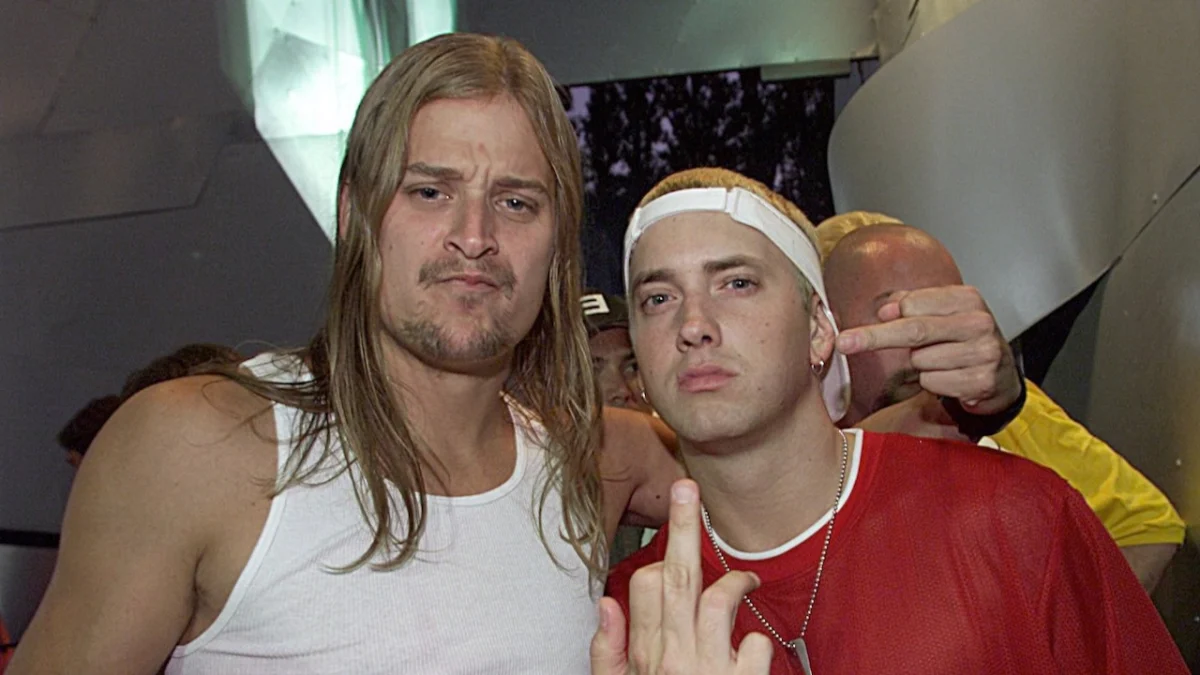
The intersection of creative technology and traditional music production took center stage recently when musician Kid Rock disclosed that his latest single, "Heal My Faith"—a collaboration with longtime friend and fellow Detroit icon Eminem—utilized artificial intelligence to generate a background choir. This revelation, made during an appearance on HBO’s Real Time with Bill Maher, has ignited a fresh debate regarding the ethics of digital synthesis in the arts, the displacement of human performers, and the shifting definitions of musical authenticity.
The Disclosure on Real Time with Bill Maher
The topic emerged during a broader conversation about the rapid advancement of generative AI tools. Host Bill Maher, known for his provocative interview style, challenged Kid Rock on the implications of AI, suggesting that the technology has reached a point where a synthetic Kid Rock track could be "almost indistinguishable" from the real thing.
Kid Rock, who has recently pivoted toward a Christian-focused musical direction with his album Halfway 2 Jesus, conceded that he had already integrated the technology into his own studio workflow. He specifically identified the choir featured on the chorus of "Heal My Faith" as an AI-generated construct. When pressed by Maher on why he opted for a digital facsimile rather than hiring human vocalists, the artist cited time constraints as his primary motivation.
"I’m an impatient guy," Kid Rock stated. "It’s not about the money of getting a choir. But everything I look at in life now is time. How much time do I have?" He further explained that he used specific prompts to craft a Southern gospel-style choir, expressing satisfaction with the final aesthetic result.
The Ethical Friction: Human Labor vs. Technological Efficiency
The admission triggered an immediate pushback from Maher, who pivoted the conversation to the socioeconomic impact of such creative choices. "A lot of people in a choir, and we put them all out of work," Maher argued. "Isn’t that what really happened? You didn’t have to get a choir in there. When The Beatles used a choir they needed to get a [expletive] choir."
The exchange highlighted a burgeoning tension in the entertainment industry: the trade-off between the logistical efficiency of AI and the preservation of human-centric labor markets. Kid Rock’s defense drew a parallel to the evolution of rhythm sections, asking, "Did we put drummers out of work when the drum machine was invented?"
While the artist acknowledged the "dangers" of the technology and advocated for it to be "regulated at the highest levels," he maintained that, for now, it serves as a functional tool for the working musician. This perspective reflects a growing divide among creators: those who view AI as an evolutionary step similar to the synthesizer or the digital audio workstation (DAW), and those who see it as an existential threat to the "human touch" that defines artistic expression.
Contextualizing Halfway 2 Jesus and the Eminem Collaboration
The release of Halfway 2 Jesus on October 17, 2026, marked a significant stylistic departure for Kid Rock. The album, which leans heavily into themes of faith and redemption, was framed as an attempt to bridge the ideological chasm that has widened in American culture. The inclusion of Eminem on "Heal My Faith" was heavily publicized as a gesture of bipartisan unity.
The friendship between the two Detroit artists has long been a subject of public interest, primarily because their political trajectories have diverged sharply over the last decade. Kid Rock has remained a vocal and steadfast supporter of President Donald Trump, while Eminem has been one of the most prominent cultural critics of the former president. Despite this, both artists characterized the track as a conscious effort to prioritize personal history over political polarization. For his part, Eminem stated that the project was not an exercise in taking sides, but rather a commitment to his long-standing creative bond with a friend.
Despite the star power behind the collaboration, the song has struggled to find a foothold on mainstream charts. Industry analysts have noted that the release failed to generate the significant commercial traction often associated with such high-profile partnerships, leading to questions about whether the experimental use of AI or the tonal shift of the album impacted its reception.
Technological Implications and Industry Standards
The use of AI in professional music production has moved from the fringes of "deepfake" experimentation to the center of mainstream recording studios. Currently, the industry faces three primary challenges regarding this evolution:
- Copyright and Ownership: As AI models are trained on vast datasets of existing music, the legal framework regarding who owns the output of an AI-generated choir remains murky.
- Labor Displacement: The "choir" example is particularly poignant because it represents a sector of the music industry that relies heavily on unionized session work. When producers replace groups of vocalists with synthesized alternatives, they remove a significant entry-level revenue stream for emerging performers.
- Creative Integrity: There is an ongoing debate regarding whether "prompting" a computer to simulate a choir provides the same emotional resonance as recording a group of humans performing in a room, where acoustics, timing, and human imperfection contribute to the quality of the sound.
A Chronology of the Debate
- October 17, 2026: Halfway 2 Jesus is released, featuring the track "Heal My Faith" with Eminem.
- Late October 2026: Initial chart data reveals that the single and album are underperforming relative to the profile of the artists involved.
- October 31, 2026: Kid Rock appears on Real Time with Bill Maher, where he defends his use of AI and engages in a broader discussion regarding the future of the music industry.
- November 2026: Public discourse surrounding the interview intensifies, with clips of the AI discussion circulating on social media platforms, leading to broader questions about the role of human labor in the age of generative AI.
Broader Implications for the Music Industry
The conversation on Maher’s show serves as a microcosm of the current state of the music business. While the industry has historically adapted to technological disruptions—from the introduction of the multitrack recorder to the rise of MIDI—the shift toward generative AI feels distinct due to its ability to simulate human nuances rather than just manipulate audio.
The defense posed by Kid Rock—that AI is simply a "tool"—is a sentiment shared by many in the production community who use it to streamline tasks like pitch correction, vocal doubling, and arrangement. However, the opposition, represented by Maher’s critique, focuses on the value of the "human element." If high-profile artists begin to replace traditional session musicians with AI models to save time or costs, the precedent could shift the economics of music production, potentially rendering session work a niche profession rather than a industry standard.
As legislation regarding AI continues to be debated in Washington and abroad, the music industry remains in a period of uncertainty. Artists like Kid Rock, who are willing to openly admit to using these tools, are at the forefront of a cultural transition. Whether the public will continue to embrace music that is partially generated by algorithms, or whether there will be a "pro-human" backlash that prioritizes analog, organic production, remains to be seen.
For now, the story of "Heal My Faith" stands as a case study in how technology can intersect with personal artistic vision, sparking conversations that transcend the music itself and force a reckoning with the future of labor in the creative economy.