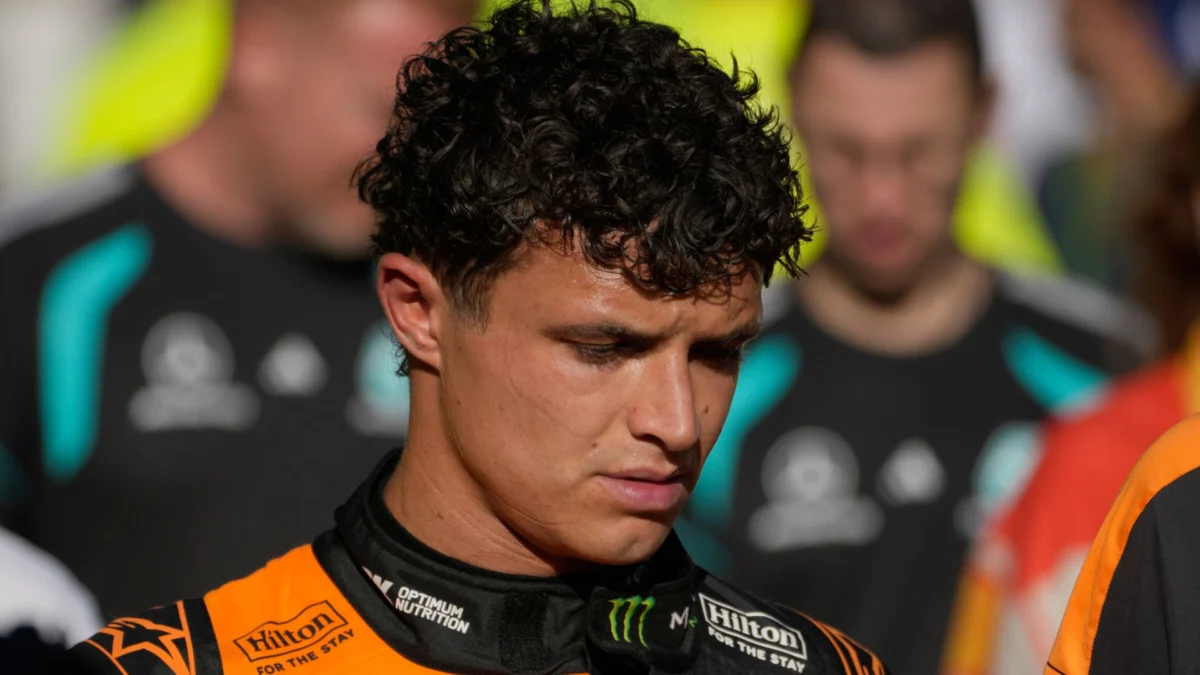
Reigning Formula 1 world champion Lando Norris has publicly retracted his stinging critique of Alpine driver Franco Colapinto, extending a formal apology following the high-stakes collision that eliminated both drivers from the Azerbaijan Grand Prix. The incident, which occurred during a chaotic Safety Car restart in Baku, served as a flashpoint for a broader conversation regarding driver conduct, the pressures of elite motorsport, and the escalating problem of toxic social media abuse directed at the F1 community.
The collision unfolded at the first corner of the Baku City Circuit. As the race resumed under green flag conditions, Colapinto suffered a critical mechanical locking of his brakes. The resulting loss of control sent the Argentine driver into the side of his Alpine teammate, Pierre Gasly. The momentum of the impact cascaded outward, forcing Gasly into the path of the McLaren driven by Norris. For all three involved, the race ended prematurely in a tangle of carbon fiber and disappointment.
A Chronology of the Baku Incident
The Baku City Circuit is notorious for its unforgiving nature, with narrow straights and tight, technical corners that leave almost no margin for error. The events of the weekend followed a specific trajectory that heightened tensions among the grid:
- Pre-Race Anticipation: Heading into the Azerbaijan Grand Prix, the championship battle was reaching a fever pitch. Norris, defending his world title, was under immense pressure to capitalize on every available point.
- The Safety Car Restart: With the field bunched up during the late-stage restart, the pack compressed into Turn 1. This is historically one of the most dangerous points on the calendar, as drivers fight for position while struggling with cold tires and brake temperatures.
- The Impact: At the moment of the restart, Colapinto’s lock-up was instantaneous. The collision with Gasly was unavoidable for the Frenchman, who effectively acted as a conduit for the force of the impact to reach Norris.
- The Immediate Aftermath: In the high-adrenaline moments following his exit from the cockpit, a frustrated Norris made headlines by suggesting that some drivers currently on the grid lacked the requisite skill to compete in Formula 1. He further suggested that incidents of this nature should carry a mandatory one-race ban to discourage aggressive or reckless decision-making.
Public Retraction and Reconciliation
By Monday morning, the tone from the McLaren camp had shifted significantly. Norris utilized his social media platforms to address the gravity of his comments, acknowledging that his initial reaction was fueled by the heat of the moment rather than a calculated assessment of the racing incident.
"Tough weekend overall in Baku and of course a disappointing and early end to the race," Norris wrote. "After the race, I sent Franco a message apologising for the comments I made that I simply should not have said. I know better, and emotions were running high, but that is not an excuse; it was wrong of me."
Norris’s statement highlighted the nature of the sport, admitting, "I’ve made mistakes of my own over the years and I know this is very much a part of racing and fighting on the limit. Me and Franco came to a good understanding, are still good friends, and are both excited to get back racing this weekend."
For his part, Colapinto had already issued apologies to his teammate Gasly and to Norris during post-race interviews. Despite the remorse shown, the FIA stewards took a dim view of the technical error that caused the crash, handing Colapinto a five-place grid penalty for the upcoming Bahrain Grand Prix at the Sepang International Circuit in Malaysia.
The Escalation of Online Toxicity
While the drivers involved have moved toward reconciliation, the surrounding discourse has been marred by a surge in vitriolic online activity. The Alpine team, frustrated by the treatment of their drivers and staff, issued a formal statement on Sunday condemning the rise in hate speech, harassment, and threats.
This is not an isolated incident for the team. Throughout the 2026 season, the online behavior of certain segments of the fanbase has come under intense scrutiny. Earlier this year, both the FIA stewards and Alpine personnel were subjected to aggressive online campaigns following a drive-through penalty issued to Colapinto in Zandvoort. Furthermore, Pierre Gasly reported that his own family had been targeted by threats during the fallout of the Spanish Grand Prix, where a team-orders dispute briefly dominated the headlines.
Alpine’s recent statement emphasized that the condemnation of abuse was not directed at any one specific fanbase, but rather as a stand against a "regular occurrence" that threatens the integrity of the sport. "As a team, we feel it’s necessary to speak out once more about the hate and abuse online… it has become a regular occurrence in recent races and cannot be condoned," the statement read.
Implications for the 2026 Championship
The fallout from the Azerbaijan Grand Prix carries significant implications for the remainder of the season. With Formula 1 heading to the Sepang International Circuit for the first time since 2017, the pressure on the grid is palpable. The return to Malaysia introduces a challenging, high-downforce circuit that will test the resilience of the teams and the temperament of the drivers.
- Stewardship and Penalties: The five-place grid penalty for Colapinto is a clear indicator that the FIA intends to maintain strict oversight of "avoidable collisions." The consistency of these rulings will remain a point of contention for team principals throughout the final quarter of the season.
- Driver Welfare and Mental Health: The episode involving Norris and the online abuse faced by drivers highlights the psychological toll of modern F1. The sport is increasingly looking at ways to protect participants from the "always-on" culture of social media, where fans feel entitled to direct hostility toward athletes.
- Team Dynamics: For Alpine, the incident represents a struggle to maintain a harmonious environment while navigating the volatile public perception surrounding their drivers. The effort to decouple the actions of the team from the toxicity of online forums is an ongoing strategic challenge.
Data-Driven Context
To understand the intensity of the Baku crash, one must look at the frequency of incidents under Safety Car conditions. Data from the 2026 season indicates that restarts are the most frequent source of multi-car pile-ups, accounting for approximately 18% of all race-ending collisions. The technical complexity of modern F1 cars, which rely heavily on sophisticated brake-by-wire systems, means that a minor sensor error or a slight miscalculation in tire pressure can lead to the "locking" phenomenon experienced by Colapinto.
Furthermore, the "social media fury" phenomenon is being studied by the sport’s commercial rights holders. Industry analysis suggests that a minority of highly vocal accounts are responsible for the vast majority of abusive content, yet the impact on the public image of the sport is disproportionate. The collaborative approach between the FIA, teams, and platforms to identify and report this abuse is expected to be a primary agenda item in upcoming commission meetings.
Looking Ahead
As the paddock prepares for the Bahrain Grand Prix at Sepang, the focus is expected to shift back to the technical battle between McLaren, Alpine, and the rest of the field. The reconciliation between Norris and Colapinto serves as a reminder that even at the highest levels of professional sport, the boundary between intense rivalry and mutual respect is often defined by the maturity of the participants.
However, the shadow of online toxicity remains a persistent challenge for the sport’s governing bodies. As Formula 1 continues its global expansion and deepens its digital footprint, the ability to manage the relationship between fans and participants will be just as critical to the sport’s future as the engineering breakthroughs occurring in the garages. For now, the focus remains on the track, where the drivers will look to put the events of Baku behind them and prove their worth on one of the most demanding circuits on the calendar.