
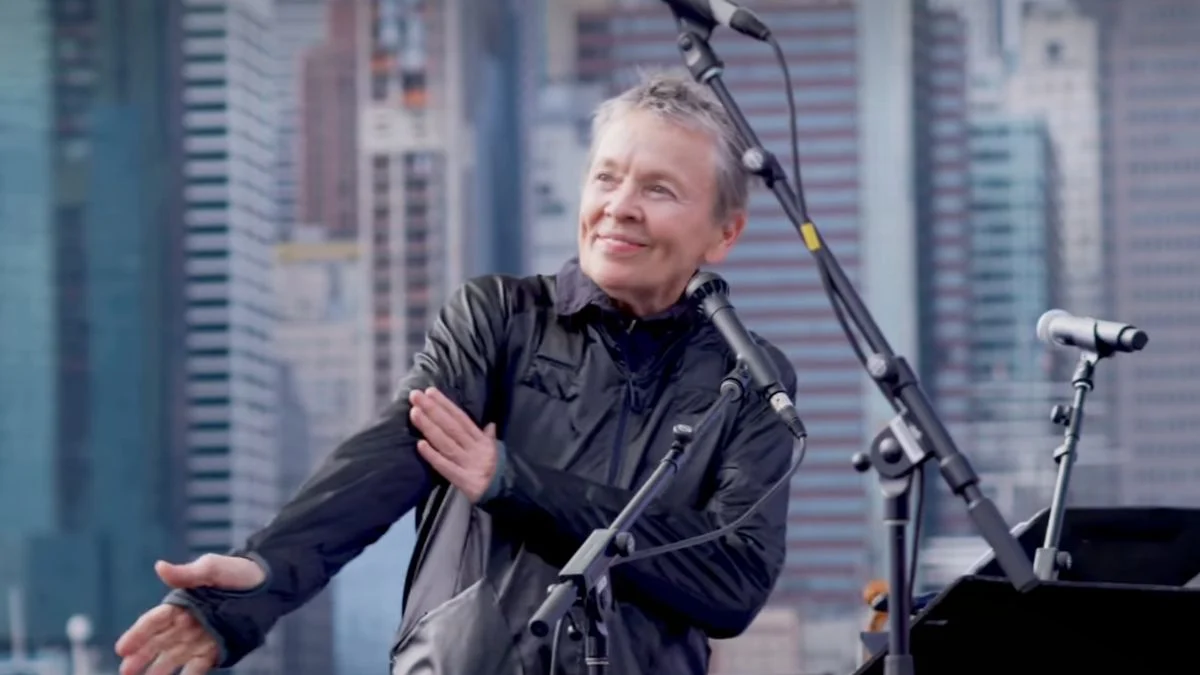
The intersection of avant-garde performance and public discourse took a profound turn earlier this month in New York City, as iconic multimedia artist Laurie Anderson utilized the grand stage of the Return of the Buffalo: Tatanka Owe Akupi project to deliver a message of resilience, skepticism, and empathy. During a September 19th procession through the streets of Downtown Brooklyn, Anderson synthesized her signature electronic percussion work with a set of guiding principles she famously developed alongside her late husband, the legendary musician Lou Reed.
This performance served as a poignant centerpiece for a broader, two-day public art installation designed to address themes of ecological recovery and cultural healing. By revisiting the “three rules for life” that have become a hallmark of her philosophical legacy, Anderson invited a modern audience to confront the current climate of societal polarization through the lens of artistic tradition and personal wisdom.
A Legacy of Wisdom: The Three Rules
The rules—"Don’t be afraid of anybody," "Get a really good bullshit detector and learn how to use it," and "Be really tender"—have evolved from private marital counsel into a public mantra that Anderson has championed since Reed’s passing in 2013. When she formally introduced these tenets to a global audience during Reed’s posthumous induction into the Rock & Roll Hall of Fame in 2015, they resonated as a distillation of the couple’s shared worldview: one that balances a sharp, critical eye toward power structures with an unwavering commitment to human vulnerability.
In the context of the Brooklyn procession, these rules functioned as an ethical framework for navigating an increasingly volatile public square. Anderson’s articulation of these points suggests a deliberate effort to provide contemporary listeners with a roadmap for maintaining integrity in an era characterized by digital noise and rapid, often aggressive, discourse.
The Anatomy of Performance: Electronic Synthesis
Anderson’s performance technique on September 19th was a masterclass in technological integration. By striking her own body to trigger electronic percussion sounds, she effectively transformed herself into a human instrument. This technique is a direct evolution of her groundbreaking 1986 "Drum Dance," a piece that relied on a specialized suit embedded with sensors to map sound to physical movement.
By returning to this method nearly four decades later, Anderson bridged the gap between her early experimental work and her current status as a cultural elder. The physical act of striking the chest and limbs served as a rhythmic metronome for her spoken-word delivery, creating a visceral experience for the onlookers. This synthesis of the somatic and the sonic emphasizes Anderson’s career-long interest in how technology mediates the human experience, turning the body into a conduit for both musical expression and philosophical inquiry.
Contextualizing the Return of the Buffalo
The performance was held under the auspices of Return of the Buffalo: Tatanka Owe Akupi, a large-scale public art endeavor directed by Amir Nizar Zuabi. The project, which took place over two days in Lower Manhattan and Downtown Brooklyn, was conceptually anchored by the deployment of 40 life-size, articulated buffalo puppets. These figures were not merely aesthetic installations but served as symbols of the species’ return from the brink of near-extinction, a narrative arc that parallels the resilience of indigenous cultures and the necessity of ecological restoration.
The collaboration featured a diverse coalition of participants, including Lenape and Lakota tribal elders, as well as an eclectic roster of artists and public figures such as Rhiannon Giddens, Haley Heynderickx, Max García Conover, Sam Waterston, Susan Sarandon, and Rosario Dawson. The presence of tribal elders provided a foundational layer of legitimacy to the project, grounding the artistic performance in historical reality and traditional ecological knowledge. The logistics of moving 40 life-size puppets through the dense urban landscape of Brooklyn required significant coordination, marking the event as one of the most ambitious public art interventions in New York City in recent years.
Analysis: Anger and the Root of the Heart
Perhaps the most significant aspect of Anderson’s contribution was her commentary on the prevalence of public anger. Drawing on the teachings of Buddhist philosophy, she challenged her audience to look past the surface-level symptoms of hostility that define much of contemporary political and social life.
"So many people are so angry these days," Anderson observed during the performance. She urged the crowd to move beyond reactionary responses to such anger, suggesting that beneath the veneer of hostility lies a more universal human condition: a broken heart. By framing anger as a symptom of deep-seated pain rather than a fundamental character flaw, Anderson provided a psychological pivot for her audience.
From a sociological perspective, this approach aligns with recent discourse regarding the "empathy gap" in digital environments. Anderson’s suggestion to "get to the bottom" of this anger implies that the responsibility of the individual is to engage in a process of investigation—to use that "bullshit detector" not just to filter out misinformation, but to identify the genuine suffering hidden behind the vitriol of others.
Historical Timeline of the Rules
To understand the significance of Anderson’s performance, one must look at the timeline of these three rules within her public persona:
- Pre-2013: The rules function as an intimate, internal dialogue between Anderson and Reed, reflecting their shared values and collaborative creative spirit.
- 2015: Anderson publicly codifies the rules during her speech at the Rock & Roll Hall of Fame, marking their transition into the public domain.
- 2017–2023: Anderson integrates these themes into various lectures, masterclasses, and experimental exhibitions, specifically focusing on the intersection of art and social justice.
- September 2024: The Brooklyn performance marks a culmination of these ideas, applying them specifically to the context of collective trauma and environmental restoration as represented by the Return of the Buffalo project.
Broader Implications and Public Response
The reception of Anderson’s performance highlights a continued public appetite for artists who function as both observers and participants in the social contract. In an age where digital activism often favors brevity and slogans, Anderson’s long-form, performance-based approach provides a necessary complexity.
Critics and attendees alike have noted that the juxtaposition of the buffalo—a creature of the plains—with the industrial backdrop of Brooklyn provided a striking contrast that mirrored the environmental concerns of the project. The involvement of high-profile actors and musicians, such as Susan Sarandon and Rosario Dawson, ensured that the event drew significant media attention, but the core of the message remained focused on the grassroots philosophy of healing and resilience.
Furthermore, the integration of indigenous perspectives through the involvement of Lenape and Lakota elders signifies a shift in how major public art projects are being curated. It moves away from the "artist as sole visionary" model toward a collaborative framework that respects historical context and communal trauma.
The Role of Art in a Polarized Society
Laurie Anderson’s performance at Return of the Buffalo serves as a case study for how public art can address the "emotional landscape" of a city. By physicalizing abstract concepts like "tenderness" and "the bullshit detector," she translates complex psychological states into actionable human behaviors.
As the world faces mounting pressures—ranging from environmental instability to geopolitical conflict—the call for "tenderness" might seem, to some, as a radical or even naive proposition. However, when delivered by an artist of Anderson’s stature and context, it is presented as a form of intellectual and emotional discipline. It requires the courage to look at anger without turning away, and the skill to discern the truth from the noise.
The success of this performance suggests that the audience is seeking more than just aesthetic enjoyment from public events; they are looking for frameworks for living. By merging her technical prowess as an electronic musician with her role as a storyteller and moral philosopher, Anderson has once again demonstrated why she remains one of the most vital figures in American performance art.
Concluding Reflections
As the Return of the Buffalo project concludes, its impact will likely be measured not only by the physical reach of the performance but by the way its central messages ripple through the communities that witnessed it. Anderson’s contribution remains a testament to the idea that the personal is indeed political, and that even in the heart of a bustling, often harsh urban environment, there is space for the quiet, difficult work of understanding.
The legacy of these three rules will undoubtedly continue to evolve as Anderson continues her work. They serve as a reminder that even after the loss of a partner, the lessons learned in partnership can provide a steady anchor in a changing world. For those who witnessed the performance in Brooklyn, the image of Anderson, the sensors on her body, and the sound of her own heartbeat amplified into the street will likely persist as a defining moment of contemporary performance art—a moment that asked not just for the audience’s attention, but for their empathy and their skepticism in equal measure.









Leave a Reply