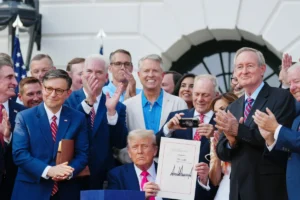
WAIANAE, Hawaiʻi — A looming shift in federal healthcare policy is triggering profound alarm across the Hawaiian archipelago, where clinicians and community advocates warn that thousands of vulnerable residents could soon lose their medical coverage. Under the provisions of the One Big Beautiful Bill Act, signed into law by President Donald J. Trump, 43 states and the District of Columbia must implement stringent new work requirements for adult Medicaid beneficiaries. While the legislation explicitly carves out exemptions for Native Americans and Alaska Natives, it omits Native Hawaiians entirely.
Beginning in January, the mandate will require most non-exempt adult Medicaid enrollees to maintain at least 80 hours per month of employment, schooling, vocational training, or volunteer work to preserve their health benefits. For a marginalized population already grappling with deep-seated health disparities, economic instability, and geographic isolation, the omission threatens to dismantle critical safety nets. Health administrators, providers, and congressional leaders argue that the exclusion is not merely an oversight, but part of a broader, systemic challenge to the recognized Indigenous status of Native Hawaiians.
Demographics and the Geographic Spread of Native Hawaiians
Understanding the scale of the impending crisis requires examining the demographic distribution of the population. Of the nearly 700,000 Native Hawaiians currently residing across the United States, approximately 47% live within the state of Hawaiʻi, while the remainder reside on the U.S. mainland. Outside of the islands, states such as California, Washington, Nevada, Texas, and Oregon maintain the largest Native Hawaiian communities.
Within Hawaiʻi itself, the Medicaid program covers roughly 390,000 individuals. State Medicaid administrator Meredith Nichols noted that approximately 15% of these enrollees—nearly 58,500 people—identify as Native Hawaiian. Because federal policy hinges on formal tribal sovereignty and federal recognition, state officials say they hit a brick wall when attempting to negotiate an exemption for the population.
During high-level discussions in June, health administrators from Hawaiʻi met with officials from the Trump administration to push for an administrative remedy or legislative carve-out. Those efforts ultimately stalled. State officials and healthcare advocates report that the Centers for Medicare & Medicaid Services (CMS) has not provided substantive responses regarding the disparate treatment, while White House spokespersons have declined to comment on the record.
Historical Context: Sovereignty, Land Trusts, and Federal Recognition
The root of the exclusion lies in the unique legal and political history of Native Hawaiians, who, unlike American Indians and Alaska Natives, are not among the 575 federally recognized tribal nations. Federal recognition can theoretically be granted through congressional statute or via an administrative process established by the Department of the Interior. However, the path toward recognition remains politically fraught and heavily contested within the Native Hawaiian community itself. Many residents and sovereignty advocates strongly oppose seeking federal recognition through standard bureaucratic channels, fearing that doing so would legitimize the U.S.-backed illegal overthrow of the Hawaiian Kingdom in 1893 and permanently extinguish claims to full national independence.
This complex legal standing has historically created gaps in federal legislation. For decades, federal healthcare statutes have drawn a stark line between Native Americans and Native Hawaiians. While the Indian Health Service (IHS) and tribal facilities receive 100% federal reimbursement for healthcare services delivered to Native Americans and Alaska Natives, Native Hawaiian healthcare systems receive standard, lower reimbursement rates comparable to general commercial or state baselines.

An exception occurred temporarily under the 2021 American Rescue Plan Act, signed by former President Joe Biden, which fully reimbursed Native Hawaiian health centers for Medicaid services for a two-year window. However, that funding stream was restricted exclusively to facilities operating within the state of Hawaiʻi, leaving mainland Native Hawaiians entirely outside the specialized funding structure.
Barriers to Compliance on the Ground
On the ground in Hawaiʻi, healthcare leaders emphasize that compliance with an 80-hour monthly work mandate is an insurmountable hurdle for many patients due to systemic socioeconomic barriers. Rich Bettini, CEO of the Waianae Coast Comprehensive Health Center on the western side of Oʻahu, points out that the local cost of living sharply contrasts with local wages.
"The annual cost of living for a family of four on Oʻahu is $100,000-plus," Bettini explained. "The average income of our patients is under $30,000 a year. That is an enormous gap."
This profound economic disparity has fueled a severe housing crisis. Native Hawaiians and Pacific Islanders comprise roughly 60% of Oʻahu’s homeless population. Bettini’s health center estimates that approximately 2,800 of its patients will be directly impacted by the new Medicaid work rules, with roughly half of those individuals being Native Hawaiian. For patients experiencing homelessness or severe housing instability, maintaining stable employment or documenting 80 monthly hours of volunteer or educational work is logistically daunting.
Compounding the economic squeeze is geographic isolation. The Waianae Coast Comprehensive Health Center serves a region rich in Native Hawaiian population density but lacking in robust local infrastructure, public transportation, and nearby job opportunities. Many residents also face prohibitive costs associated with childcare, further restricting their ability to enter the formal workforce.
Inter-island travel presents yet another financial obstacle covered by Medicaid. When patients on neighbor islands—such as Kauaʻi or Niʻihau—require specialized medical treatment available only in Honolulu on Oʻahu, Medicaid typically covers the steep transportation expenses. Round-trip airfare between islands can cost hundreds of dollars, meaning that the loss of Medicaid eligibility could instantly cut off rural residents from advanced medical care.
Dr. Kapono Chong-Hanssen, medical director of Hoʻāla Lāhui, the Native Hawaiian healthcare system serving Kauaʻi and Niʻihau, warns that the policy will severely damage patient trust. Historical disenfranchisement has already made marginalized populations skeptical of institutional systems. When bureaucratic barriers arise, patients are statistically more likely to disengage entirely from healthcare networks.
"It just flies in the face of everything that we’re trying to do," Chong-Hanssen said, noting that many of his patients will likely fall through the cracks and forgo necessary medical interventions.
A Broader Assault on Indigenous Status?

The Medicaid work requirement is viewed by many community leaders not as an isolated administrative oversight, but as part of an escalating, multi-pronged challenge to Native Hawaiian rights, lands, and educational programs.
In the federal budget proposal for fiscal year 2027, the Trump administration recommended cuts to several Native Hawaiian programs, explicitly citing the group’s lack of federal tribal status as justification. Simultaneously, a wave of federal lawsuits filed by conservative organizations has targeted long-standing support systems. These legal challenges aim to dismantle university scholarships reserved for Native Hawaiians pursuing healthcare careers and seek to overturn historic legislation that provides homestead land at near-zero cost to Native Hawaiians based on blood quantum requirements.
These homesteads trace their origins to the Hawaiian Homes Commission Act of 1921, through which Congress placed over 200,000 acres of land into a trust to return Native Hawaiians to their ancestral lands following the 1893 overthrow. Today, nearly 30,000 Native Hawaiians remain on waiting lists for homestead plots, while more than 34,000 people reside on established homestead lands that are frequently far removed from the urban healthcare hubs of Honolulu.
Reflecting on the compounding pressures facing community advocates, Keolamaikalani Dean, CEO of the King Lunalilo Trust, described the Medicaid rule as an injurious policy implemented amidst a sea of concurrent threats. While acknowledging the severity of the healthcare loss, Dean noted that advocates are stretched thin trying to defend multiple fronts simultaneously.
"It’s horrible as a policy, but there are bigger fish to fry," Dean remarked, suggesting that organizations must prioritize systemic legislative fixes, such as securing permanent full federal Medicaid reimbursement parity for Native Hawaiian health systems, to create enduring financial stability.
Political Reaction and Future Implications
Federal lawmakers representing Hawaiʻi have condemned the exclusion in unambiguous terms. U.S. Representative Jill Tokuda (D-Hawaiʻi) characterized the denial of the Medicaid exemption as an intentional political maneuver designed to weaken the legal standing of Native Hawaiians.
"These are not one-offs," Tokuda stated. "This is a targeted, coordinated attack to undercut the Indigenous status of Native Hawaiians."
As January approaches, healthcare providers are racing to implement mitigation strategies. Facilities like the Waianae Coast Comprehensive Health Center are deploying technological solutions, such as interactive campus pods that connect patients directly via phone with administrative staff trained to help them navigate complex Medicaid application and verification processes.
Nevertheless, health professionals fear that administrative outreach will not be enough to prevent a surge in uninsured patients. Without congressional intervention to amend the One Big Beautiful Bill Act or administrative guidance from CMS granting parity, thousands of Native Hawaiians face the prospect of losing access to essential medical services, preventive care, and life-sustaining treatments.