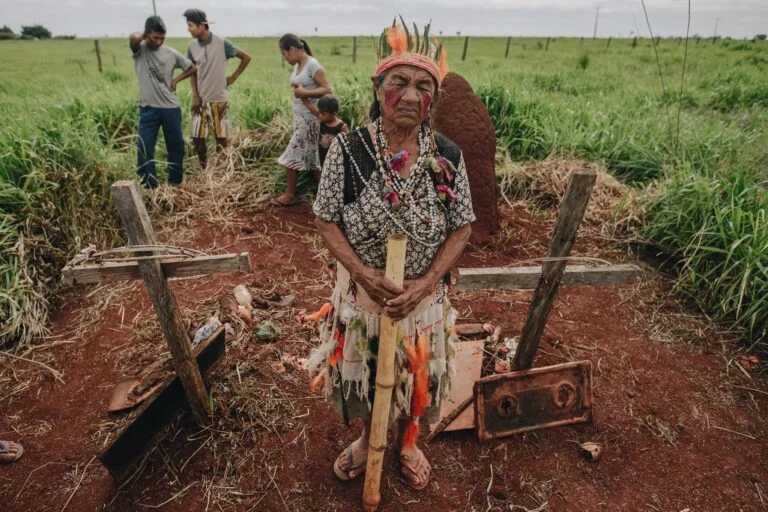
The re-election of Brazilian President Luiz Inácio Lula da Silva on October 25 marked a significant democratic milestone, galvanized in large part by a historic mobilization of Indigenous voters seeking to secure their constitutional rights and territorial protections. However, the democratic victory has rapidly been overshadowed by a dangerous wave of political and racial animus. In the municipality of Tacuru, located in the western Brazilian state of Mato Grosso do Sul, municipal officials allegedly responded to the election results by circulating audio messages threatening to poison the water supply of the vulnerable Guarani-Kaiowá Indigenous population. While the local government has suspended the implicated employees, human rights defenders, legal authorities, and Indigenous leaders warn that administrative slaps on the wrist are entirely inadequate to address a deeply entrenched, systemic crisis of violence that threatens the physical survival of Brazil’s original inhabitants.
The WhatsApp Threat and the Reality of Water Contamination
Shortly after the final runoff election results were broadcast nationwide, two municipal employees in Tacuru allegedly took to WhatsApp to voice their bitter resentment over the electoral outcome. According to reports filed by the Articulation of Indigenous Peoples of Brazil (APIB) and formally submitted to the Ministry of Indigenous Peoples (MPI), the officials targeted the Guarani-Kaiowá communities with explicit hate speech and lethal threats.
"I already said it, we have to [put] poison in the water. Kill those pests in the water," the audio messages stated, blaming the Indigenous constituency for Lula’s victory.
For civil society groups and legal observers, treating this incident as an isolated case of cyber-harassment or bad behavior ignores the terrifying historical context of Mato Grosso do Sul. Matias Benno Rempel, coordinator of the state’s Indigenous Missionary Council (Cimi), emphasized that the threat goes far beyond rhetorical racism.
"Talking about poisoning the water in Mato Grosso do Sul is not just verbal racism; it is not merely a message of hate," Rempel said. "It is grounded in concrete reality, drawing from numerous instances where this has been a recurring tactic used against the state’s Indigenous peoples."
Throughout the region’s turbulent agrarian history, water sources inside or adjacent to Indigenous territories have frequently been targeted by hostile farming interests attempting to starve out, displace, or intimidate communities resisting land grabs. The casual mention of poisoning a communal water supply taps into a dark history of environmental warfare waged against marginalized groups in Brazil’s agricultural frontier.
Chronology of Post-Election Escalation
The threats in Tacuru did not occur in a vacuum; they formed part of an immediate post-election surge in physical attacks, hate speech, and acts of targeted vandalism across Mato Grosso do Sul. The chronology of escalation highlights an alarming breakdown in public safety for Indigenous communities following the democratic transition of power:
- October 25: Incumbent President Luiz Inácio Lula da Silva wins the presidential runoff election, aided by a high turnout of Indigenous voters prioritizing environmental and territorial safeguards.
- Late October: Shortly after the election results are certified, municipal employees in Tacuru circulate WhatsApp audio messages calling for the poisoning of Guarani-Kaiowá water supplies.
- Days Following the Election: APIB and local monitors record a wave of aggressive incidents, including targeted hit-and-run accidents, physical assaults, and property destruction directed at Indigenous individuals.
- Late October: The home of ’Andesy Roberta, a revered 90-year-old Guarani-Kaiowá spiritual leader, is deliberately set on fire in an act of arson aimed at intimidating community leadership.
- Early November: The Tacuru City government announces a 20-day suspension of the two accused municipal employees while opening internal administrative disciplinary proceedings.
- Ongoing: The Federal Police (PF) and the Federal Public Ministry (MPF) launch formal multi-agency investigations into the wave of violence and hate speech sweeping Mato Grosso do Sul.
Institutional Response and Government Intervention
As reports of violence multiplied, federal and municipal institutions scrambled to mount a coordinated response. The Tacuru City administration confirmed to Mongabay and the Federal Public Ministry that the two municipal workers linked to the genocidal water-poisoning audios were suspended for 20 days pending the conclusion of an internal administrative inquiry. However, this disciplinary action has been widely criticized by civil rights organizations as a token gesture that fails to match the severity of the alleged crimes.

The Federal Public Ministry and the Federal Police have stepped in, initiating comprehensive criminal investigations into the hate speech campaign and related acts of political violence. Meanwhile, Brazil’s federal Indigenous rights agency, Funai, issued a stern public statement condemning the escalation.
"The reports are extremely concerning," Funai stated, drawing explicit attention to "possible instances of discrimination and hate speech against indigenous peoples." In response to the crisis, Funai announced the creation of a specialized task force dedicated to investigating political violence targeting both Indigenous populations and Afro-Brazilian minority groups.
At the ministerial level, Minister of Indigenous Peoples Eloy Terena has taken a firm stance against the rising tide of aggression. To ensure that isolated communities have a direct line to federal protection, the MPI established a dedicated emergency hotline (+55 11 98202.5433).
"We will continue to combat all forms of violence against Indigenous communities here," Minister Terena affirmed in a public address.
The Shadow of Bolsonarism and Agrarian Conflict
To fully understand the gravity of the current crisis in Mato Grosso do Sul, analysts must examine the broader political and socio-economic dynamics of the region. For decades, the state has been a primary epicenter of violent land conflicts between Indigenous groups—such as the Guarani and Kaiowá—and powerful agribusiness interests, ranchers, and rural elites.
Matias Benno Rempel of Cimi points out that the political movement known as Bolsonarism—named after former far-right President Jair Bolsonaro—has injected a virulent new strain of hostility into an already volatile environment. Bolsonaro’s tenure was marked by aggressive anti-Indigenous rhetoric, promises to halt land demarcations, and the promotion of commercial exploitation within traditional territories. According to Rempel, this political ideology serves as "one of the most aggressive facets" of contemporary violence, representing an "additional layer" in a landscape of historical violations that pre-date the Bolsonaro administration but found powerful ideological encouragement during his time in office.
The physical vulnerability of Indigenous elders highlights the cruelty of this backlash. The deliberate burning of the home of 90-year-old spiritual leader ’Andesy Roberta demonstrates that attacks are not merely aimed at acquiring land, but at destroying the cultural, spiritual, and generational pillars of the community. In a culture where elders act as the custodians of history, language, and sacred traditions, targeting figures like Roberta is an assault on the collective identity of the Guarani-Kaiowá people.
Broader Implications and the Path Forward
The crisis in Mato Grosso do Sul presents an urgent test for the administration of President Lula da Silva. Having built part of his electoral coalition on promises to restore Indigenous rights, halt illegal deforestation, and protect ancestral lands through the newly created Ministry of Indigenous Peoples, the federal government faces immense pressure to translate policy promises into boots-on-the-ground security.
Activists argue that mere suspensions and investigative committees are insufficient to deter heavily entrenched local aggressors who operate with a historic sense of impunity. For the Guarani-Kaiowá, true safety will require structural reforms: the accelerated demarcation of traditional lands, the permanent removal of illegal occupiers, aggressive prosecution of hate speech and political violence, and the dismantling of local power networks that treat Indigenous lives as disposable obstacles to economic expansion.
As the Federal Police and the MPF press forward with their inquiries into the Tacuru water-poisoning threats and the broader wave of post-election terror, the eyes of the international human rights community remain fixed on Brazil. The coming months will determine whether the federal government possesses the enforcement power necessary to protect its most vulnerable citizens from the lethal fallout of political polarization.