A routine presidential departure from Joint Base Andrews in Maryland encountered an unexpected and dramatic hurdle when an emergency evacuation slide deployed from the newly acquired Boeing 747-8 Air Force One aircraft. The incident, which took place on Wednesday, September 9, 2026, temporarily halted the president’s travel schedule and drew immediate scrutiny from aviation experts, political observers, and the general public. While standard aviation protocols and historical precedents strongly suggest that the deployment was the result of an accidental disarming oversight by ground or flight crew, President Donald Trump publicly insisted that the deployment was an intentional pre-flight safety test designed to verify the operational integrity of the evacuation system.
The sequence of events on Wednesday afternoon highlighted the complex logistics surrounding presidential air travel, particularly involving newly integrated or unconventional aircraft within the military fleet. This occurrence not only caused a brief logistical delay for the commander-in-chief but also reignited discussions regarding the operational protocols of high-profile government aircraft and the transparency of official explanations when minor mechanical or human errors occur in high-security environments.
Chronology of Events at Joint Base Andrews
The schedule for Wednesday, September 9, 2026, began with standard preparations for a presidential flight out of Joint Base Andrews, a premier military installation housing critical wing commands for both the United States Air Force and the United Navy. President Trump was scheduled to board the aircraft—a Boeing 747-8 wide-body jet frequently discussed in public discourse for its origin as a gift from the government of Qatar—shortly after 2:00 PM local time.
Prior to boarding, the president arrived at the tarmac via the presidential marine helicopter, Marine One. According to eyewitness reports and pool reporters on the scene, the president remained seated inside Marine One for approximately 20 minutes upon arrival at the designated transfer point. This extended holding period inside the helicopter was unusual for standard departures, hinting that ground crews were already attempting to resolve an unforeseen complication on the primary transport aircraft.
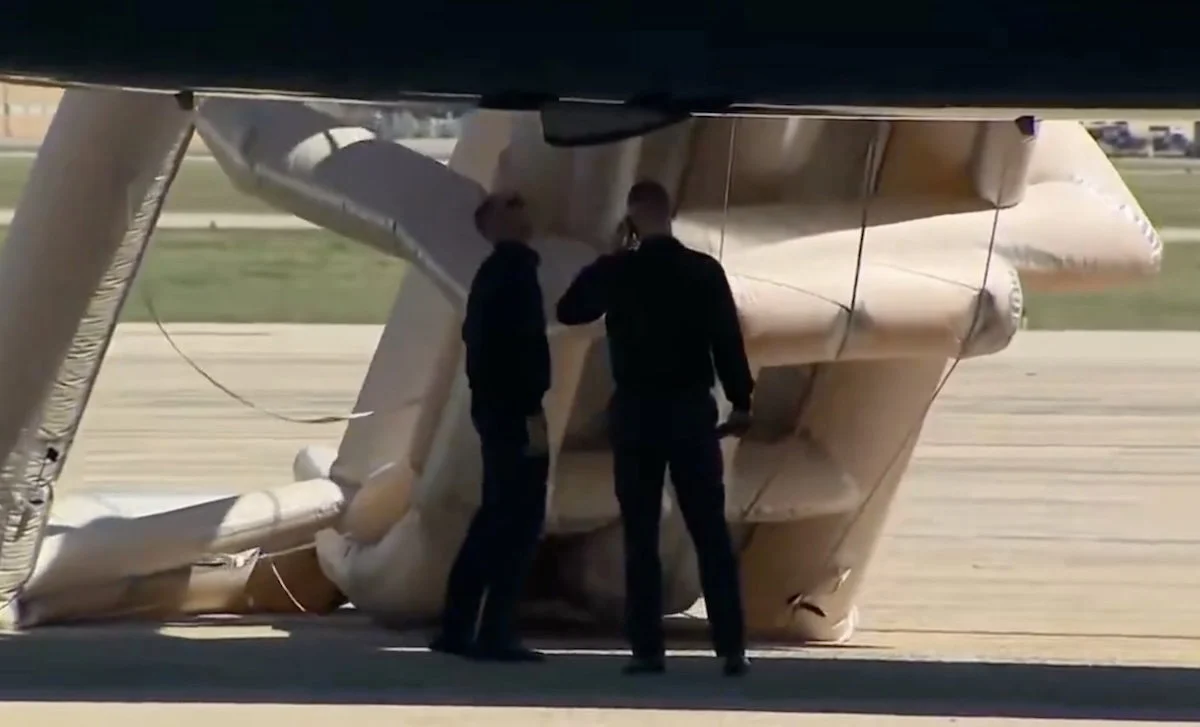
Once the president emerged from Marine One and proceeded toward the tarmac, the source of the delay became visibly apparent. One of the forward right emergency evacuation slides of the Boeing 747-8—whether from the upper or lower deck—had fully inflated and extended outward onto the tarmac. The bright yellow-orange slide stood out sharply against the fuselage of the massive aircraft, drawing immediate attention from press photographers and security personnel stationed around the perimeter.
Ground crews immediately mobilized to address the obstruction. Standard aviation safety protocols require that deployed slides be detached, deflated, and stowed before an aircraft can be cleared for movement or taxiing. According to observers on the ground, the slide was rapidly removed from the aircraft structure, and technicians worked quickly to secure the exit door and assess the surrounding mechanics. Despite the unexpected disruption, the delay was kept relatively brief, allowing the president to board the aircraft and complete his departure after a revised timeline.
Contrasting Accounts: Human Error Versus Intentional Testing
The central point of contention surrounding the incident involves the exact mechanism and motivation behind the slide’s deployment. In commercial and military aviation, emergency escape slides are packed into dedicated door housings alongside a mechanical arming lever. When a door is armed, opening it automatically triggers the inflation of the slide to facilitate rapid passenger evacuation in an emergency. When the door is disarmed, opening it allows normal passenger or service entry without deploying the slide.
Historically, the vast majority of unexpected slide deployments on commercial and government aircraft are attributed to human error—specifically, a crew member or maintenance technician forgetting to disarm the door before it is opened from the inside or outside for catering, cleaning, or ground service operations. Similar high-profile incidents have occurred throughout aviation history, including a notable accidental slide deployment on a previous iteration of Air Force One in July 1994, as well as periodic occurrences across major commercial carriers worldwide.
However, President Trump offered a starkly different explanation when approached by members of the media upon arriving at the aircraft. When asked about the inflated slide visible on the side of the aircraft, the president dismissed the notion of an accident, characterizing the event as a deliberate and routine technical check.
"They were doing a check on the slide, you know, on the emergency, so I think it takes about 15 minutes," President Trump stated to reporters gathered near the tarmac.
When pressed further by a reporter regarding whether the incident represented a broader security concern or malfunction with the newly integrated aircraft, the president maintained his position. He asserted that the deployment was part of a pre-flight inspection protocol designed to guarantee absolute mechanical perfection before takeoff. "No, they were checking before, and they just wanted to make sure, so they’ve, I guess they already put it up, they just wanted to make sure everything works perfectly," he added.
Aviation Industry Analysis and Technical Feasibility
The president’s public explanation met with skepticism from commercial pilots, flight attendants, and technical operations specialists who monitor aviation safety standards. Within the professional aviation community, standard maintenance and inspection protocols for emergency evacuation slides are rigorous, highly regulated, and time-intensive procedures.
According to certified aircraft technicians, emergency slides undergo extensive testing, recertification, and inspection during scheduled heavy maintenance checks—such as C-checks or D-checks—performed in specialized hangar facilities. These procedures involve specialized test cylinders, careful repacking by certified technicians, and strict adherence to manufacturer manuals.
Furthermore, industry experts point out that casually deploying an evacuation slide on the active tarmac mere minutes before a high-profile departure is virtually unprecedented in standard aviation operations. Once a slide is deployed, it is considered spent; it cannot simply be folded back into its housing and re-armed for immediate flight without professional repacking, safety recertification, and potential replacement of the inflation pressure cylinders. Attempting to restore a deployed slide to its stowed position within a 15-minute window contradicts standard technical guidelines, leading aviation analysts to speculate that ground crews may have simply removed the spent slide entirely or deferred the permanent repair, choosing to dispatch the aircraft without an operational slide at that specific exit if regulatory minimum equipment lists (MEL) permitted.
The operational reality of opening doors on a Boeing 747-8 immediately prior to departure also raises operational questions. Typically, forward doors are utilized for passenger boarding or final catering deliveries. When ground service vehicles interface with aircraft doors, strict communication protocols are maintained between the flight deck, cabin crew, and ground agents to prevent accidental deployments.
Background and Broader Context of the Aircraft
The aircraft involved in the incident adds a unique layer of context to the event. The Boeing 747-8 in question is a wide-body commercial airliner gifted to the United States government by the State of Qatar. The aircraft has frequently been a subject of intense public interest, media coverage, and political discussion due to its estimated value, extensive luxury modifications, and its integration into the presidential fleet as an alternative or supplementary transport vehicle often referred to colloquially in news reports as Air Force One or the VC-25B bridge aircraft.
Because this specific Boeing 747-8 operates outside the traditional military acquisition and outfitting pipeline typically managed by the United States Air Force and defense contractors like Boeing, its maintenance, servicing, and ground handling involve specialized protocols. The integration of foreign-gifted luxury aircraft into the presidential fleet requires navigating unique logistical frameworks, ranging from specialized security sweeps to customized maintenance support structures that differ from standard military transport protocols.
Implications and Public Communications
While the incident ultimately resulted in nothing more than a temporary tarmac delay and did not pose a direct threat to the safety of the flight once resolved, the event underscores the delicate intersection of public relations, political messaging, and technical aviation realities.
Aviation safety advocates emphasize that transparency regarding human error is standard practice in the transportation sector. In commercial aviation, acknowledging an accidental door disarming oversight is routine, viewed simply as an operational hiccup rather than a reflection on leadership or aircraft reliability. When political figures offer alternative explanations that run counter to established technical procedures—such as framing an accidental deployment as an intentional 15-minute pre-flight test—it often generates unnecessary confusion among aviation professionals and the public regarding the actual mechanics of aircraft safety systems.
Ultimately, the delayed departure from Joint Base Andrews serves as a reminder of the complex machinery, stringent safety demands, and high visibility surrounding presidential transportation. Whether viewed as an unfortunate human error during ground preparations or defended as an unorthodox technical verification, the deployment of the emergency slide on the Qatari-gifted Boeing 747-8 highlights the constant scrutiny under which the modern presidential fleet operates.