
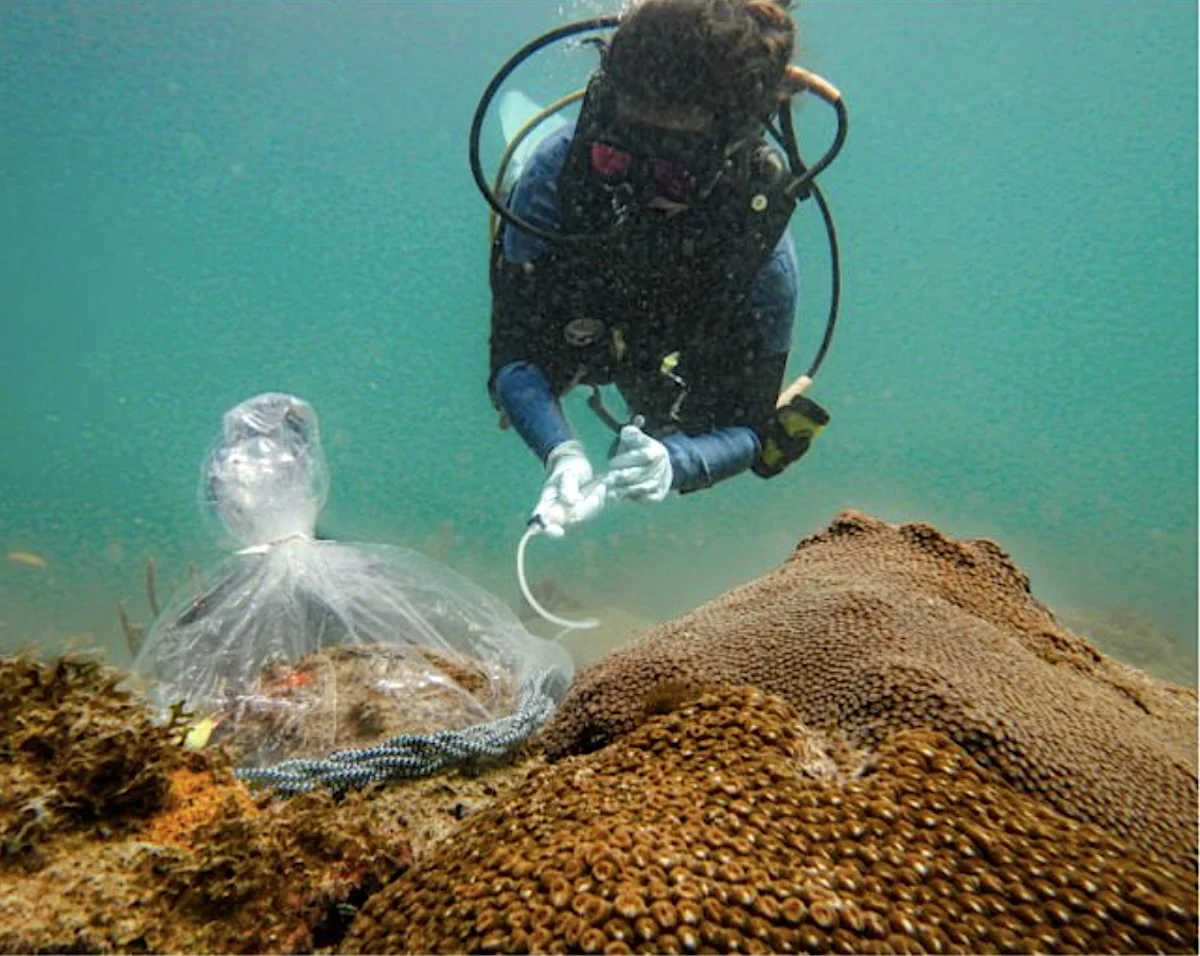
Marine scientists have reached a significant milestone in the fight to preserve the world’s coral reefs, identifying a probiotic treatment that offers long-term protection against one of the most devastating aquatic pathologies in history. In a comprehensive study published in the journal Frontiers in Marine Science, researchers from the Smithsonian Marine Station and collaborating institutions have demonstrated that a specific bacterial strain, known as MCH1-7, can drastically reduce the progression of Stony Coral Tissue Loss Disease (SCTLD). By utilizing an innovative "whole-colony bagging" delivery method, the team successfully slowed the spread of the disease in great star coral (Montastraea cavernosa) for over two years, providing a glimmer of hope for the beleaguered Florida Reef Tract and the wider Caribbean.
The breakthrough centers on the application of beneficial bacteria to diseased coral colonies, a process analogous to humans taking probiotics to restore gut health. This specific strain, MCH1-7, produces a potent compound called tetrabromopyrrole (TBP). The research indicates that when corals are treated with this probiotic, their survival rates skyrocket, and the loss of vital tissue is significantly minimized. While the scientific community has long searched for a sustainable alternative to chemical antibiotics—which carry the risk of promoting environmental resistance—this probiotic approach represents a natural, biologically derived solution that works in harmony with the reef ecosystem.
The Crisis of Stony Coral Tissue Loss Disease
To understand the weight of this discovery, one must look at the unprecedented destruction caused by Stony Coral Tissue Loss Disease. First identified off the coast of Miami in 2014, SCTLD has since become the most lethal coral disease ever recorded. Unlike other coral ailments that might affect a single species or progress slowly, SCTLD is characterized by its rapid transmission and high mortality rate. It affects more than 30 species of reef-building corals, including those that have lived for centuries.
Once a colony is infected, the disease manifests as white lesions where the coral tissue sloughs off the calcium carbonate skeleton. In many cases, a colony that took hundreds of years to grow can be completely killed within weeks or months. The disease has now spread throughout the Florida Keys and across much of the Caribbean, including the Bahamas, Mexico, Jamaica, and the Virgin Islands. The ecological stakes are immense; coral reefs provide essential coastal protection from storm surges, support massive biodiversity, and drive multi-billion-dollar tourism and fishing industries.
Chronology of the Discovery: From Resilience to Research
The journey to finding MCH1-7 began in 2018, four years after the initial SCTLD outbreak. Scientists at the Smithsonian Marine Station noticed a peculiar phenomenon: while entire reefs were being decimated, certain individual coral colonies remained healthy and vibrant despite being surrounded by diseased neighbors. This suggested that these specific corals possessed a natural defense mechanism.
Upon sampling these resilient colonies, researchers isolated the MCH1-7 bacterial strain. Laboratory trials soon confirmed that this bacterium inhibited the growth of the pathogens associated with SCTLD. The discovery shifted the focus from merely documenting the decline of reefs to actively intervening using the ocean’s own chemistry.
Between 2018 and 2021, preliminary tests were conducted in controlled laboratory environments to ensure the probiotic did not harm non-target species. Following successful lab results, the researchers moved to in-situ field trials off the coast of Florida. This transition from the lab to the open ocean was critical, as the complex variables of current, temperature, and microbial competition often render laboratory successes ineffective in the wild.
Methodology: The Whole-Colony Bagging Technique
One of the primary challenges in treating coral is the delivery of the medicine. In the open ocean, substances are quickly diluted by currents. To combat this, the research team developed and tested two primary methods of application on the great star coral (Montastraea cavernosa).
The first method involved a localized paste. Researchers mixed the probiotic with a specialized ointment and applied it directly to the active lesions on the coral. The second, more innovative method was the "whole-colony bagging" technique. In this approach, divers placed a large, weighted plastic bag over an entire coral colony, creating a temporary enclosed environment. They then injected the MCH1-7 probiotic into the seawater trapped inside the bag. The bag remained in place for several hours, allowing the coral and its associated microbiome to be "bathed" in the beneficial bacteria.
This method allowed the probiotic to reach the entire surface area of the coral, including healthy-looking tissue that might have been harboring microscopic pathogens. After the treatment period, the bags were removed, and the corals were monitored over a rigorous 2.5-year observation period.
Data and Findings: A Two-Year Success Story
The results of the field trials were stark and statistically significant. Corals that were treated using the whole-colony bagging method showed a remarkable level of resistance to the disease compared to the control group.
According to the data, corals treated via the bagging method lost an average of only 7% of their tissue to SCTLD over the course of the study. In contrast, untreated colonies in the same environment lost an average of 35% of their tissue. Some untreated colonies were completely consumed by the disease during the observation window.
The study also highlighted a major discrepancy between the two treatment methods. While the whole-colony bagging was highly effective, the direct paste application on lesions did not yield the same long-term benefits. The researchers hypothesized that the paste only treated the visible symptoms, whereas the bagging method reinforced the coral’s entire "holobiont"—the complex system of the coral animal and its resident microscopic organisms.

Furthermore, the protection offered by the MCH1-7 strain was not a fleeting fix. The data confirmed that the slowed disease progression persisted for 30 months after a single treatment. This long-term efficacy is a game-changer for conservationists, as it suggests that reefs may not require constant, labor-intensive interventions to survive an outbreak.
The Role of Tetrabromopyrrole (TBP)
A key finding of the research involves the chemical compound produced by MCH1-7: tetrabromopyrrole (TBP). This compound serves a dual purpose in the reef environment. Beyond its antimicrobial properties that fight SCTLD, TBP is known as a "natural settlement cue."
Jennifer Sneed, a biologist at the Smithsonian Marine Station, explained that TBP often signals to coral larvae that a location is a healthy and suitable place to attach and grow. "If TBP is a natural settlement cue, and if bacteria that also produce this compound protect corals from disease, it makes sense that larvae would settle where those compounds are being produced," Sneed noted. This creates a positive feedback loop: the probiotic protects the adult corals, and the chemical signals it produces encourage the next generation of corals to settle in a protected, healthy area.
Operational Viability and Diver Safety
While the bagging method proved superior in efficacy, the researchers acknowledged the practical hurdles of scaling this treatment. The process requires scuba divers to transport heavy equipment, manage large bags in potentially surge-heavy environments, and return hours later to retrieve the materials.
Despite these logistical demands, the study concludes that the performance of the whole-colony treatment outweighs the costs. The researchers have already begun refining the process to make it more efficient for reef managers. They also conducted extensive safety tests to ensure that the MCH1-7 strain does not negatively impact other Caribbean coral species or the surrounding marine life. The results indicated that the probiotic is highly specific in its action and does not disrupt the delicate balance of the wider reef ecosystem.
Expert Reactions and Future Implications
The scientific community has reacted to the study with cautious optimism. Kelly Pitts, the lead author of the study and a researcher at the Smithsonian Marine Station, emphasized that while this is a major step forward, it is not a "magic bullet" for the global coral crisis.
"It’s important to understand that this is the very beginning," Pitts told Mongabay News. "This is definitely not a cure-all, but we’re definitely moving in the right direction."
The success of the MCH1-7 strain opens the door for a new era of "personalized medicine" for coral reefs. As climate change continues to warm the oceans, corals are becoming more susceptible to various diseases. The methodology established in this study—identifying resilient colonies, isolating beneficial microbes, and developing effective delivery systems—can now be applied to other diseases and other coral species globally.
Broader Environmental Analysis
The implications of this research extend far beyond the laboratory. The Florida Reef Tract is estimated to have an asset value of $8.5 billion, supporting over 70,000 jobs. The loss of these reefs would be an economic catastrophe for the region. By providing a tool that can arrest the spread of SCTLD, scientists are giving these ecosystems a "fighting chance" to survive while the global community works to address the underlying cause of reef decline: rising sea temperatures and ocean acidification.
Moreover, the move toward probiotics represents a significant shift in conservation philosophy. For years, the primary response to SCTLD was the application of amoxicillin-based pastes. While effective in the short term, the widespread use of antibiotics in the ocean raises concerns about the development of "superbugs" and the unintended destruction of beneficial bacteria. The MCH1-7 probiotic offers a biological alternative that strengthens the reef’s natural defenses rather than relying on external chemical suppression.
Conclusion: The Road Ahead
The study published in Frontiers in Marine Science marks a turning point in marine pathology. By proving that a whole-colony probiotic treatment can provide 2.5 years of protection against Stony Coral Tissue Loss Disease, the Smithsonian team has provided reef managers with a potent new weapon.
The next steps for the research team involve investigating whether the probiotic can be delivered via automated systems or through broader "broadcast" methods to cover larger areas of the reef without the need for individual bagging. Additionally, scientists are looking to see if MCH1-7 can be combined with other probiotic strains to create a "cocktail" of beneficial bacteria capable of defending against multiple diseases simultaneously.
As the great star coral colonies off the Florida coast continue to be monitored, they stand as a testament to the power of microbial ecology. In the face of a seemingly unstoppable disease, a tiny bacterium found on a single resilient coral has provided the blueprint for saving an entire ecosystem. The work continues, but for the first time in a decade, the outlook for Florida’s reefs is beginning to brighten.









Leave a Reply