The European automotive landscape underwent a seismic shift in September 2026, as fully electric passenger vehicles (BEVs) captured a record-breaking 31% of the total market share. This surge, fueled by 422,000 new registrations, represents a 63% increase year-over-year, marking the fastest growth rate for the sector in over three years. When combined with plug-in hybrid (PHEV) sales of 167,000 units, the total plug-in vehicle (PEV) volume reached an unprecedented 590,000 units, accounting for 43% of the European market.

This data, coming in the wake of a volatile year, suggests that the transition to electric mobility is moving from a niche preference to a mainstream economic necessity. While overall plugin vehicles saw a 49% increase, the disparity in growth rates between BEVs and PHEVs—the latter growing by a more modest 23%—highlights a clear consumer shift toward full electrification.
Chronology of a Market Pivot
The acceleration of the European EV market cannot be viewed in isolation; it is deeply tied to the geopolitical and economic climate of 2026. At the dawn of the year, European legacy automakers maintained a strategy of gradual electrification, funded largely by robust combustion engine (ICE) vehicle profits. Projections from early 2026 anticipated moderate growth, with most analysts expecting EV share to stabilize around the 20% to 25% range by year-end.

However, the landscape shifted dramatically on February 28, 2026. The escalation of regional instability involving US and Israeli involvement in Iran triggered a rapid spike in global oil prices. As fuel costs climbed, the European consumer mindset transformed. The purchase of an electric vehicle evolved from a choice driven by environmental consciousness to a pragmatic decision based on household energy budget management.
This shift created a "perfect storm" for manufacturers capable of rapid production scaling. While legacy OEMs were often constrained by long-standing supply chain dependencies and slower-moving production lines, Tesla and various Chinese manufacturers—who had already been pivoting production away from a cooling domestic market in China—were able to fill the supply gap in Europe. By the third quarter of 2026, the market moved toward a model where availability became the primary driver of sales, allowing brands with higher inventory levels to capture significant market share from established European incumbents.

The Decline of Traditional Powertrains
The data for September 2026 provides clear evidence of a broader structural decline for internal combustion engines. Petrol-powered vehicle market share dropped to 18%, a 21% decrease year-over-year, while diesel registrations fell by 28% to a mere 4% share.
Perhaps more significant is the stalling growth of plugless hybrids (HEVs). While these vehicles still accounted for 34% of the market in September, their growth rate of 5% lagged significantly behind the overall market growth of 10%. When compared to the 36% market share held by HEVs in September 2025, it is increasingly probable that 2026 marks the arrival of "peak HEV." If this trend holds, the industry is entering a phase where non-rechargeable hybrids will begin a permanent downward trajectory as they are squeezed by the increasing affordability and efficiency of full battery-electric vehicles.
Sector Analysis and Segment Shifts
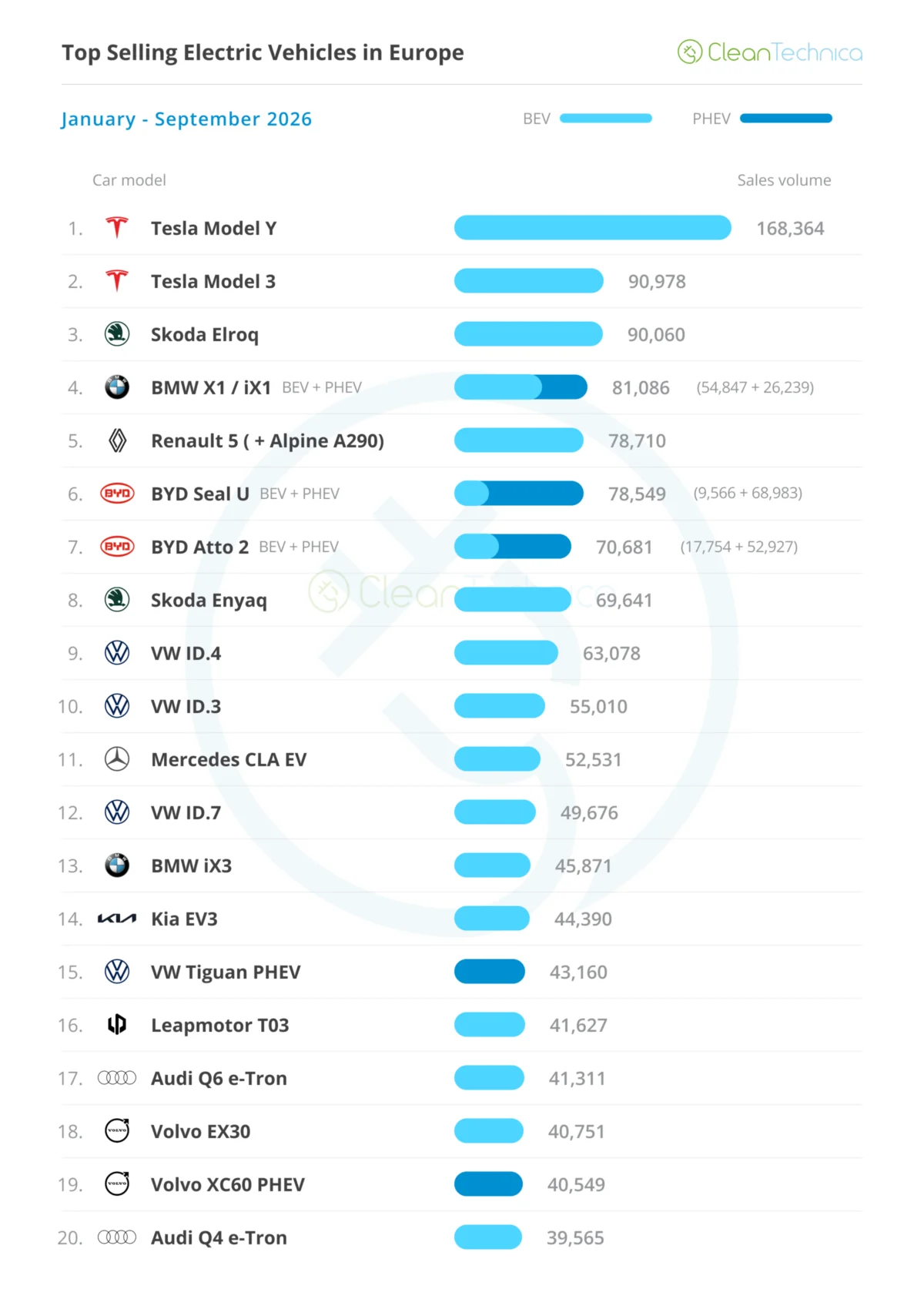
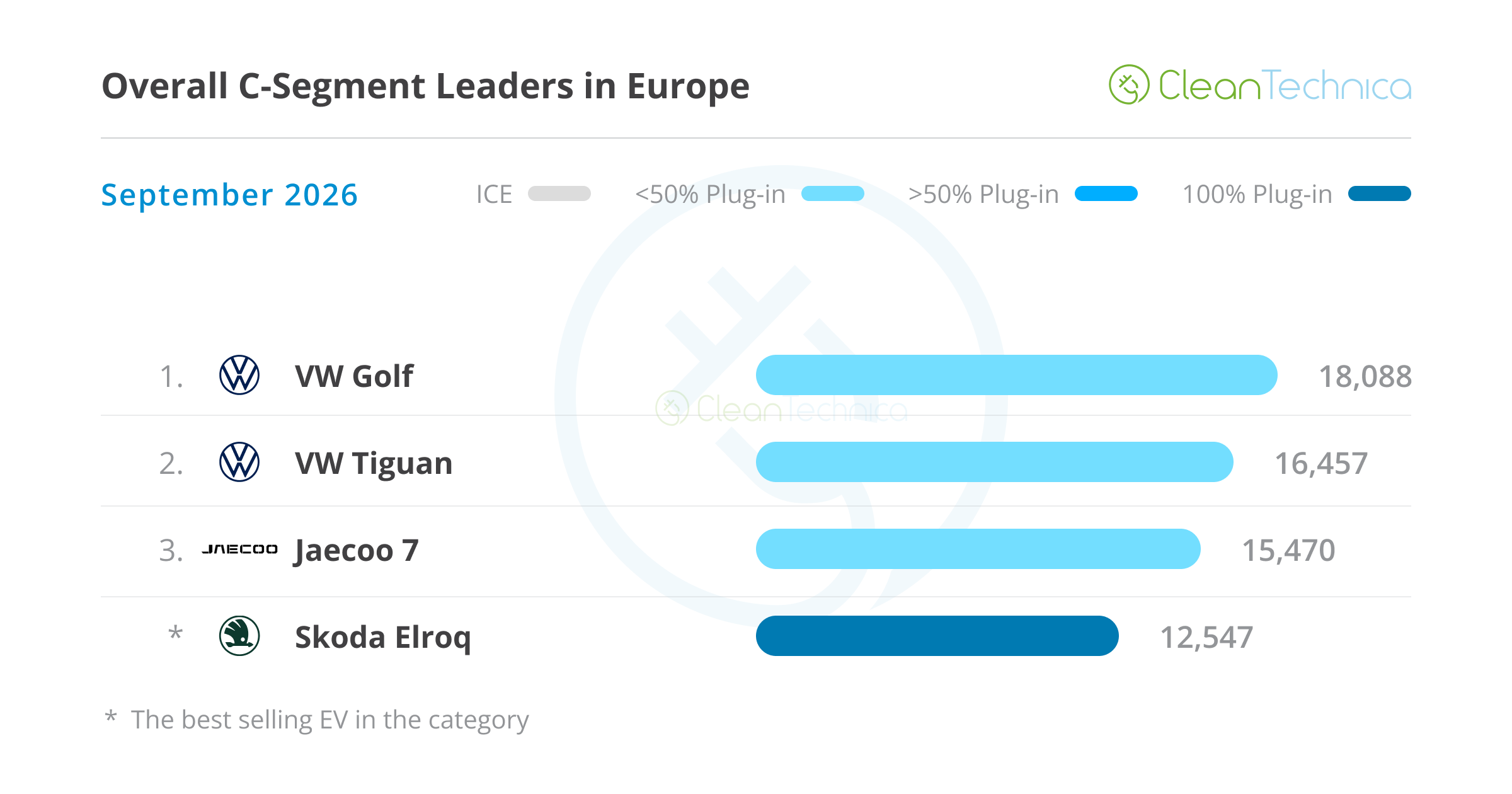
The electrification trend is not uniform across all vehicle categories. In the midsize segment, the impact of EVs is undeniable. Tesla’s Model Y and Model 3 have effectively redefined the category, with the Model Y securing 41,987 registrations in September alone.
The midsize mainstream segment, once dominated by models like the Ford Mondeo or Opel Vectra, had effectively vanished as premium German manufacturers pushed prices north of €50,000. Tesla, alongside Chinese competitors such as the Xpeng G6, BYD Seal, and Leapmotor C10, has successfully reclaimed this space by offering vehicles in the €40,000 to €50,000 range. This "value-first" approach is proving highly effective in attracting buyers who prioritize lower total cost of ownership over brand prestige.

In the city car (A-segment) category, the landscape is evolving rapidly. While the Fiat Panda remains a fixture on the podium, the rise of the Renault Twingo, the impending launch of the Dacia Spring, and the future arrival of the VW ID.Up indicate a total overhaul of the segment by 2028. Future entries, including the Fiat Koala and a collaborative model between Citroen and Leapmotor, are poised to offer high-volume, low-cost electric solutions that will likely displace remaining ICE competitors entirely.
Conversely, the B-segment remains the most significant laggard. With none of the top three models in this category currently offering a plug-in version, the B-segment is the primary battleground where legacy automakers are losing their grip, as they have yet to introduce high-volume, affordable electric alternatives.

Brand Performance and the "Pants Down" Effect
The divergence in performance between brands in September reveals a stark divide between those who successfully anticipated market demand and those who were caught unprepared.
Tesla’s performance was a standout, with a 71% year-over-year growth rate, securing the 7th position in the overall brand ranking. Their ability to leverage a 10-year-old platform (Model 3) to achieve a silver medal in the overall European market is a testament to the effectiveness of their production-scaling strategy.

BYD, meanwhile, continues its aggressive expansion, ranking 11th overall and surpassing established players like MG and Dacia. The strength of the Chinese automotive surge lies in its diversity; with 15 brands in Europe’s top 50, the Chinese industry is not reliant on a single manufacturer, but rather a robust ecosystem of specialized players like Jaecoo, Omoda, and Leapmotor, all of which posted triple-digit growth in September.
In contrast, the "pants down" classification—a term used to describe legacy OEMs that have failed to scale production to meet the sudden, spike-driven demand—includes major names such as Ford, Volvo, and Hyundai. While these companies have invested in electrification, their year-over-year growth figures (ranging from 0% to 4% in September) show a failure to surf the current demand wave. Even the Volkswagen Group, while holding the largest market share at 23.3%, saw its position erode as production bottlenecks and model transition issues limited its ability to capitalize on the market shift.

Economic and Strategic Implications
The implications for the European automotive sector are profound. The current data indicates that the "transition period" where ICE vehicles could serve as the primary funding mechanism for electric R&D is closing faster than anticipated.
For legacy OEMs, the challenge is twofold: they must simultaneously manage the declining margins of their combustion business while accelerating the production of "fresh metal" to compete with the rapid iteration cycles of Chinese manufacturers. The reliance on legacy prestige is fading in the face of a consumer base that is increasingly focused on energy efficiency and immediate availability.

Furthermore, the European market’s E-segment (full-size luxury) remains a niche, representing only 6% of the total market, compared to 18% in the United States and China. This highlights that European manufacturers cannot rely on the high margins of large, luxury vehicles to offset losses in the mass-market segments.
As we look toward the final quarter of 2026, the competition for the runner-up spot in the plugin brand rankings between BMW, Tesla, and BYD will be the defining narrative. If current trends persist, the European automotive market is on a trajectory toward full electrification by the mid-2030s, not because of regulation alone, but because the economic reality of fuel volatility has fundamentally realigned consumer preference toward the electric powertrain. The manufacturers that survive this decade will be those that treat the electric transition as a sprint rather than a marathon.