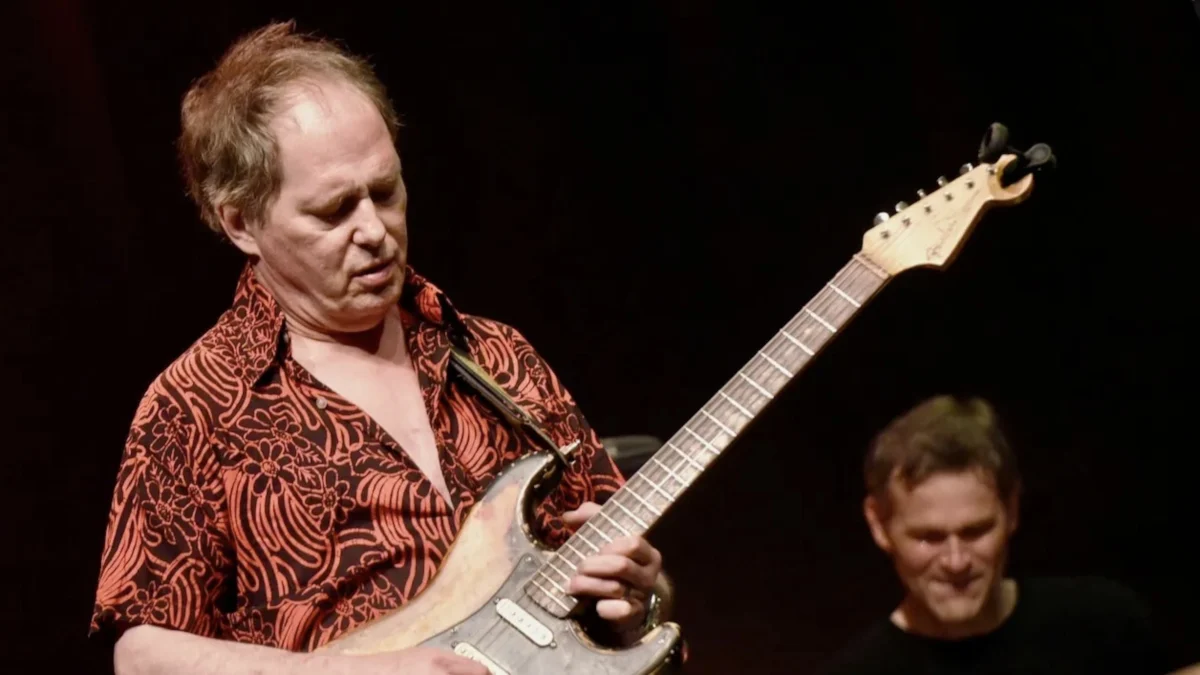
The music world is mourning the loss of Richard Lloyd, the co-founding guitarist of the seminal post-punk outfit Television and a transformative figure in the New York City rock landscape of the 1970s. Lloyd passed away on Saturday morning at his home in Chattanooga, Tennessee, at the age of 75. His death follows a public battle with cholangiocarcinoma, a rare and aggressive form of bile duct cancer, which he had disclosed to his fans and the public in August 2026.
Lloyd’s passing marks the end of a singular, uncompromising career that spanned over five decades. While he is most frequently associated with the intricate, interlocking guitar tapestries of Television—a band that redefined the possibilities of rock music—his influence extended far beyond a single group. As a solo artist, session musician, and self-proclaimed architect of the downtown Manhattan scene, Lloyd’s legacy is woven into the very fabric of modern alternative and indie rock.
The Architect of an Era: A Chronology of Influence
Born in Pittsburgh, Pennsylvania, Lloyd’s journey toward musical significance began with an unlikely connection to the icons of his youth. As a teenager, his initial foray into the guitar was guided by Velvert Turner, a musician who claimed to be a direct protégé of Jimi Hendrix. While historians have debated the veracity of Turner’s claims, the connection provided Lloyd with a direct, if tangential, line to the era’s most innovative guitarists. The mythos surrounding this period was punctuated by one of rock’s more surreal anecdotes: a backstage encounter in which Lloyd reportedly received a punch from Hendrix himself after a minor social blunder.
By the early 1970s, Lloyd had relocated to New York City, a transition that would prove pivotal. In 1973, he joined forces with Tom Verlaine, Richard Hell, and Billy Ficca to form Television. At the time, the New York music scene was in a state of flux, shifting away from the excesses of the stadium-rock era toward something more raw and cerebral.
Television’s formation was not merely the birth of a band; it was the catalyst for the birth of a venue. Lloyd frequently credited himself as the driving force behind turning the Bowery dive bar CBGB into the world’s most significant incubator for punk and new wave. By convincing the club’s management to host live music, Lloyd provided a stage for the movement that would eventually house The Ramones, Blondie, Talking Heads, and Patti Smith. As he noted in a 2007 interview, he viewed his role at CBGB as that of an “invisible force,” orchestrating a cultural revolution that allowed his peers to sustain their creative lives.
Musical Innovation and the Legacy of Marquee Moon
Television’s 1977 debut album, Marquee Moon, remains a cornerstone of 20th-century music. In a genre dominated by the three-chord simplicity of punk, Lloyd and Verlaine introduced a sophisticated, dual-guitar architecture characterized by angular melodies, harmonic dissonance, and an avoidance of standard power chords.
Lloyd’s contribution was essential to this sound. His ability to weave intricate, contrapuntal leads against Verlaine’s rhythm work transformed the guitar from a mere accompaniment tool into a primary narrative device. This approach set a template for "art-punk" and post-punk that would influence generations of musicians, from the jagged intensity of Fugazi to the melodic textures of R.E.M. and the avant-garde sensibilities of The Pixies.
Despite the band’s profound impact, their initial run was brief. Following the release of their second album, Adventure (1978), the group splintered. While they reunited periodically throughout the 1990s and 2000s, Lloyd ultimately departed the band in 2007 to focus on his own trajectory.
A Solo Career and the Craft of Persistence
Beyond his work with Television, Lloyd maintained a robust solo career that showcased his versatility as a songwriter and performer. His 1986 album Field of Fire and the 1987 successor Real Time garnered critical acclaim, proving that his technical proficiency was matched by an ear for pop sensibilities.
His reputation as a “musician’s musician” was further solidified by his work with power-pop icon Matthew Sweet. Lloyd’s contributions to Sweet’s seminal 1991 album Girlfriend are widely regarded as a masterclass in lead guitar, providing the record with its distinctive, biting edge. Throughout the 2000s, Lloyd continued to record and tour, culminating in his final solo effort, The Countdown, released in 2018.
Philosophy of the Unfinished Life
Lloyd’s relationship with his profession was famously complex. In his later years, he often resisted the label of a “career musician,” describing his path as a deliberate choice to remain outside the conventional structures of adulthood. His refusal to conform to the standard metrics of success—wealth, corporate status, or traditional stability—was, in his view, a strategy for maintaining his creative integrity.
"I’m a musician by refusing to grow up," Lloyd remarked in a 2000 interview. "I lived in absolute terror of growing up, and I found the one thing that you could actually do and do well and it prevented you from growing up."
This ethos of perpetual artistic youth defined his work. He viewed music not as a ladder to be climbed, but as an environment in which to live. This commitment to the craft, often at the expense of mainstream commercial dominance, earned him a dedicated, cult-like following that sustained him through five decades.
Implications and Industry Impact
The loss of Richard Lloyd leaves a significant void in the history of American rock. As one of the few remaining architects of the original CBGB scene, his death serves as a poignant reminder of the fragility of that foundational era.
Analysts of the post-punk movement emphasize that Lloyd’s influence was not merely stylistic but structural. By proving that guitar music could be both aggressive and intellectually rigorous, he expanded the vocabulary available to subsequent generations of alternative rock bands. His passing has triggered an outpouring of tributes from the music community, with many noting his distinct ability to bridge the gap between technical virtuosity and raw, unvarnished expression.
The broader implications of his death underscore the importance of preserving the oral and recorded history of the 1970s downtown New York scene. With the passing of key figures like Lloyd, the responsibility shifts to the archival and academic study of these musicians to ensure that their contributions to the evolution of modern sound are properly contextualized for future audiences.
Final Reflections
Richard Lloyd did not seek to be a household name, nor did he strive for the kind of stadium-filling fame that often accompanies rock stardom. Instead, he sought to be a vital component of a living, breathing musical ecosystem. Whether he was crafting the intricate leads that defined Marquee Moon, performing as a sideman for Matthew Sweet, or simply championing the scene at CBGB, his life was defined by a singular focus: the pursuit of the perfect note.
As the music world reflects on his 75 years, the consensus remains that Lloyd was a rare talent who operated on his own terms. From his early days in Pittsburgh to his final years in Tennessee, his career was a testament to the idea that true influence is not measured in sales figures or chart positions, but in the enduring resonance of one’s work. Richard Lloyd leaves behind a catalog that will continue to challenge, inspire, and define the sound of the guitar for years to come.