
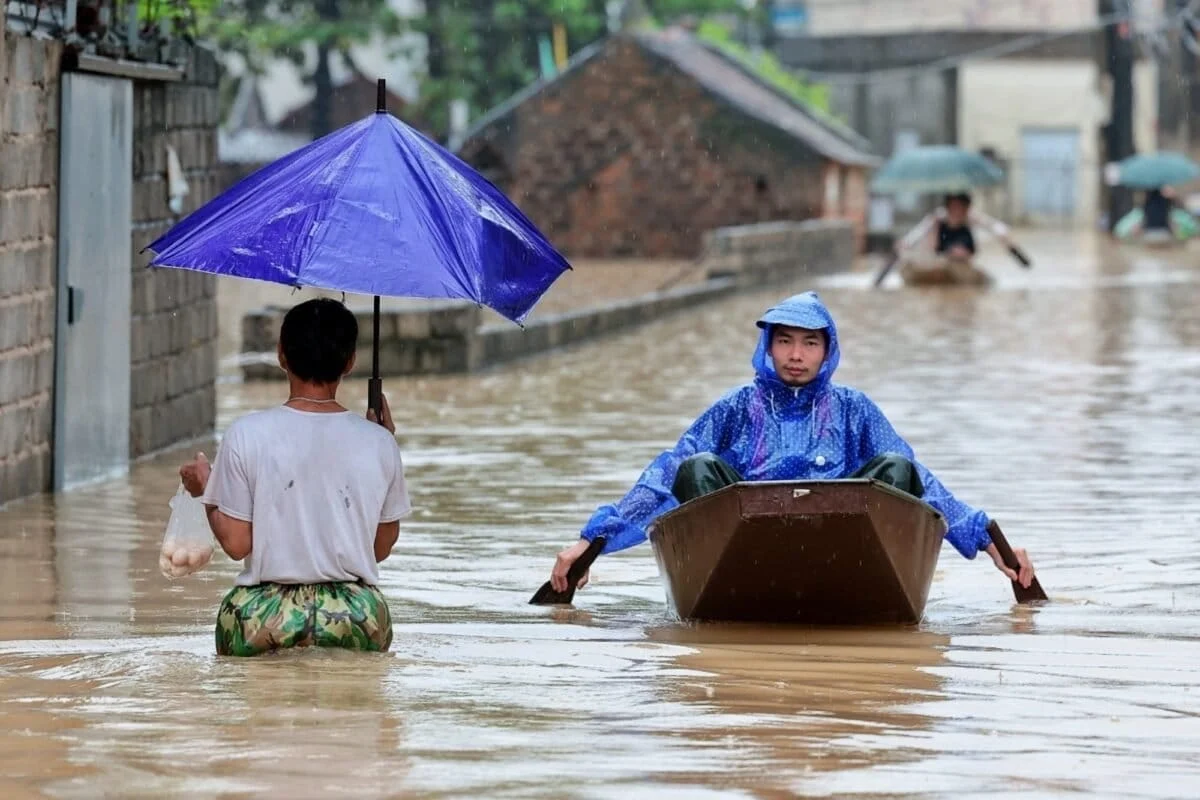
Torrential downpours have triggered widespread and severe flooding across northern and north-central Vietnam, inundating residential neighborhoods, crippling vital transportation networks, and driving several major waterways well above critical danger thresholds. The extreme weather event, which intensified significantly throughout the week, has affected hundreds of thousands of residents, isolated remote communities, and caused devastating losses to regional agriculture and infrastructure.
According to reports from the national disaster prevention department and state media outlets, cumulative rainfall in several parts of northern and north-central Vietnam has exceeded 50 centimeters (19.7 inches) over the course of the week. In the capital city of Hanoi and surrounding provinces, the persistent deluge has transformed streets into rushing waterways, disrupted daily economic life, and forced emergency services into a state of high alert. As the region grapples with the immediate humanitarian and logistical challenges, meteorological agencies warn that the threat is far from over, with impending weather systems poised to extend the crisis further south.
Widespread Destruction and Disruption in Urban and Rural Centers
The impacts of the relentless monsoon-style rains have been felt intensely across both urban hubs and rural agricultural belts. In Hanoi, residents woke up to deeply flooded thoroughfares on Thursday morning, with water levels reaching nearly a meter (3.2 feet) in low-lying districts. The inundation severely compromised public transportation, paralyzing morning commutes and preventing thousands of citizens from reaching workplaces or educational institutions. In response to the hazards posed by impassable roads, numerous high schools and universities in the capital either canceled classes entirely or rapidly transitioned to remote, online learning models.
On the southwestern outskirts of Hanoi, the rapidly rising waters of the Bui River presented a direct and immediate threat to residential settlements. State media reported that local authorities were forced to mobilize hundreds of military personnel and emergency responders to assist vulnerable families. Soldiers worked tirelessly alongside residents to construct makeshift barriers and move essential belongings, livestock, and valuables to higher ground before floodwaters breached residential perimeters.
Beyond the capital, the provinces of Ninh Binh and Thanh Hoa—encompassing a mix of vulnerable lowland plains and steep, landslide-prone hilly terrain—sustained some of the worst damage. More than 2,000 homes have been entirely submerged, while key regional transportation arteries have been rendered impassable by mudslides and deep standing water. Consequently, over 1,000 households found themselves entirely isolated from municipal support networks, prompting local governments to launch emergency supply drops and rescue operations. In Thanh Hoa, provincial authorities implemented mandatory closures for all schools, deeming travel conditions far too treacherous for children and teachers.
Despite the mounting devastation, local resilience remains visible. Tran Ngoc Tai, a resident of Ninh Binh, expressed a grim sense of familiarity with the recurring catastrophe in an interview with national broadcaster VTV. "The flood happens every year," Tai noted, explaining that proactive communities had attempted to stockpile emergency supplies of fresh drinking water and non-perishable food items ahead of the peak rainfall.
Agricultural Devastation and Economic Toll
The human displacement and urban disruption are compounded by catastrophic losses within Vietnam’s agricultural sector. Initial assessments released by provincial agricultural boards indicate that approximately 10,014 hectares (24,745 acres) of vital rice paddies and diverse cash crops have been severely damaged or completely washed out. The heaviest blows have fallen upon Ninh Binh, Thanh Hoa, and Nghe An provinces, regions that serve as crucial breadbaskets for the country.
In addition to destroyed harvests, the floods have decimated regional livestock and poultry populations. Thousands of farm animals have perished either by drowning or from subsequent exposure and disease, threatening the livelihoods of smallholder farmers who rely on animal husbandry for their primary income. The destruction of these crops and livestock is expected to exert upward pressure on local food prices in the coming weeks, complicating broader national economic stabilization efforts.
Chronology of the Current Crisis and Historical Context
The unfolding disaster is part of a relentless sequence of extreme weather events that have battered Southeast Asia in recent years, highlighting Vietnam’s acute vulnerability to shifts in global climate patterns.

The timeline of the current weather emergency began earlier in the week as a heavy stationary rainband settled over northern and north-central Vietnam, fueled by moisture-laden regional winds. By Wednesday night, rainfall accumulations in isolated pockets had surpassed 15 centimeters (5.9 inches) within a single 12-hour window. This sudden spike pushed rivers over their banks, culminating in the widespread urban and rural flooding observed on Thursday.
This crisis follows a harrowing precedent set throughout 2025, during which Vietnam endured an unprecedented succession of severe tropical storms and typhoons. In July of that year, Tropical Storm Wipha delivered torrential rains and severe flooding to coastal and inland communities. Barely had recovery efforts begun when Tropical Storm Kajiki made landfall in August, bringing catastrophic landslides and secondary inundations. The compounding trauma continued into September, when Typhoon Bualoi claimed at least 26 lives, followed swiftly in October by historic, record-breaking floods that submerged the cultural heritage cities of Hue and Hoi An in central Vietnam, alongside sweeping deluges across the entire northern tier.
Climate scientists and disaster management experts frequently categorize Vietnam as one of the nations most susceptible to climate change impacts, largely due to its extensive coastline, dense river networks, and millions of residents living in low-lying delta regions. The compounding frequency of these disasters has forced the Vietnamese government to drastically overhaul its national disaster preparedness, moving away from purely reactive emergency responses toward integrated, long-term climate resilience and water management frameworks.
Impending Dangers: Southern Vietnam on Alert
Even as emergency response teams battle the aftermath of the floods in the north, meteorological authorities have issued urgent warnings for the southern half of the country. A substantial cold air mass currently pushing southward is projected to collide with existing seasonal moisture, triggering an intense, multi-day precipitation event across southern Vietnam starting September 17.
According to the Southern Regional Hydro-Meteorological Center, the severe weather is forecast to persist through September 21, posing an acute threat to densely populated urban centers and agricultural lowlands alike. Ho Chi Minh City, Vietnam’s sprawling financial capital and a notorious hotspot for urban flooding due to inadequate drainage and rapid land subsidence, is directly in the path of the storm system. Forecasters predict that Ho Chi Minh City will receive between 10 and 20 centimeters (4 to 8 inches) of rain, with certain vulnerable neighborhoods experiencing even higher totals.
Regional authorities in the south have placed emergency services on high alert, clearing storm drains, inspecting sea dykes, and issuing public safety advisories warning residents in low-lying and riverine communities to prepare for sudden evacuations.
Broader Implications and Future Outlook
The immediate economic and humanitarian costs of the ongoing northern floods, coupled with the imminent threat facing the south, underscore the profound socio-economic challenges confronting Vietnam. As extreme weather events transition from anomalous occurrences to predictable, annual catastrophes, the country’s infrastructure, agricultural supply chains, and emergency response mechanisms face relentless stress testing.
Economists note that repeated multi-billion-dong damages to infrastructure and agriculture threaten national gross domestic product growth targets and strain public fiscal reserves dedicated to poverty alleviation and rural development. Furthermore, the persistent displacement of agrarian communities risks accelerating rural-to-urban migration, placing additional pressure on municipal services in Hanoi and Ho Chi Minh City.
For now, the immediate priority for the Vietnamese government remains search-and-rescue operations, the provision of clean water and medical supplies to isolated households, and the mitigation of further loss of life. However, as the region prepares for the next wave of storms approaching from the south, policymakers face the undeniable reality that adapting to accelerating climate volatility will require unprecedented investments in engineering, environmental conservation, and cross-sector disaster management infrastructure.










Leave a Reply