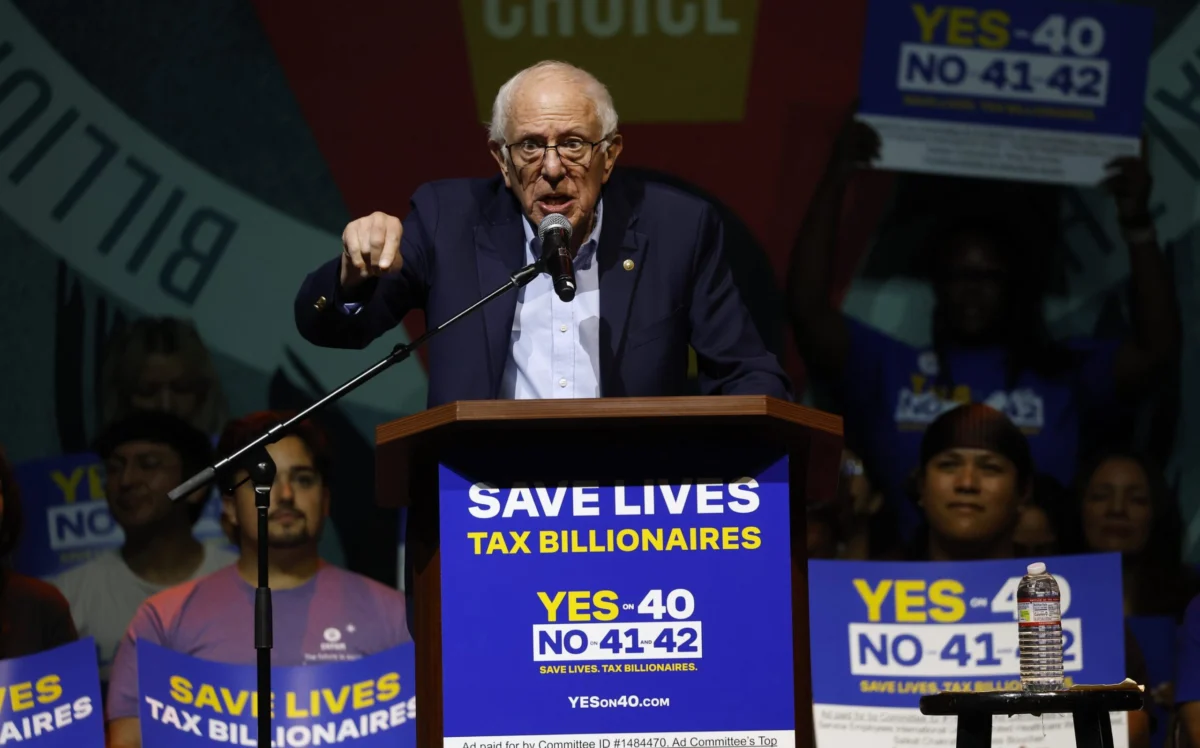
As California voters prepare to cast their ballots on Proposition 40—a controversial and heavily contested billionaire wealth tax proposal—another powerful ghost from the state’s political history looms large over the debate. Nearly fifty years after its landmark passage, Proposition 13 remains the foundational anchor of California’s property tax system, casting a long shadow over modern fiscal policy and complicating attempts by lawmakers and labor unions to generate sustainable state revenue.
The current political battle lines are drawn over Prop 40, which proposes a one-time 5% tax on residents with a net worth exceeding $1 billion. Proponents argue that the measure, backed by powerful labor unions, could unlock up to $100 billion in revenue to offset anticipated federal cuts to health spending and capitalize on the immense wealth generated by the recent artificial intelligence boom. However, critics, economists, and policy analysts warn that targeting a hyper-mobile elite will trigger capital flight, depress economic growth, and ultimately destabilize state coffers.
Amid this high-stakes clash, prominent economists and policy experts are arguing that California’s reliance on volatile income taxes and novel asset levies misses the mark. Instead, they point backward to a 1978 conservative ballot measure as the true catalyst for the state’s structural budget challenges.
A Historical Turning Point: The Legacy of Proposition 13
To understand the friction underlying modern California tax policy, one must examine the socio-political landscape of the late 1970s. In June 1978, amidst a surging nationwide tax revolt that foreshadowed the rise of Ronald Reagan and an era of conservative governance, California voters overwhelmingly approved Proposition 13.
The measure fundamentally restructured the state’s relationship with property ownership. It capped property taxes at just 1% of a property’s assessed value, limited annual assessment increases to a maximum of 2%, and dictated that properties could only be reassessed at full market value following a change in ownership or substantial renovation.
While Prop 13 successfully reined in skyrocketing property tax bills for homeowners at the time, it systematically starved local governments and the state of predictable, stable property revenue. Consequently, California was forced to pivot toward alternative revenue streams, heavily relying on income taxes—including capital gains—to fund public services and infrastructure.
Over the decades, this shift transformed California into the state with the most progressive income-tax structure in the nation. Today, the state levies a top marginal income tax rate of 13.3%. When combined with federal income tax obligations, high earners in California can face a total marginal tax rate exceeding 50%.
The Volatility Trap of a Narrow Tax Base
This heavy reliance on high-income earners has created a notoriously volatile fiscal environment. State revenue data consistently reveals that the top 1% of earners account for up to half of all state income tax collections. Consequently, California’s budget health is intimately tethered to the performance of the stock market and capital gains cycles. When Wall Street thrives, state surpluses balloon; when markets correct, budget deficits loom large.
At the same time, this structure struggles to capture the true wealth of the ultra-rich. Billionaires frequently earn relatively little traditional taxable "income," instead leveraging their vast portfolios of assets, stock options, and real estate holdings to finance their lifestyles without triggering significant income tax liabilities.
Seeking to remedy this perceived loophole, the architects of Proposition 40 designed a tax targeting total net worth rather than annual income. Proponents of the measure emphasize that even after a 5% one-time levy, California’s tech tycoons and corporate titans would retain fortunes amassed during the unprecedented AI and technology booms.
Conversely, opponents argue that a wealth tax is fundamentally unworkable. Critics point out that forcing entrepreneurs and startup founders to liquidate substantial equity stakes in their companies to pay tax liabilities could stifle innovation, depress venture capital investment, and accelerate the migration of wealth out of the state. Indeed, a recent Stanford study estimated that the implementation of Prop 40 could ultimately trigger a net loss of $39 billion in economic activity and state revenue over time as high-net-worth individuals establish legal residency elsewhere.
Looking Beneath the Surface: The Real Estate Paradox
As the debate over Prop 40 intensifies, economists Owen Zidar of Princeton University and Eric Zwick of the University of Chicago’s Booth School of Business—authors of the book The Everywhere Millionaire—have offered an alternative perspective. In a widely discussed New York Times op-ed, the economists argued that California’s lawmakers are ignoring a much larger, more stable source of undertaxed wealth located right beneath their feet.
"The original sin underlying California’s tax structure is Prop 13, the 1978 law that rewrote the rules of property ownership," Zidar and Zwick wrote. "Getting rid of it would be a more efficient and durable way to make the rich pay their fair share."
Under the protections of Prop 13, home values across California have appreciated at a dramatic pace, far outstripping the growth of the property taxes levied upon them. Zidar and Zwick estimate that California homeowners currently pay an average effective property tax rate of just 0.8%, generating roughly $100 billion in property tax revenue during the 2025 fiscal year.
In stark contrast, homeowners in states like Texas pay an average property tax rate of roughly 2%. The economists calculate that if California were to align its residential property tax structure with Texas, overall property tax revenues would more than double, while simultaneously injecting downward pressure on soaring housing prices, cooling the market by an estimated 13%.
However, replicating the Texas model in California is fraught with political peril. Property taxes in Texas have recently sparked their own significant voter backlashes during election cycles. While Texas famously levies no state income tax, residents frequently complain that heavy local property tax burdens create an onerous overall cost of living.
Furthermore, any legislative or ballot-driven attempt to repeal or drastically alter Prop 13 in California would face immense public resistance. Millions of homeowners—including many middle-class and fixed-income seniors—rely on Prop 13’s protections to remain in their homes, and would fiercely oppose reforms that exposed them to sharp property tax spikes.
The Broader Fiscal Landscape and Expert Warnings
The debate over Prop 40 and property tax reform arrives as California faces mounting fiscal pressures. The state government plans to deploy approximately $540 billion in spending during the current fiscal year, necessitating reliable, long-term revenue streams. Yet, relying on a narrow slice of the population remains a perilous strategy.
"It is simply not possible to fund the state’s needs by leaning on a few hundred people, as politically appealing as that may be," Zidar and Zwick argued, emphasizing the need to broaden the tax aperture to capture the hundreds of thousands of affluent residents who could comfortably contribute more through a functional real estate tax system.
Other prominent economic policy experts have echoed these concerns, warning that aggressive wealth taxation could backfire before it even takes effect. Laura Tyson, a former White House economic adviser, and Lenny Mendonca, a former chief economic adviser to California Governor Gavin Newsom, have cautioned that billionaires exhibit high sensitivity to asset and estate taxes when choosing their primary residences.
In a joint analysis published via Project Syndicate, Tyson and Mendonca pointed out that even before Prop 40’s proposed effective date, at least six prominent California billionaires—who collectively would have accounted for roughly one-quarter of the measure’s projected revenues—had already relocated their legal residences out of state.
Moreover, because Prop 40 relies on a novel, untested framework for assessing and taxing non-liquid assets, Tyson and Mendonca warned it would likely unleash a "tidal wave of litigation," rendering the promised budgetary funding speculative, volatile, and unreliable.
"Instead of a tax on billionaires, the U.S. needs to raise taxes on the capital income that feeds wealth," Tyson and Mendonca argued, suggesting alternative pathways such as higher corporate tax rates, taxes on both realized and unrealized capital gains, the closure of loopholes like carried interest, and increased inheritance levies.
Implications for the Future of California Governance
As California voters head toward the ballot box, the outcome of Proposition 40 will serve as a critical bellwether for the future of progressive taxation in the United States. If passed, the measure could embolden progressive lawmakers in other states to pursue similar wealth-based levies, fundamentally altering the relationship between state governments and ultra-high-net-worth individuals.
Conversely, if the measure fails—or becomes bogged down in years of protracted legal challenges—policymakers may be forced to confront the structural deficiencies embedded in their tax code since 1978. Whether through a difficult reckoning with Proposition 13 or the development of more durable capital income frameworks, California’s fiscal architects face a narrow path forward in balancing the state’s immense social spending ambitions with the economic realities of a mobile, globalized elite.