

The rapid integration of artificial intelligence into the modern enterprise is fundamentally altering the human capabilities required to succeed in the workplace. However, this technological shift has introduced a profound paradox: while workers are expected to rely more heavily on sophisticated cognitive functions, they simultaneously report that these exact skills are deteriorating. According to a comprehensive global study released by the IBM Institute for Business Value (IBV), capabilities such as critical thinking, professional judgment, and the meticulous evaluation of machine-generated outputs now sit at the center of a growing corporate tension.
The report, titled "Designing the Thinking Organization," sheds light on a rapidly evolving corporate landscape where day-to-day job descriptions are morphing faster than organizational frameworks can adapt. Based on dual surveys conducted in partnership with Oxford Economics between April and June 2026, the research captures the viewpoints of 1,500 Chief Human Resources Officers (CHROs) and senior executives responsible for workforce strategy—spanning 21 geographic regions and 23 industries—alongside 8,800 full-time employees across 28 countries. The resulting data paints a vivid picture of a workforce caught between the immense productivity promises of artificial intelligence and the tangible human cost of cognitive offloading.

The Chronology and Scope of the IBM Study
The timeline leading up to the publication of the "Designing the Thinking Organization" report reflects a critical window in corporate history. By early 2026, generative AI had transitioned from a novelty experimentation phase into core enterprise infrastructure. Recognizing that workforce strategies were struggling to keep pace, IBM and Oxford Economics initiated their global data collection effort in April 2026, concluding fieldwork at the end of June 2026.
The ambition of the study was to map out the widening disconnect between top-down corporate leadership expectations and the bottom-up reality experienced by the global labor force. While executive boards have spent the last several years architecting sweeping AI adoption roadmaps, the frontline reality for employees has been much more chaotic. The study’s findings reveal that more than half of all surveyed employees—specifically 52%—experienced direct changes to their assigned daily tasks over the preceding twelve months purely as a result of AI integration.
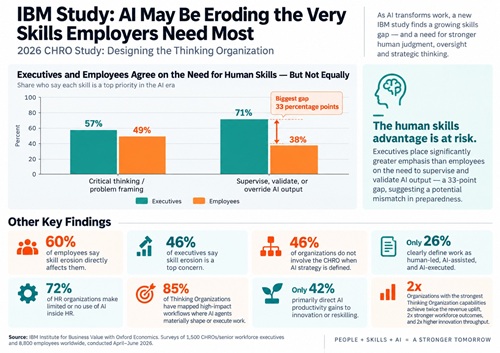
Despite this massive operational pivot, only 26% of organizations have established clearly defined workflows that deliberately categorize tasks across human-led, AI-assisted, and AI-executed activities. This stark discrepancy underscores a reactive organizational culture. Rather than proactively designing how humans and algorithms should collaborate, companies are relying on ad-hoc, day-to-day adjustments by employees who are left to navigate the division of labor on their own.
The Executive-Employee Disconnect on Critical Oversight
One of the most revealing insights generated by the IBV study concerns the severe misalignment between leadership and staff regarding the skills required to manage AI systems safely and effectively.
Both groups nominally agree on the foundational value of problem-framing and critical thinking. Approximately 57% of executives and 49% of employees place these capabilities near the top of the list of essential skills for an AI-enabled workplace. However, when the conversation shifts to the tactical supervision of technology, a massive chasm opens up.
Seventy-one percent of surveyed executives prioritize the human ability to supervise, validate, or override AI outputs, viewing it as a non-negotiable safeguard against algorithmic bias, hallucinations, and operational errors. In stark contrast, only 38% of employees prioritize this same oversight function—representing a dramatic 33-percentage-point gap in perception.

Further compounding this divide, a separate metric highlighted in official IBM announcements reveals that only 29% of employees rank professional judgment as a top priority in their daily routines. This lower figure underscores a dangerous complacency among workers who may be growing overly comfortable accepting generative AI outputs at face value without applying the rigorous skepticism necessary to catch latent errors. Executives recognize that an over-reliance on unvetted machine logic poses existential risks to corporate compliance, quality control, and brand reputation, yet they are struggling to instill this same vigilance across their distributed workforces.
A New Enterprise Threat: The Phenomenon of Skill Erosion
Beyond the traditional skills gap—the notion that workers lack the training to adopt new technologies—the IBM study isolates a more insidious threat: skill erosion. While conventional upskilling programs focus on what employees must learn to work alongside machines, skill erosion addresses the gradual atrophy of existing capabilities that occurs when automated systems perform the underlying cognitive work.
The data reveals that skill erosion is no longer a theoretical concern; it is an active workplace crisis. Forty-six percent of executives cite skill erosion as a top operational worry, but the anxiety is far more acute among frontline staff. Sixty percent of employees report that skill erosion directly affects them, with critical thinking cited most frequently as the capability suffering the steepest decline. Among the subset of workers who actively worry about skill erosion, an alarming three out of four report that AI has already begun to erode at least some of their core competencies.

This phenomenon presents a unique challenge for human resources departments. The study notes that 80% of enterprises currently boast formal reskilling roadmaps designed to help workers collaborate with advanced technologies. However, IBM analysts argue that these conventional training pipelines are fundamentally miscalibrated. While reskilling programs successfully impart new knowledge, they do not inherently prevent the decay of foundational human skills that are left unexercised as algorithms take over routine drafting, data synthesis, and preliminary analysis.
Official Responses and Strategic Implications
As organizations digest the implications of the IBM report, human resources leaders are facing mounting pressure to rethink how enterprise productivity gains are reinvested. Industry analysts and HR experts suggest that the structural efficiency unlocked by generative AI cannot simply be absorbed into profit margins at the expense of human capital development. Instead, forward-thinking organizations are being urged to channel AI dividends back into structured cognitive workouts, mentorship programs, and deliberate workflow redsign that forces meaningful human engagement.
The broader implications of the "Designing the Thinking Organization" study point toward a necessary evolution in corporate governance. If companies continue to treat AI integration purely as a software deployment exercise rather than a profound sociological reorganization of labor, they risk creating a hollowed-out workforce. In such a scenario, organizations would possess advanced technological infrastructure paired with a workforce that has lost the critical judgment required to audit, challenge, and direct it.

Ultimately, the findings serve as an urgent wake-up call for the C-suite. Bridging the 33-percentage-point oversight gap and combating the silent creep of skill erosion will require deliberate action. Organizations must move beyond reactive task-shuffling and establish explicit frameworks that protect human agency, mandate critical evaluation of machine outputs, and ensure that the future of work enhances—rather than diminishes—the cognitive capabilities of the people driving it.










Leave a Reply