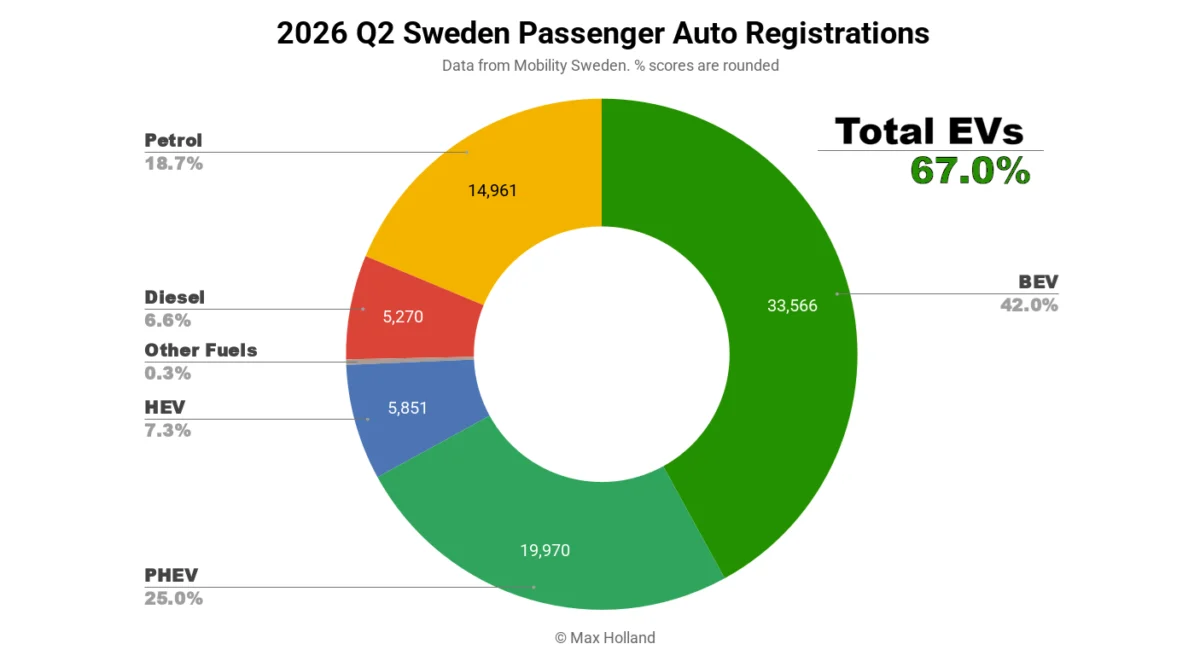
The Swedish automotive landscape underwent a significant transformation during the second quarter of 2026, with plugin electric vehicles (EVs) capturing a dominant 67.0% of the total passenger car market. This figure represents a notable increase from the 62.5% market share recorded during the same period in 2025, signaling a renewed momentum in the nation’s transition toward sustainable transport. Within this segment, battery electric vehicles (BEVs) demonstrated particularly robust growth, while plugin hybrid electric vehicles (PHEVs) maintained a steady, albeit slower, upward trajectory. The overall automotive market in Sweden also showed signs of recovery and expansion, with total registrations reaching 79,891 units for the quarter—a 22% increase compared to the previous year.
Comprehensive Breakdown of Market Share and Volume
The second quarter of 2026 provided a clear indication that the Swedish consumer preference has shifted decisively toward electrified powertrains. Of the 67.0% total plugin share, BEVs accounted for 42.0%, while PHEVs made up the remaining 25.0%. To put these figures into a historical perspective, the second quarter of 2025 saw a combined plugin share of 62.5%, consisting of 36.2% BEVs and 26.4% PHEVs.
The most striking data point from the recent report is the 42% year-on-year increase in BEV sales volume. This surge indicates that full electric vehicles are not just gaining market share due to a shrinking overall market, but are driving the growth of the industry itself. In contrast, PHEV volumes grew by a more modest 16%. Meanwhile, the combined market share for traditional internal combustion engine (ICE) vehicles, including non-plugin hybrids, has dwindled to 25.7%. If current trends persist, industry analysts project that BEV market share could approach the 50% threshold in the final months of 2026.

Manufacturer Performance and Brand Dynamics
The growth in BEV registrations was fueled by strong performances from several key manufacturers, most notably Kia, BMW, Toyota, and the domestic leader, Volvo. These gains are largely attributed to a wave of new model releases and mid-cycle refreshes that have revitalized consumer interest.
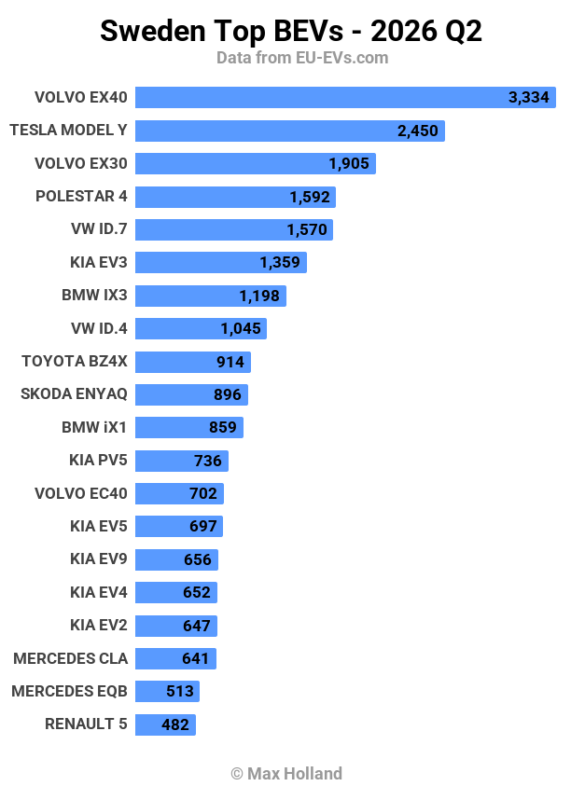
Volvo continues to anchor the Swedish market. The Volvo EX40 maintained its position as the country’s best-selling BEV for the fourth consecutive quarter, recording 3,334 registrations. It was followed by the Tesla Model Y, which saw 2,450 units registered—a figure nearly identical to its performance in the first quarter of 2026. Volvo’s smaller offering, the EX30, secured the third spot with 1,905 units. The consistency of this top-three ranking highlights the strong brand loyalty Swedish consumers hold for Volvo and the sustained demand for Tesla’s flagship crossover.
However, the quarter was not without its shifts in fortune. The Volkswagen Group experienced a significant year-on-year decline in performance. Market observers suggest this may be a result of temporary market-allocation priorities, where the manufacturer may have diverted inventory to other European regions to meet specific regulatory targets or supply chain requirements.
In contrast, BMW saw success with its refreshed iX3, which surged to 7th place with 1,198 units. While some of this volume likely stems from pent-up demand following the model’s update, the figures suggest a higher baseline of sales compared to the previous iteration. Kia also demonstrated remarkable growth across its entire electric lineup. The new Kia PV5, a versatile platform that debuted in late 2025, rose to 12th place. Its siblings, the EV5 and EV4, followed closely in 14th and 16th places, respectively. The most dramatic jump came from the Kia EV2; after seeing only negligible showroom volumes in the first quarter, it shot up to 17th place with 647 units in the second quarter.

Impact of the 2026 Incentive Scheme
A pivotal factor in the resurgence of BEV growth is the introduction of a new incentive scheme at the start of 2026. Unlike previous broad-based subsidies, this program specifically targets below-average-income households in rural areas. The goal of the policy is to democratize EV ownership and ensure that the transition to electric mobility is not confined to affluent urban centers.
Preliminary data suggests the scheme is achieving its objective of stimulating demand in previously underserved demographics. However, the policy has not been without controversy. Some critics argue that the pricing strategies of legacy automakers are designed to absorb these incentives, effectively transferring public funds to corporate balance sheets rather than passing the full savings to the consumer. For example, the Cupra Raval—a new entry in the compact segment—is priced significantly higher in Sweden than in other European markets like Spain. While the 52 kWh variant starts at 368,900 SEK (approximately €33,400), a smaller 37 kWh version expected in the autumn is priced at 320,900 SEK (€29,070). In Spain, the same model starts at approximately €26,000, leading to allegations that manufacturers are inflating Swedish prices in anticipation of government subsidies.
New Model Debuts and Diversification
The second quarter of 2026 saw a diverse array of new electric models entering the Swedish market, providing consumers with more choices across various price points and vehicle categories. Notable debutants included:
- Subaru Uncharted and Subaru Outback (Electric): Marking a significant step for the brand in the Nordic region.
- Cupra Raval: A sporty compact aimed at younger, urban demographics.
- Porsche Cayenne (Electric): Targeting the luxury SUV segment.
- Xpeng P7+ and Zeekr 7GT: Representing the continued expansion of Chinese premium electric brands into the European market.
- Lexus ES (Electric): Adding a refined sedan option to the luxury plugin market.
The entry of brands like Xpeng and Zeekr is particularly noteworthy, as they bring competitive technology and software integration that challenges established European manufacturers. This increased competition is expected to drive further innovation and eventually lead to more competitive pricing as the market matures.
The Economic Context and Macroeconomic Trends
The growth of the EV market is occurring against a complex macroeconomic backdrop. Sweden’s economy has shown signs of cooling over the past year, though recent data indicates a level of stabilization. The year-on-year GDP growth stood at 2.3% in the third quarter of 2025, followed by 2.0% in both the fourth quarter of 2025 and the first quarter of 2026.
Inflation remains relatively low, with the headline figure standing at 0.7% at the end of the second quarter, a slight increase from 0.5% at the end of the first quarter. The Swedish central bank (Riksbank) has kept interest rates steady at 1.75% since September 2025. This stability in borrowing costs has likely provided consumers with the confidence to proceed with major purchases like new vehicles. Furthermore, the Manufacturing Purchasing Managers’ Index (PMI) rose to 58.3 points in June, up from 56.4 in March, suggesting a healthy expansion in the industrial sector which often correlates with broader economic resilience.
There have been discussions regarding the frequency of revisions to Sweden’s economic data, with some observers raising questions about the accuracy of initial reports. Despite these concerns, the prevailing narrative remains one of cautious optimism, with the automotive sector serving as a bright spot in the national economy.
Historical Trajectory and Future Outlook
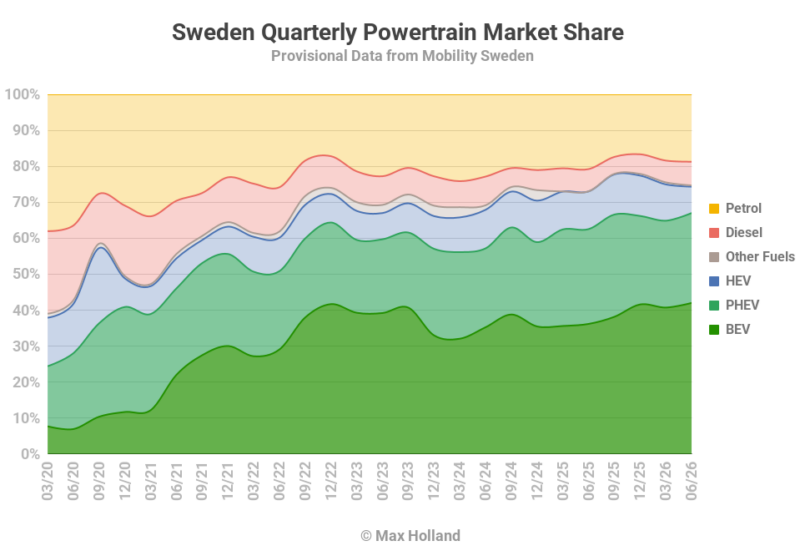
The current growth phase marks a significant turning point for Sweden. The adoption of BEVs followed a steep upward curve until late 2022, after which the market experienced a period of relative stagnation. High energy costs, supply chain disruptions, and the removal of previous subsidy programs contributed to this lull. The data from the first half of 2026 confirms that this period of stagnation has ended, and the market is back on a growth trajectory.
The steady decline of non-plugin hybrids (HEVs) and traditional ICE vehicles suggests that the "tipping point" for electric mobility in Sweden has already passed. As charging infrastructure continues to expand—particularly in the rural areas targeted by the new incentives—the remaining barriers to adoption are being dismantled.
Looking ahead to the second half of 2026, the industry will be watching closely to see if the 50% BEV market share milestone can be reached. The arrival of more affordable models, such as the smaller-battery variant of the Cupra Raval and the full-scale rollout of the Kia EV2, will be critical in sustaining volume growth. Additionally, the performance of the Volvo EX60, which recently debuted, is expected to bolster Volvo’s dominance in the premium SUV segment.
In conclusion, Sweden’s second-quarter performance reinforces its status as a global leader in the electric vehicle transition. With a 67% plugin share and a resurgent BEV sector, the nation is well-positioned to meet its climate targets and provide a roadmap for other European nations to follow. The combination of targeted government policy, a surge in new model availability, and a stabilizing economic environment has created a fertile ground for the continued evolution of the Swedish automotive market.