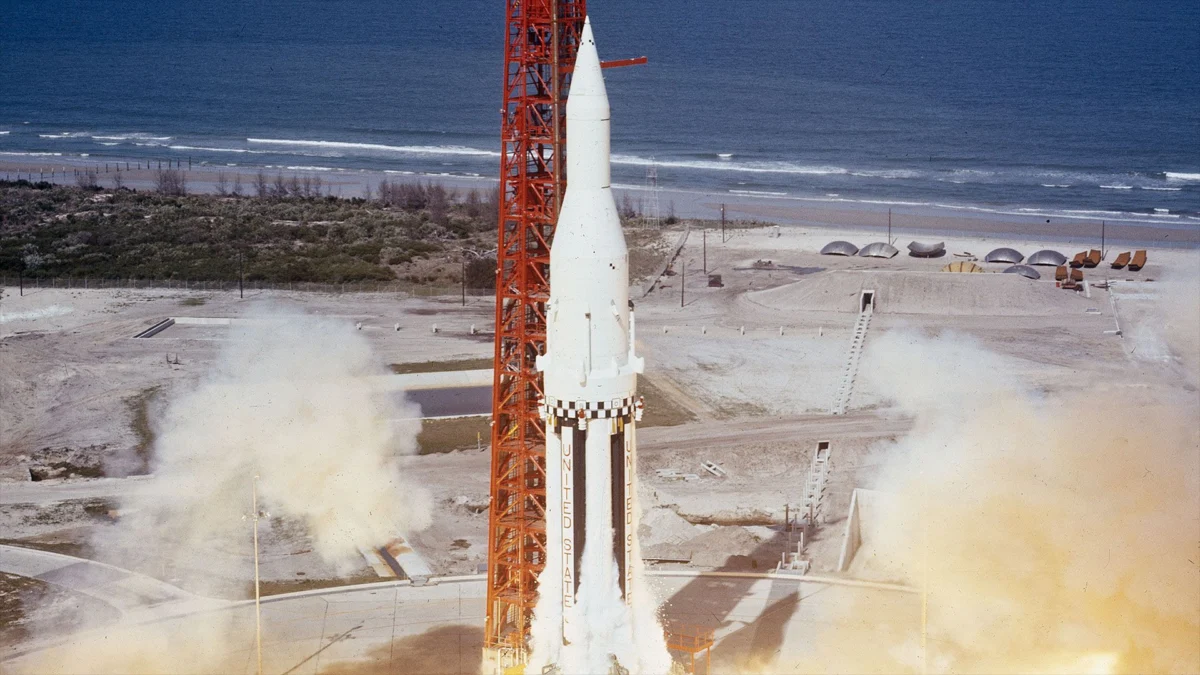
On November 9, 1967, the trajectory of human exploration shifted permanently as the National Aeronautics and Space Administration (NASA) successfully launched the inaugural flight of the Saturn V, a colossal machine that remains the definitive icon of the Apollo era. Standing at a staggering 363 feet tall—towering over the Statue of Liberty by more than 50 feet—the Saturn V was, at the time of its debut, the most powerful launch vehicle ever engineered. Its maiden voyage, known as Apollo 4, was not merely a test of hardware; it was a desperate, necessary demonstration of capability for an agency reeling from tragedy and operating under the immense pressure of the Space Race.
The Anatomy of a Titan
The Saturn V was a three-stage super-heavy-lift vehicle, a feat of aerospace engineering spearheaded by the legendary rocket scientist Wernher von Braun. To achieve the velocity required to break free of Earth’s gravitational pull and carry a crewed spacecraft to the moon, the rocket relied on a staggering amount of fuel and thrust. The first stage, the S-IC, utilized five F-1 engines that burned refined kerosene and liquid oxygen, producing a combined 7.5 million pounds of thrust at liftoff.
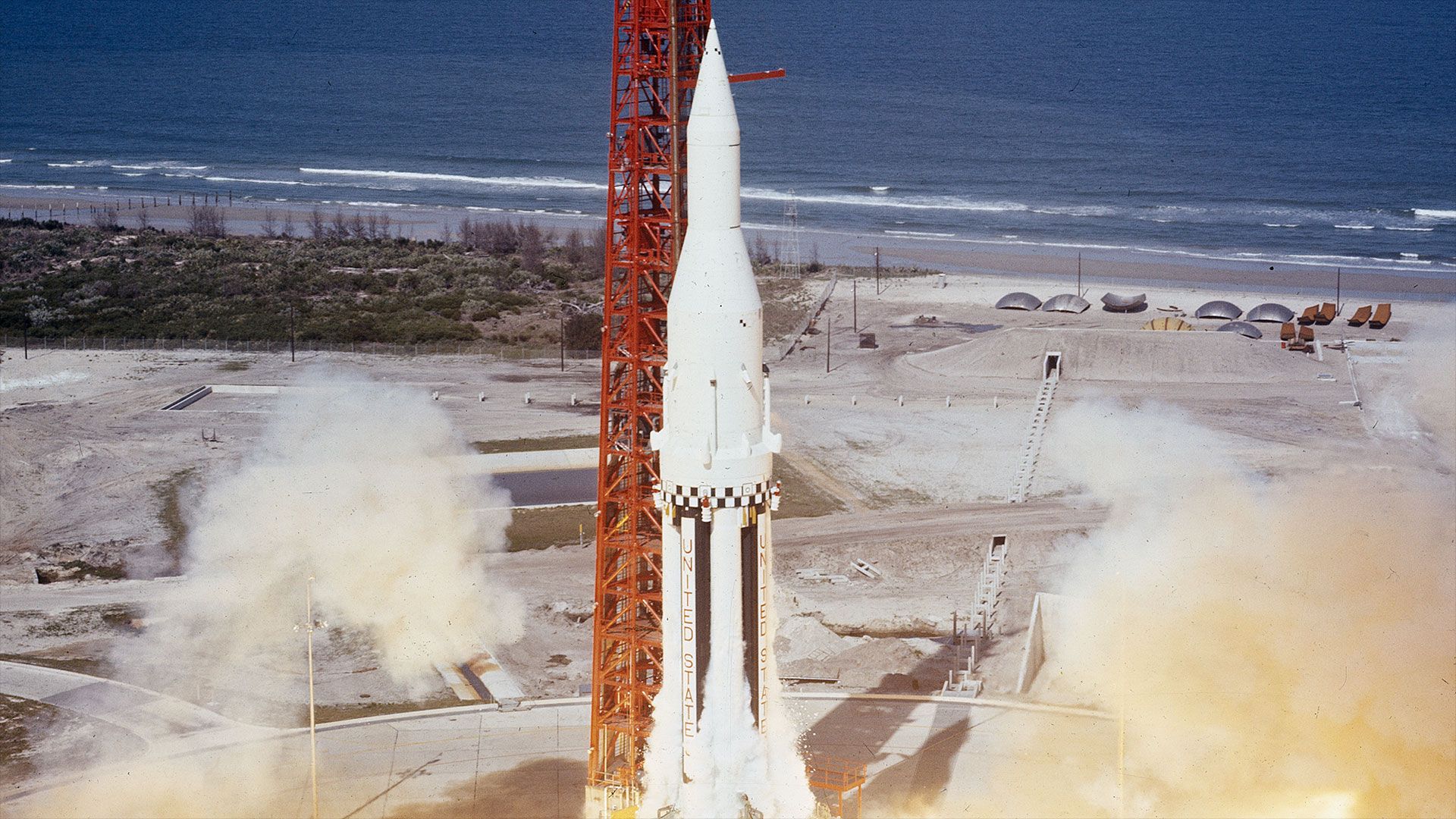
The scale of the rocket was difficult for contemporary observers to fathom. When fully fueled and ready for flight, the Saturn V weighed approximately 6.5 million pounds. The sheer power of its ignition on that November morning in 1967 was unprecedented. As the engines roared to life, they generated a sonic shockwave that was felt miles away from the Kennedy Space Center. The ground itself seemed to buckle under the intensity, rattling nearby structures and showering the launch complex in a cascade of debris and dust, a physical testament to the raw, unbridled energy contained within the rocket’s architecture.
A Chronology of the Apollo 4 Mission
The Apollo 4 mission was an uncrewed "all-up" test, a strategy that carried significant risk. Rather than testing each stage of the rocket individually, NASA engineers opted to fly the entire vehicle—all three stages plus the command and service module—in a single, high-stakes flight.
The launch sequence began at 7:00 a.m. EST at Launch Complex 39, the newly minted "Moonport" in Florida. The mission lasted a total of 8 hours and 36 minutes. The flight profile was rigorous:
- Liftoff: The S-IC first stage performed as intended, lifting the massive vehicle through the dense lower atmosphere.
- Staging: The successful separation of the stages occurred with precision, a major milestone for a rocket that had never before left the ground.
- Orbital Insertion: The S-IVB third stage successfully placed the command module into a high-Earth orbit.
- Lunar Simulation: After completing two orbits, the third stage reignited to simulate the trans-lunar injection, pushing the spacecraft to an altitude of over 11,000 miles.
- Reentry: The command module was then accelerated back toward Earth to test the heat shield’s integrity under the extreme temperatures associated with a return from the moon.
- Splashdown: The module descended under parachutes, splashing down in the Pacific Ocean, where it was recovered, proving that the Saturn V could safely transport human cargo to the moon and back.
The Context of Tragedy and Recovery
The success of Apollo 4 cannot be fully appreciated without understanding the atmosphere at NASA during 1967. Less than a year earlier, on January 27, 1967, the agency suffered a devastating blow when a fire erupted inside the Apollo 1 command module during a pre-launch test. The tragedy claimed the lives of astronauts Gus Grissom, Ed White, and Roger Chaffee.
The fire led to a total redesign of the command module and an internal cultural reckoning within NASA regarding safety protocols and engineering oversight. Apollo 4 was, therefore, a psychological necessity for the agency. The successful launch provided a much-needed morale boost, demonstrating that despite the loss of three national heroes, the path to the moon remained viable and that the engineering team had mastered the volatile, complex systems required for deep-space flight.

Official Reactions and Scientific Impact
Following the successful splashdown, the reaction from NASA leadership was one of profound relief and triumph. Wernher von Braun, the architect of the Saturn V, remarked on the precision of the flight, noting that every stage performed exactly as designed. The "all-up" testing philosophy, which had been criticized by some as overly ambitious, was validated.
George Mueller, then-Associate Administrator for Manned Space Flight, captured the national sentiment by stating that the maiden voyage of the Saturn V significantly bolstered public confidence in the largest research and development project in Western history. For the American taxpayer and the political establishment, the success of Apollo 4 signaled that the technological gap between the United States and the Soviet Union was closing, and that the lunar landing goal set by President John F. Kennedy was finally within reach.
Broader Implications for Space Exploration
The Saturn V did not merely serve as a ferry to the moon; it established the standard for heavy-lift launch vehicles for the next half-century. Its modular design allowed it to evolve, eventually supporting the Skylab space station program in the 1970s.
From a modern perspective, the Saturn V remains the benchmark against which all subsequent "megarockets" are measured. While the space industry has seen the emergence of reusable systems like SpaceX’s Starship—which has technically surpassed the Saturn V in terms of total thrust and scale—the Saturn V’s reliability record remains legendary. Across 13 total launches, the rocket never suffered a catastrophic failure that resulted in the loss of a mission, a staggering achievement given the complexity of the technology at the time.

The Legacy of the Saturn V
The legacy of the November 9, 1967, launch is woven into the history of every mission that followed. One year after the Apollo 4 test, the Saturn V launched the Apollo 8 crew on a journey to orbit the moon, and in July 1969, it carried the Apollo 11 crew to the Sea of Tranquility.
The data gathered during the Apollo 4 flight—regarding vibration, acoustic loads, and thermal stress—formed the foundation for the flight software and structural reinforcement that allowed astronauts to walk on the lunar surface. The mission proved that the "Moonport" at Kennedy Space Center was a functional, world-class facility, establishing Florida as the permanent epicenter of American human spaceflight.
As we look toward current efforts to return to the moon via the Artemis program and private sector deep-space initiatives, the lessons of the Saturn V remain vital. The shift from experimental testing to operational capability is the most dangerous transition in aerospace engineering. The success of Apollo 4 serves as a reminder that bold, calculated risk-taking, when supported by rigorous engineering and clear strategic goals, can overcome even the most daunting technological barriers.
The Saturn V was more than just a rocket; it was a manifestation of a nation’s will to extend its reach into the cosmos. Its debut on that November day in 1967 did more than just clear the launch pad; it opened the door to the lunar surface and fundamentally expanded the horizons of human potential. Today, as we continue to push the boundaries of what is possible in low-Earth orbit and beyond, the shadow cast by the Saturn V continues to provide the blueprint for the next generation of space exploration.