
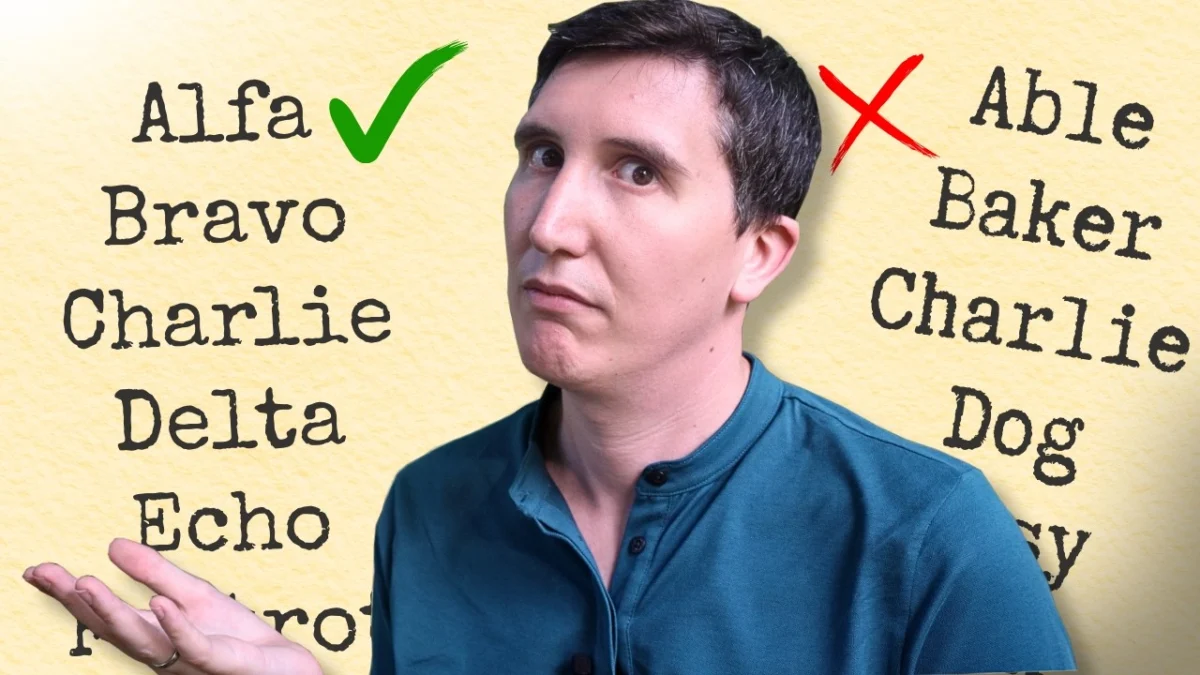
Most individuals familiar with contemporary communications can effortlessly recite the opening sequence of the internationally recognized radiotelephony spelling alphabet. Terms such as Alfa, Bravo, and Charlie readily come to mind, while cultural exposure to cinematic depictions of military operations frequently cements subsequent entries like Delta, Echo, and Foxtrot. Yet, fewer speakers could reliably produce terms like Kilo, Mike, or Sierra under pressure, let alone detail the rigorous historical evolution that transformed simple linguistic habits into a vital global safety standard. Far from being a phonetic alphabet—or an invention exclusive to the North Atlantic Treaty Organization—this system represents a meticulously engineered spelling alphabet designed to bridge language barriers and preserve human lives across high-risk communication channels.
A recent digital feature produced by linguistic content creator Rob Watts on his YouTube channel, RobWords, dismantles common misconceptions surrounding the system. Watts clarifies the fundamental distinction between a phonetic alphabet, which maps written symbols to speech sounds (such as the International Phonetic Alphabet used by linguists), and a spelling alphabet, which assigns distinct, easily understood words to individual letters to prevent catastrophic miscommunication over low-fidelity transmission mediums.
The Origins of Telephonic Misunderstanding
The necessity for a standardized spelling system predates modern aviation and military coalitions, originating with the commercialization of the telephone during the 1870s. As early telephonists and switchboard operators established long-distance connections, they quickly encountered a persistent operational hurdle: acoustic limitations in early analog transmission equipment frequently caused distinct consonant sounds to bleed together. Names, addresses, and alphanumeric identification codes were routinely misinterpreted, transforming routine data transmission into a guessing game prone to costly human errors.
To mitigate these losses, operators began informally substituting letters with common, distinct words beginning with the target letter. However, without centralized coordination, this practice remained fragmented. Different companies, industries, and regions developed idiosyncratic lexicons, which created new bottlenecks whenever cross-network communication was attempted.
Chronology of Standardization: From Western Union to World War II
The first organized attempt to eliminate ambiguity emerged in the early 1910s when Western Union published an official spelling alphabet. This early iteration relied heavily on prominent proper nouns representing geographical locations and common surnames, utilizing entries such as Adams, Boston, Chicago, Denver, and Edward. While functional for domestic telegraph and telephone traffic, the system lacked the phonetic distinctiveness required for high-stress environments.
By the outbreak of World War I, military organizations recognized that civilian systems were entirely inadequate for battlefield communications, where radio static, artillery noise, and multilingual coalitions compounded acoustic distortion. The British Army implemented a remarkably eccentric spelling alphabet featuring words like Beer, Monkey, Nuts, Orange, Pip, and Yorker.
As global conflict escalated into the technological warfare of World War II, the fragmentation reached a critical juncture. Every distinct armed service branch across the British and United States military establishments had developed its own proprietary spelling alphabet. A pilot communicating with a naval vessel or a joint command post might rely on entirely different vocabularies, leading to dangerous operational confusion. The lack of interoperability hampered coordination and underscored the urgent requirement for a universal standard.
The Post-War Push for Global Aviation Safety
Following the conclusion of the Second World War, the rapid globalization of civil aviation and commercial trade transformed interoperability from a localized military concern into a worldwide imperative. Transoceanic flights and expanding commercial air routes meant that pilots and air traffic controllers from dozens of different nations needed to communicate rapidly and flawlessly in English—the established international language of aviation—regardless of their native tongue or varying degrees of fluency.
The primary impetus for the modern system came not from military planners, but from the International Civil Aviation Organization (ICAO), a specialized agency of the United Nations established to manage the principles and techniques of international air navigation. During the late 1940s and early 1950s, ICAO commissioned extensive linguistic research to design a spelling alphabet that would satisfy two critical constraints:
- The selected words had to be easily recognizable and pronounceable by non-native English speakers.
- The phonetic structures had to be distinct enough to prevent confusion even under severe audio distortion, static interference, or heavy accents.
Linguists and communications experts tested hundreds of candidate words, evaluating them across diverse international phonetic profiles. For instance, words containing sounds easily masked by radio static were systematically discarded.
By 1956, ICAO finalized its exhaustive list, which was subsequently adopted by the International Telecommunication Union (ITU) and later embraced by NATO for all tactical and diplomatic communications, earning it the widely recognized moniker of the "NATO Phonetic Alphabet," though its official designation remains the International Radiotelephony Spelling Alphabet.
Supporting Data and Structural Breakdown of the Alphabet
The 26 words comprising the International Radiotelephony Spelling Alphabet are distributed across various word lengths, stress patterns, and vowel sounds to maximize acoustic separation.
- A – Alfa (spelled intentionally with an ‘f’ to assist non-English speakers with pronunciation)
- B – Bravo
- C – Charlie
- D – Delta
- E – Echo
- F – Foxtrot
- G – Golf
- H – Hotel
- I – India
- J – Juliett (spelled with a double ‘t’ to prevent French speakers from dropping the final consonant)
- K – Kilo
- L – Lima
- M – Mike
- N – November
- O – Oscar
- P – Papa
- Q – Quebec
- R – Romeo
- S – Sierra
- T – Tango
- U – Uniform
- V – Victor
- W – Whiskey
- X – X-ray
- Y – Yankee
- Z – Zulu
Statistical analysis of voice transmission failures prior to the 1956 standardization indicated that pairs such as ‘M’ and ‘N’, or ‘S’ and ‘F’, accounted for the vast majority of misunderstood verbal data. The ICAO system deliberately separated these sounds by ensuring that words like Mike and November, or Sierra and Foxtrot, possessed contrasting vowel nuclei and distinct terminal consonants.
Implications and Contemporary Relevance
Decades after its finalization, the NATO phonetic alphabet remains a cornerstone of global infrastructure. Beyond its foundational role in military and naval operations, the system is universally utilized in civil aviation, maritime navigation, meteorology, emergency dispatch services, and information technology sectors where accurate alphanumeric data transcription is non-negotiable.
In an era dominated by digital data packets and automated error-checking protocols, the human voice remains a critical fail-safe when electronic systems degrade or fail entirely. The enduring success of the International Radiotelephony Spelling Alphabet stands as a testament to applied linguistic science, demonstrating how rigorous cross-cultural research solved a fundamental vulnerability in human communication and continues to protect lives across the globe on a daily basis.










Leave a Reply