
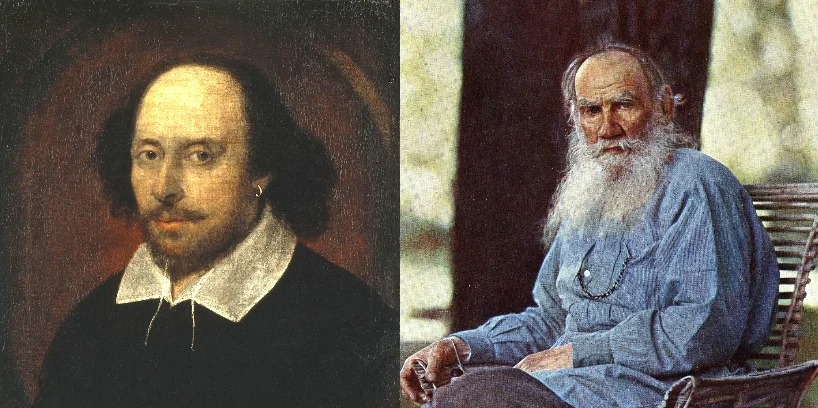
The annals of literary history are rarely marked by such a profound and vitriolic clash as the one initiated by Count Leo Tolstoy against the legacy of William Shakespeare. In the twilight of his life, the celebrated author of War and Peace and Anna Karenina underwent a transformative spiritual and political shift, pivoting toward a radical form of Christian anarchism. This conversion did not merely change his lifestyle; it fundamentally altered his perception of art, morality, and the European literary canon. By 1906, Tolstoy’s ideological evolution culminated in a scathing polemic that sought to dismantle the global reputation of Shakespeare, a writer he came to view as not only overrated but actively immoral.
Tolstoy’s offensive was centered on the belief that the "Bard of Avon" was an "insignificant, inartistic writer" whose works failed to meet the basic requirements of meaningful art. This rejection was not a fleeting whim but a deeply considered extension of Tolstoy’s broader assault on the aristocratic institutions and patriarchal traditions that he believed oppressed the common people and stifled spiritual life. Decades later, the English essayist and novelist George Orwell would provide a seminal rebuttal, suggesting that Tolstoy’s hatred for Shakespeare, and for King Lear in particular, was rooted in a subconscious recognition of his own psychological struggles and failed renunciations.
The Radical Evolution of Leo Tolstoy
To understand Tolstoy’s vehemence, one must examine the socio-political context of his later years. Following a period of profound existential despair in the 1870s, Tolstoy rejected the Russian Orthodox Church and the state, embracing a philosophy of non-violence, communal living, and a literal interpretation of the teachings of Jesus. He began to align himself fervently with the Russian peasantry, viewing their "ruddy moral health" as the antidote to the "decadence" of the aristocracy.
In his 1907 pamphlet, The Meaning of the Russian Revolution, Tolstoy defined revolution not as a mere political turnover but as a fundamental change in a people’s relation to power. He viewed himself as part of the collective "we" of the Russian people, a sentiment echoed in his 1909–10 journal, Three Days in the Village. His literary criticism became an extension of this activism. He demanded that art be accessible, moral, and purposeful. Under this new, austere rubric, the complex, secular, and often bawdy plays of William Shakespeare were found wanting.
The 1906 Manifesto: Shakespeare as an "Inartistic" Writer
Tolstoy’s primary vehicle for this critique was a lengthy 1906 essay titled A Critical Essay on Shakespeare. In it, he focused much of his ire on King Lear, a play generally regarded as one of the pinnacles of Western literature. After a meticulous and highly biased summary of the plot, Tolstoy concluded that Shakespeare’s works "do not satisfy the demands of all art, and, besides this, their tendency is of the lowest and most immoral."
Tolstoy was particularly troubled by what he perceived as the "unnatural" language of Shakespeare’s characters and the "incredible" nature of his plots. He argued that no real human being would speak in the elaborate metaphors or blank verse that Shakespeare employed. More significantly, Tolstoy questioned how the Western world had come to a state of "universal admiration" for a writer he deemed a failure.
He proposed a theory of "epidemic suggestion," a concept strikingly similar to the modern understanding of a viral meme. Tolstoy argued that the cult of Shakespeare was a collective delusion initiated by German professors in the late 18th century. He contended that these academics, seeking a counterweight to French classicism, elevated Shakespeare to the status of a secular deity. Once this "suggestion" took hold, it became a form of cultural "vaccination." Tolstoy wrote that every individual in Christian society is "inoculated" with the idea of Shakespeare’s genius from childhood, making it impossible for them to view the work with an objective, "free-minded" perspective.
Chronology of the Literary Conflict
The tension between Tolstoy’s religious asceticism and Shakespeare’s humanism can be mapped across a timeline of publication and cultural shifts:
- 1860s–1870s: Tolstoy achieves global fame with War and Peace and Anna Karenina, works that arguably share Shakespeare’s expansive humanism.
- 1879–1882: Tolstoy publishes A Confession, marking his formal break with his previous life and the beginning of his radical Christian anarchist phase.
- 1906: Tolstoy publishes his essay on Shakespeare, shocking the international literary community by calling for the "liberation" of humanity from Shakespeare-worship.
- 1910: Tolstoy dies at a railway station in Astapovo after fleeing his home in a final attempt to live as a wandering ascetic.
- 1947: George Orwell publishes "Lear, Tolstoy and the Fool" in Polemic, offering a psychological and philosophical defense of Shakespeare that remains the definitive response to Tolstoy’s critique.
George Orwell’s Rebuttal: The Humanist vs. The Ascetic
Forty years after Tolstoy’s initial attack, George Orwell took up the task of defending the Bard. In his essay "Lear, Tolstoy and the Fool," Orwell did not merely argue that Shakespeare was a great poet; he sought to diagnose why Tolstoy was so uniquely triggered by Shakespeare’s work. Orwell conceded that Shakespeare was not a "systematic thinker" and that his plots were often "ragged" or "incredible." However, he argued that Tolstoy’s objection was not truly about aesthetics but was instead a "quarrel between the religious and the humanist attitudes towards life."
Orwell posited that Tolstoy’s distaste for Shakespeare’s "exuberance" and "belly-to-earth selfishness" was a rejection of life itself. Shakespeare, Orwell argued, loved the world—its colors, its smells, its messy emotions, and its "jouissance." Tolstoy, in his quest for saintliness, viewed this worldliness as a threat to the spiritual purity he sought to attain.
The Mirror of King Lear
The most compelling aspect of Orwell’s analysis is the psychological parallel he drew between Tolstoy and the character of King Lear. Orwell noted that the most significant event in Tolstoy’s later life was a "huge and gratuitous act of renunciation." Much like Lear, who gives away his kingdom while expecting to retain the prestige and authority of a king, Tolstoy renounced his title, his estate, and his copyrights, yet remained a central, commanding figure whose every word was scrutinized by the world.
Orwell suggested that Tolstoy’s hatred of King Lear was a case of "the lady doth protest too much." The play, which depicts the disastrous consequences of a king’s ego-driven renunciation, hit too close to home. Tolstoy had attempted to become a saint and a peasant, yet he remained plagued by the same "selfishness" and "sissiness" he lamented in his earlier diaries. By attacking the play, Tolstoy was subconsciously attacking the reflection of his own failure to achieve true self-denial.
Broader Implications and Cultural Data
The clash between Tolstoy and Shakespeare represents more than a disagreement between two writers; it highlights a fundamental divide in Western thought regarding the purpose of art.
- Aestheticism vs. Didacticism: Tolstoy’s critique represents the extreme end of didacticism—the belief that art must serve a specific moral or social function. In contrast, the Shakespearean tradition represents a "negative capability," a term coined by John Keats to describe a writer’s ability to exist in "uncertainties, mysteries, doubts, without any irritable reaching after fact and reason."
- The Persistence of the "Inoculation": Historical data on the literary canon supports Tolstoy’s observation of Shakespeare’s dominance. Since the 18th century, Shakespeare has been translated into every major living language and remains the most-performed playwright in the world. However, modern scholarship often echoes Tolstoy’s concerns regarding the "German influence," noting how 19th-century "Bardolatry" was indeed a constructed cultural movement.
- The Conflict of Wills: Orwell’s analysis suggests that the "Christian attitude" as practiced by Tolstoy is ironically self-interested, as it seeks an escape from the "painful struggle of earthly life" for the sake of eternal peace. The "humanist attitude," which Shakespeare embodies, accepts the struggle as the essential fabric of existence.
Analysis of the Impact on Modern Criticism
Tolstoy’s polemic failed to deconstruct Shakespeare’s reputation, but it succeeded in forcing a conversation about the nature of literary genius. Today, Tolstoy’s concept of "epidemic suggestion" is often discussed in the context of "prestige bias" in the arts—the idea that people claim to enjoy certain works primarily because they are told those works are important.
Orwell’s defense, meanwhile, is cited as a masterclass in psychological criticism. By looking past the surface-level arguments to the "personal preoccupations" of the critic, Orwell demonstrated that literary judgment is rarely objective. The feud serves as a reminder that even the greatest minds are subject to the biases of their own spiritual and psychological journeys.
Ultimately, the disagreement between Tolstoy and Orwell underscores a choice that remains relevant for every reader and artist: the choice between a world-denying spiritualism and a world-embracing humanism. While Tolstoy sought a "Heaven or Nirvana" beyond the messy realities of the stage, Shakespeare—and later Orwell—found the meaning of life within the very "raggedness" and "exaggerated language" that Tolstoy so despised. The enduring popularity of both writers suggests that humanity continues to oscillate between these two poles, seeking both the moral clarity of the prophet and the earthy, exuberant truth of the poet.










Leave a Reply